Author: artful words

  • A tale of your or you’re

    Red apples on a branchOnce upon a time there was a word and the word was “your”. Or maybe it was “you’re”. And each of these words had the same sound but neither carried the same meaning, and thus were the people confused. And the writers of English did wail and gnash their teeth, and their teachers did sigh and some rolled their eyes, and the proofreaders hastened to fix every glitch, and the editor took a deep breath and said, “It’s ok. I can explain.”

    So here goes…

    The words “your” and “you’re” are homophones. This has nothing to do with their sexual preferences or mode of communication and everything to do with the fact they sound alike when spoken. The “homo” part of “homophone” means “same”, while the “phone” bit refers to sound.

    Homophones such as “your/you’re”, “whose/who’s”, “to/too/two” and the infamous “their/there/they’re” are often confused or misused when written, which can be annoying. Fortunately, it is also avoidable. We do want our story to have a happy ending, after all.

    The simplest way to choose the appropriate version of such words is to learn the distinctions between each and then pause before using them to consider which spelling is correct for the meaning you intend. Likewise, when looking over your own or someone else’s work, take particular note of these terms and check make sure they are right. If necessary, consult a dictionary, grammar checker or cheat sheet until you feel confident about which (but not “witch”) word to use.

    For our currently unfolding fable, the difference is easy to pick.

    To avoid muddling your “your” and your “you’re”, just remember that the apostrophe in “you’re” indicates a contraction.

    It marks the place where something has been left out, which in this case is the letter “a” from the word “are”. If you can substitute “you are” for “you’re” without unraveling the sense of your sentence, then you’ve chosen accurately. If not… Well, you’ll probably want to address that.

    The word “your” is the possessive adjective that relates to the pronoun “you”. It signifies ownership, as in “your thoughts”, “your words”, “your magnificent wishes”, and so on. You’ll usually find it hanging around in front of a noun (a person, object or concept).

    To test if this is the homophone you really want, try switching “your” for another possessive adjective, such as “my”, “her” or “his”, just to see if your phrase is still meaningful. At this point your syntax is likely to wrinkle, but you will have a sense of whether (not “weather” or “wether”) you’re on the right track.

    All clear?

    But wait! There is a twist in this tale. It comes in the form of two additional homophones for “your” and “you’re”, although these characters appear more rarely. The word “yore” refers to a time long past, while “yaw” (as a verb) means to waver or deviate from a set course, or (as a noun) describes the action of such deviation.

    Perhaps the lesson in the story is this: provided you know your “your” from your “you’re”, you’re less likely to yaw. If you know what I mean.

    Maybe it’s just better to say that homophones can be confusing if used without care. Give them a little consideration, however, and we can all live grammatically ever after.

    The end.

    Now it’s your turn…

    Do you get confounded by homophones? Is there a technique you use to choose wisely? Are there other areas of grammar that would you like to understand better? Feel free to continue the narrative…
  • Building beautiful bridges through structural editing

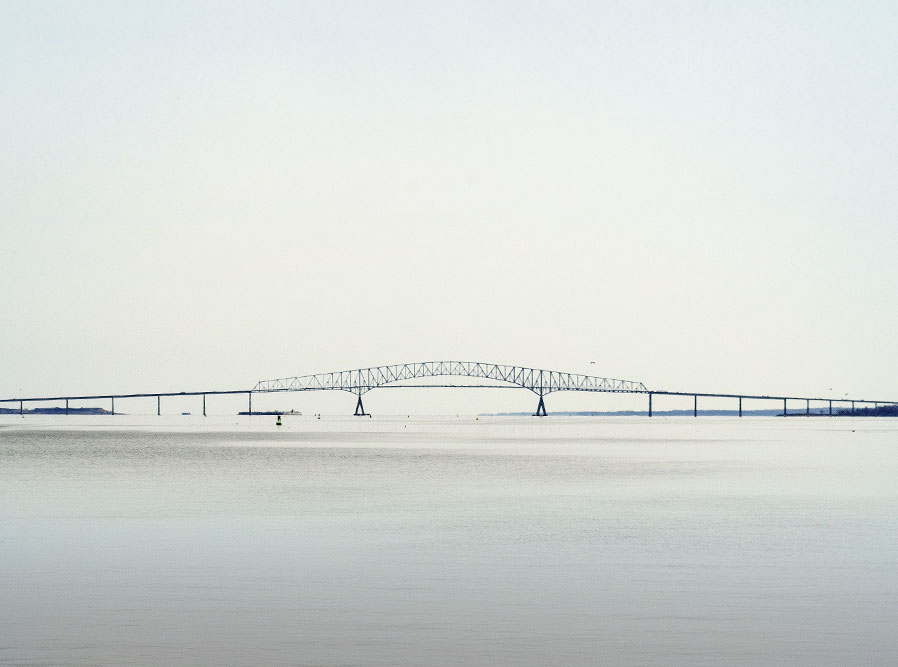
    Distant view of a truss bridge spanning a broad body of waterI have been thinking about metaphors to help explain structural editing. As the name suggests, this kind of editing aims to create a strong framework for your ideas. Poised between developmental editing and copyediting, its focus is on arranging the text in a way that is logistically and aesthetically pleasing.

    The first image that came to my mind to describe structural editing was the construction of a building. Certainly, there are some similarities between the two. Each begins with a wealth of raw material that must be assembled into an effective composition. Books, like buildings, need to be well made, with a design that reflects their purpose. They require solid foundations and easy navigation, and are at best functional, accessible and inviting. Ideally, both will also look and feel good when you’re in them.

    I was enjoying this little analogy when a friend mentioned the idea of a bridge. My imagination engaged in the implications of this image and I found that it too works well as a metaphor for structural editing.

    It is true that I don’t have the first clue about how to build bridges. What I can do, however, is structure a document so the ideas within it interlink to form an effective piece of textual architecture. This could, of course, be thought of as a building. But the bit that fits so neatly with the image of a bridge is the way it connects two points on a journey.

    Structural editing, as noted above, takes place between developmental editing and copyediting. More significantly, however, it is the process through which a chaotic collection of words transforms into a coherent manuscript.

    Structural editing bridges the distance between a rough draft and a refined document, enabling you to communicate more meaningfully with your reader.

    It also provides the firm footing upon which your readers may traverse your writing from beginning to end. Or, if you like, it is what lets them cross easily from one place to other.

    The practice of structural editing occurs when a text is still flexible and may be crafted into interesting new shapes. As with all forms of editing, it starts with attentive reading. There is a technique of seeking, almost sensing, patterns, recurrences and themes. Particular attention is paid to repetition, which may reveal the importance of a certain concept, or could highlight areas to consolidate, condense or cut.

    The skill lies in finding the best way, among many alternatives, to guide readers to their destination.

    When I edit this way, I often find one particular form or organising principle will emerge most strongly. Even so, I still see other possibilities and encourage myself to come up with more. I present all of these options to my client, who has the final responsibility for deciding what shape the work will take.

    Then, I make a plan. I assemble the elements. I begin to build.

    What may have started out as a provisional arrangement of materials can, through careful engineering, become a thing of grace. Picture the elegance of a suspension bridge, the sturdiness of a truss bridge, or the simple dignity of an arch bridge hewn from stone or wood.

    All of these allow travellers to venture from a place they know to somewhere as yet undiscovered.

    Your words, artfully structured, can do the same.

    Now it’s your turn…

    Have you ever had a document structurally edited? What was the experience like? And, just because I’m wondering, do you have a favourite type of bridge?

  • Strike your note:
    A new year’s admonition

    View of grasses on a windswept beachIt stretches before us, crisp and unsullied. Poised as we are at the start of this bright, shiny year, we are free to imagine without hint of disappointment all the wondrous things we might experience, witness, learn and achieve in months to come.

    Although I do not make new year’s resolutions, I do try to hold a hopeful approach at this time. Perhaps that is why the following lines felt so resonant to me. They are from ‘Station Island’ by Seamus Heaney.

    ‘…The main thing is to write
    for the joy of it. Cultivate a work-lust
    that imagines its haven like your hands at night

    dreaming the sun in the sunspot of a breast.
    You are fasted now, light-headed, dangerous.
    Take off from here. And don’t be so earnest,

    let others wear the sackcloth and the ashes.
    Let go, let fly, forget.
    You’ve listened long enough. Now strike your note.’

    These words are spoken by the ghost of James Joyce to an uncertain Heaney who is here both poet and protagonist. In the poem, he makes a pilgrimage to Station Island, a site on Lough Derg in Donegal that is sacred to St Patrick. Along the way, he encounters and engages with the spirits of a number of significant figures in his life, with writers like Joyce among them.

    This injunction, to “write for the joy of it” and “Cultivate a work-lust”, is found in the concluding section of the twelve part poem. It is a final, fierce denial of the poet’s disquiet that reads to me like a rallying cry for all those who quaver before the page. The words urge a certain audacity and a readiness to accept both the role and responsibility of being a writer, despite any lingering misgivings any of us – Heaney included – may have.

    Later in the poem, Joyce speaks again, telling the poet:

    ‘… it’s time to swim

    out on your own and fill the element
    with signatures on your own frequency,
    echo soundings, searches, probes, allurements,

    elver-gleams in the dark of the whole sea.’

    I am indebted to David Fawbert, whose excellent website on Heaney’s poetry not only gave me some insight into ‘Station Island’, but also advised me that an “elver” is a young eel. It is a bewitching image, and an apt one too. Those glimmers of movement, the flash of something beneath the surface. That’s what writing is like, with words and ideas flickering somewhere, perhaps in reach, “in the dark of the whole sea”.

    As we enter this new year, I add my own plea to the voice of Joyce in this poem. I invite you to decide it is time to swim. Find your frequency and seek out those subtle gleams. Then, equipped with grit and grace, with courage and wonder, “Take off from here”.

    Go and strike your note.

    Now it’s your turn…

    Do you set an intention for your writing at this time of year? Do you have a favourite poem or quotation that inspires you to write? What feelings do Seamus Heaney’s words stir in you?

  • “We never finish books”:
    Wise words from Dani Shapiro

    Detail of a white flower against a pale skyIt is a reminder I gave to the research students who I advised at university. It’s an assurance I give to the writers I work with today. And it’s something I heard author and memoirist Dani Shapiro say recently.
    “We never finish books.”

    She doesn’t mean that we never read all the way to the final page (although sometimes that can be the case too.) Rather, it is the books we write that we never really finish. What happens instead, according to Dani, is this:

    “We reach a point where we have made them as good as we can with the tools we have at the moment we have them. And so could any book benefit from being put in a drawer for another year and then pulled out again and looked at with cold eyes? Probably. But at a certain point you say, ‘It’s time for this to go into the world. I’ve taken it as far as I can.’”

    Writing can turn into a endless process if we let it. There are always more tweaks to make, more details we could add, and more words we might shuffle, shift or discard. It is devastatingly easy to come up with reasons why our manuscript is still not yet ready and to justify our inability to finish it. If we just had a bit more time, if we just did a little more research, if we just keep working on it then surely we will get it right. Eventually. Won’t we?

    Allow me to tell you, as gently as I can, that your book will never be perfect.

    Despite your heartfelt efforts, it will never be definitive, never conclusive nor complete. All it ever can be, and all it really needs to be, is a reflection of a moment in time, crafted with the best tools you have.

    Of course you will do everything you can to make your book as good as possible. Yet even so, you may find that after taking the brave step of sharing it with the world, you will suddenly see a whole other way you could have done it. There’s a decent, if disappointing, chance that after all your labours, you may still look back on it someday with a sense of dissatisfaction or even embarrassment.

    Friends, that happens. It is part of being a writer. Sure, it’s not the best part. But neither is it a compelling enough excuse for us to not to write and not to publish.

    We are never really ready. Or we are already ready. Either way, at some point we must just trust – closing our eyes first if necessary – that we have taken our writing as far as we can and to realise that it is time to let it go into the world.

    That can be a scary moment for any writer, yet it is one that we must face and embrace again and again, for it is only in the world and in the minds of our readers that our words truly come alive.

    Now it’s your turn…

    Do you struggle to finish writing your books? Is it hard for you to send them into the world? What holds you back from sharing your writing and what helps you decide when it is ready?

  • Copyediting and proofreading:
    Five things you should know

    The inky nib of a silver fountain pen writing on paperThe first thing you need to know is that copyediting and proofreading are not the same thing. While both focus on making your document as clear, consistent and free of errors as is humanly possible, they do so in different ways.
    The second thing you should know is that, done correctly, copyediting and proofreading happen at separate stages of the publication process. Technically, proofreading only occurs after a document has been copyedited and when it is fully formatted. It is the final step, prior to publication, when all the tiny details get checked.

    In practice, however, the boundaries between copyediting and proofreading are becoming increasingly muddy. A certain amount of proofreading is done these days when a manuscript is still in the form of a word processing document. This is not necessarily a problem, but nor is it quite what the practice of proofreading has traditionally been. That’s the third thing you should know.

    In my view, the distinction between copyediting and proofreading is found less in the format of the document and more in the approach to it. The simplest way to explain it is this:

    A copyeditor’s role is to suggest changes to a text, while a proofreader’s job is to correct it.

    As your copyeditor, I want your words to be as effective and poetic as possible. That means I will correct any mistakes I find in your grammar and punctuation, but I will also advise you about the tone and style of your writing. I will point out areas where your reader might get distracted or confused and will offer you options for addressing these.

    My way of working is to include you in this process. I respect your views and acknowledge that you are free to ignore my suggestions if you choose (even though they are made with the best interests of you and your readers in mind.)

    Proofreaders, in contrast, often have a more distant relationship with writers. Some who work in the publishing industry have no direct contact with the authors of the words they examine so scrupulously. Their task is not to ponder the writer’s wishes or intentions, nor to propose methods for embellishing the expression. Instead, the expertise of the proofreader is in identifying and correcting those inconspicuous but still existent errors and inconsistencies that can mar an otherwise exceptional document.

    With that in mind, it is advisable to accept any alterations made to your text by your proofreader. This is about technicalities, not taste. If a change has been made at the proofreading stage, it is because it was necessary.

    The fourth thing you should know about copyediting and proofreading is that I am happy to do either, according to your needs. Sometimes you might not know which is required and that’s ok. I can help you with this and provide examples if appropriate.

    Finally, it is worthwhile knowing who can benefit from a proofreader’s keen eye. Such fine folk include:

    • bloggers who are seeking to maintain a professional image by having someone check their posts for errors before they are published
    • entrepreneurs and website owners who send out email newsletters
    • creators of ebooks or online courses (because it is disappointing to find mistakes in material you’ve paid good money for)
    • artists who are applying for grants or access to exhibition spaces
    • fiction writers who have had their manuscripts copyedited and formatted prior to publication
    • non-fiction writers who have lots of headings, references, captions, figures and so on in their text
    • researchers and postgraduate students who are submitting articles for publication in journals
    • writers of all kinds whose attention to detail is less than ideal.

    Really, anyone who has written a document that is subject to the scrutiny of others could consider asking a proofreader to peruse their work. (And just so you know, that includes editors who write too.)

    There are, of course, many deeper mysteries to explore in the realms of copyediting and proofreading, and some of these will be covered in future articles. For now, I hope this brief guide has given you some idea of a few important features of these two related but different arts.

    Now it’s your turn…

    How do you understand the distinctions between copyediting and proofreading? What more would you like to know about the way each one works?

  • Christmas fears appear ambiguous

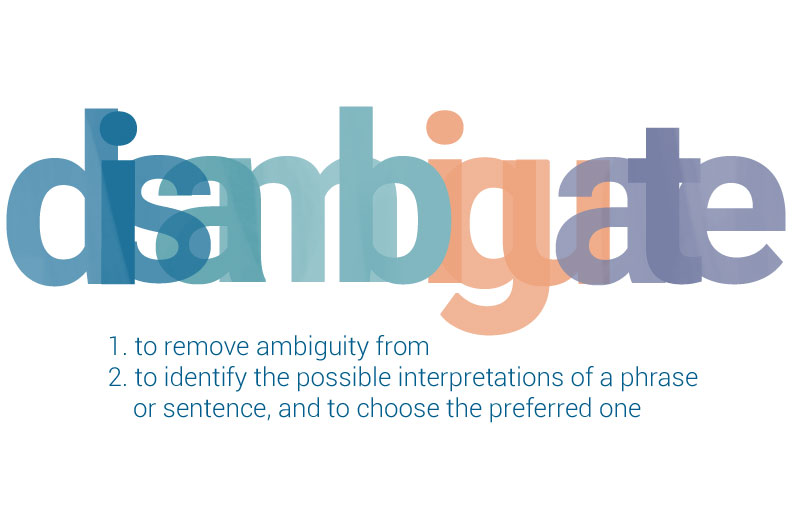
    Disambiguate means to remove ambiguity from, or to identify the possible interpretations of a phrase or sentence, and to choose the preferred one. It's an essential practice for writers and editors alike.There is no denying that Christmas is a difficult time for many people. The reasons for this vary, but they are often quietly personal. An article I read a little while back highlighted this issue by sharing the story of a woman whose son died in a car accident during the festive season. It contained these lines:

    “Christmas has changed for her family. She fears, possibly forever.”

    While the meaning here is sorrowfully obvious, it is also imprecise in its current form. Each of these two sentences is complete and correct in itself. The effect is that while their individual meanings could be seen to relate to one another due to proximity, they are not actually connected.

    The statement that “Christmas has changed for her family” expresses one thought, as does the second sentence about the woman’s fear. Read on its own, this latter statement does not give any indication of why the woman is afraid. It only proclaims that she experiences fear and that this feeling might endure, “possibly forever”.

    By placing each thought in a separate sentence, the writer has isolated the cause of the fear from its source, which relates to the way that Christmas has changed. In so doing, the meaning of these lines becomes ambiguous. To remedy this situation, we need to associate the fear with its reason more clearly. One way to do this is as follows:

    “Christmas has changed for her family, she fears. Possibly forever.”

    This version maintains the structure of the original but shifts the full stop so that both “Christmas” and “fears” appear in the one sentence. However, it creates a sentence fragment with the words “Possibly forever”. Lacking both a subject and a verb, this phrase is grammatically incomplete. Nevertheless, it could be used in this way for a deliberate stylistic effect.

    A more correct form of expression would see the sentences reframed as:

    “She fears that Christmas has changed for her family, possibly forever.”

    Now the entirety of the meaning is conveyed in a single, if sad, statement.

    In selecting these sentences as an example to disambiguate, I am conscious of the need for a degree of delicacy. Part of me wonders whether it is appropriate to use the story of a family’s bereavement for this purpose, but there is another part of me that reads this tragic tale and wants to ensure it is given its full significance through clear and correct expression.

    I have said before that editing, for me, is about showing respect. This respect is given first to the writer but I believe it is due to the subject of the writing too. That is why this is a good example to use.

    By rephrasing an otherwise inexact statement, I hope to show how much more meaningful it can be and how effectively it can express its message.

    Incidentally, having recently written about embarrassment, I also want to make it plain that I do not cite these examples of ambiguous writing in order to shame or demean anyone. That is why I do not specify where I find these snippets, nor name those who write them. I’m sure we can agree that all of us are at times clumsy in our written expression. Indeed, it is when writing about the things that matter most to us that our words may get especially tangled.

    It is never my wish to make anyone feel bad about their writing. Instead, my intention is to show how the subtlest of alterations can make a distinct difference to the way our words and our stories are read.

    I hope that is how you see it too.

    Now it’s your turn…

    How did you read the original sentences used in this example? If you encountered them in an article, would they have bothered or stopped you, or would you have understood their implied meaning? How important is precise expression to you, both when you read and when you write?

  • Embarrassed? You should be!

    Black and white photo of an embarrassed little boyI know I’m not the only one. I know it has happened to you too. It happened to one of my clients just the other day. We have been working together for over a year now on a project which is almost ready to be published. As we were discussing the final stages of the work, she said to me:

    “When I look back now at the draft I first sent to you, I am so embarrassed by it.”

    I had to laugh, because I’ve been there too and so have you. Sometime or another, we have all read back over something we wrote a week, a month or a few decades ago, and yes, we are embarrassed by it. And so we should be.

    That is what I said to my client, the moment I stopped laughing. I told her it was wonderful that she felt embarrassed about her earlier writing, because it shows how much she has developed since then. Over the past year, both her voice and her vision for her book have become clearer, keener, more precise and more refined. Her style has changed and she has become more confident, which is a beautiful thing.

    Far from being unwelcome, embarrassment is sometimes a sign of progress.

    I remember once hearing the Australian writer Peter Carey give a reading of his work at a literary festival. He began, inauspiciously enough, with an apology for any awkward pauses that might occur during his reading.

    “I can’t read my own work in public without wanting to change some bit of it,” he explained.

    Know the feeling?

    I can’t help thinking that editors are particularly guilty of this proclivity to want to revise everything they have ever written, but my guess is that most writers are susceptible to it. We could choose to read this discomfort as evidence that we are genuinely inept at our craft. Or we could see that our tastes change, our talents evolve and our insight into our written expression alters over time.

    That is not to say, however, that there is anything wrong with revisiting some earlier work only to find ourselves pleasantly surprised by a deft turn of phrase, an arresting metaphor or the sincere emotion evoked by our prose. It doesn’t mean we have not advanced beyond that shining moment; only that there are times in our lives when we write with a certain elusive grace, and that we sometimes cannot truly see the beauty in our words until our eyes and minds are older.

    Either way, I encourage you, as I did with my client, to embrace your embarrassment but let yourself find delight in your own writing too. You are allowed both to be proud and to progress.

    That is, in fact, exactly what you need to do.

    Now it’s your turn…

    Go on, admit it. You’re among friends here, so go ahead and share the story of some occasion on which you glanced back at a piece of your writing and felt that little bit of a cringe inside. Or, if you prefer, tell the tale of a time when your words filled you with a flush of pleasure. I’d really love to hear it.

  • What you get from a manuscript appraisal

    An orange origami paper craneIt happens every time. Whenever a writer sends me a manuscript, I feel a delightful sense of anticipation. It’s like something potentially wonderful is in front of me and I’m eager to discover what I will make of it. This pleasure, however, is always measured by my need to read the document critically and analytically. I have to see what is working and what is not, to figure out how I can help.

    In most cases, the assistance I offer is editing, whether it be at copy, structural or developmental level. But sometimes a different kind of expertise is required. It could be that the text is not yet ready to be edited or that the writer is seeking an opinion or some assurance about the work, rather than wanting any alterations to it.

    That’s when a manuscript appraisal can be useful.

    A manuscript appraisal differs from editing work in that the focus is on providing an evaluation of the document without making any textual changes to it.

    Such appraisals will typically consider the effectiveness (or otherwise) of elements of the manuscript, such as the topic, structure, pacing, plot development, characterisation, narrative voice and writing style. It may also address the plausibility of the story and dialogue, and reflect upon the themes presented.

    Some manuscript assessments or appraisals will also include observations about market expectations and prospects for publication, although I am wary of offering such comments myself. The world of publishing can be a fickle thing and I do not want to give advice nor raise hopes that may be washed away in the wake of the next bright and shiny trend.

    Both fiction and non-fiction works can benefit from a manuscript appraisal. It is a step before editing that offers guidance for revising, reducing, reframing or expanding a document. That said, there is still significant work involved in appraising a manuscript, beginning with a careful reading of the entire document. This is followed by the preparation of a detailed report which contains practical advice and examples for reworking the draft.

    What you get from a manuscript appraisal, therefore, is the advantage of having a discerning reader for your work who is able to give insights into how you may improve it. You get a thoughtfully written report to assist with your revision, and you get the chance to refine your writing before embarking on the next stage of your journey.

    If that sounds useful to you, then say hello and let me know. I am, as always, happy to help if I can.

    Now it’s your turn…

    Have you ever had a manuscript assessed or appraised? How useful was it? What did you learn and what did you change?

  • The quirks of “while” or “whilst”

    "While" or "whilst"? Which do you favour?I confess. It’s true. Like you, I have my word quirks. There are those I use often because I’m fond of them (“nifty”, “tricky”, “expressive”, “poetic”) and many I use rarely because they don’t resonate with my voice.
    This is fine when I’m being a writer. I can choose and use whichever words I want. It’s another matter, however, when I am editing.

    A document I was recently working on contained numerous instances of the word “whilst”. My immediate inclination was to change all of these to “while” or to make gentle alterations to certain sentences so that neither word was necessary. There was arguably no need and no reason for me to do this, because the term “whilst” is not incorrect.

    Used as a conjunction, “whilst” carries exactly the same meaning as “while”.

    Even so, the tone of the two words differs.

    Most of us would bump into the word “while” more frequently each day than we realise. Yet the simple addition of the “-st” on the end turns it into a term that is more likely to catch our notice. It just sounds that little bit more formal or even old-fashioned.

    That’s fine if it is the writer’s intention. In general, however, the word “while” is probably preferable.

    It may be that this tendency to use “whilst” is a quirk of my client that I ought to have left unchanged in the text. Yet as an editor, I need to balance the voice of the writer with the purpose of the document and also keep in mind the needs of the reader. My distinct feeling in this case was that the extra attention the word “whilst” attracted was more distracting than deliberate and did not fit with the overall tone of the document.

    I made the changes accordingly and explained the reason for these to my client. I did leave one or two occurrences in place, though, partly to respect my client’s choice and also to add a touch of distinction here and there.

    I guess you could say I’m quirky that way.

    Now it’s your turn…

    Which do you favour – “while” or “whilst”? What differences do you see between the two? When would you use one rather than the other?

  • The doorway into thanks and silence

    The doorway into thanks and silence

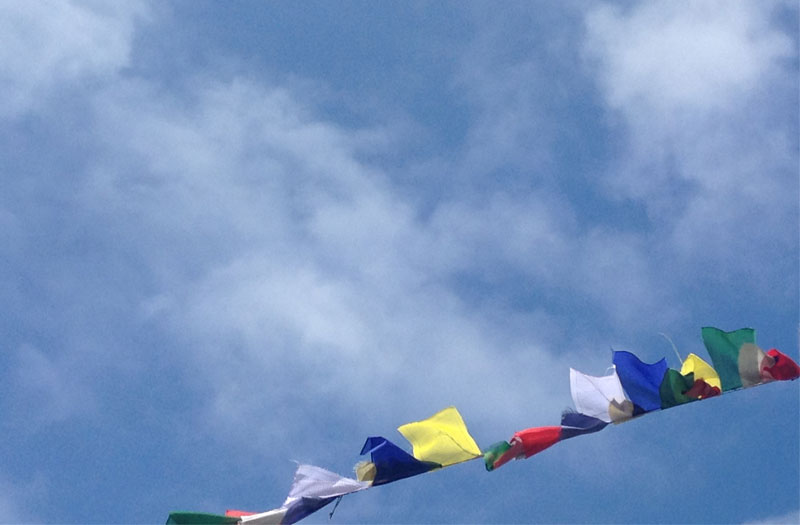
    Buddhist prayer flags billowing in a blue skyTime for some more poetry, I think. (Isn’t it always?)

    Sometimes it takes no more than a moment. You meet a person, see a painting, hear some music or read certain words. Immediately, there is a feeling of recognition, appreciation and even awe. It is simple and instant. It just feels right.

    That’s what I experienced when I first read Mary Oliver’s poem ‘Praying’.

    It doesn’t have to be
    the blue iris, it could be
    weeds in a vacant lot, or a few
    small stones; just
    pay attention, then patch

    a few words together and don’t try
    to make them elaborate, this isn’t
    a contest but the doorway

    into thanks, and a silence in which
    another voice may speak.

    Isn’t it wonderful? With only a few gentle words, Mary Oliver reminds us that poetry can be found in the humblest of things, such as weeds and stones. We don’t always need magnificence for our inspiration, and nor is it always necessary for our writing to impress or compete. Pleasure is often found in simplicity, and the delight of writing is a gift in itself.

    As a poet, however, Mary is clever with her use of the homograph “elaborate”. There are different ways of reading this word, either as an adjective or a verb. Each option offers a slight shift in our understanding of the poem. Are we being advised not to make our patched together words too ornate and complicated? Or is the suggestion instead that they do not have to explain or expound? These two interpretations sit in a friendly tension, lending a more nuanced edge to an otherwise modest message.

    The last lines are my favourites, with their evocation of writing being a “doorway” to gratitude and to the “silence in which / another voice may speak.” But whose voice is this? Is it our own inner expression, so often suppressed by other sounds and distractions, or could it be something more mysterious than this?

    As yoga teaches us, we breathe and are breathed. Perhaps we can also say that we write and are written.

    However it may be, this poem is one to which I return again and again, giving thanks and listening quietly for that other voice in the silence.

    I hope that you enjoy it too.

    Now it’s your turn…

    What does this poem evoke for you? What do you make of its title, ‘Praying’? Where else in your life do you find both thanks and silence for another voice to speak?

  • Why comma splices aren’t so nice

    Blurred background with nice white commaI know what it’s like. You’re full of ideas that you’re eager to share. You want to say everything all at once, give your reader every detail, say all of the things, all in one go, immediately and now, because it’s really important and you just have to get it out there, all of it, this instant!

    But sometimes you need to stop.

    Or rather, you need a full stop.

    Let me introduce you to one of those pesky grammatical gremlins: the run-on sentence. Also known as a comma splice, this particular glitch occurs when two complete sentences get squished together with nothing but a comma between them.

    Here’s an example.

    Good writing is a genuine pleasure, it can open up entirely new worlds in your mind.

    The problem is that the phrases on either side of the comma are complete sentences in their own right. That means they deserve to begin with their very own capital letter and end with their own full stop.

    Just as a reminder, a sentence is complete and correct when it contains an independent clause. This is a clause that has both a subject, which is the thing or person doing something, and a verb, which is the action being done by the thing or person. (It’s even better when the subject and verb agree with each other, but that’s a topic for another article.)

    The subject and the verb may be joined by other grammatical elements, like objects or complements, but the whole point of a sentence is to communicate a coherent idea. It’s what they are designed to do.

    Sentences are happiest when they express one clear, complete thought.

    This is why comma splices aren’t so nice. They comprise two (or possibly more) complete thoughts that ought to reside in separate sentences. When this doesn’t happen and a sentence runs on, there can be a feeling of breathlessness in the writing. It is as if everything becomes rushed. Individual ideas pile up on one another and the discrete expression of each gets blurred.

    Fortunately, it is easy to mend a comma splice. The simplest way is to insert a full stop and capital letter.

    Good writing is a genuine pleasure. It can open up entirely new worlds in your mind.

    Other appropriate punctuation, such as a semicolon or dash, can likewise replace the comma, or you could add the word “and” or another appropriate conjunction after the comma to create a compound sentence.

    Good writing is a genuine pleasure, as it can open up entirely new worlds in your mind.

    See how easy it is?

    Learning to detect and correct comma splices in your own writing is a skill that is worthwhile nurturing. One approach for this is to check each comma in turn and assess whether it should be a full stop instead. This involves having some understanding of clauses and sentences, which is in itself is a good idea if you want to improve your writing.

    You might also try that magical trick of reading your writing aloud. It may not always help you detect a run-on sentence, but it can be a useful practice anyway.

    Ideas, like people, need space to breathe. By making sure you have a single idea in a single sentence, you will avoid comma splices and keep your writing nice.

    Now it’s your turn…

    Do you have a tendency towards run-on sentences? What will you do differently now you understand more about them?

  • Why I need to see your work
    (and why it’s ok to show me)

    Detail of a girl's eyes from a vintage photographThis is how it goes.

    You write your document. You work away at it until you happily hit that final full stop. You take a breath. You let it go. You’re ready for the next step.

    You decide to get your work professionally edited. One way or another, you find me.

    Maybe a friend mentions my name or you glean my details from a list of freelance editors. You might click through various, curious links until you arrive at this website and fill in my contact form, or perhaps I slip you a business card when we meet at an event somewhere.

    However it happens, you find me and you send me a message. Chances are, it goes something like this… I’ve just finished writing my novel / PhD thesis / self-help book / website content / family history / entire life’s work. How much will it cost to edit?

    This is the point at which I will ask you, very politely, to please send me a sample of your work.

    Because without reading the actual words you want me to edit,
    I have no way of knowing how much it will cost.

    Your words are your own. They are unlike those that any other writer might compose. This means your manuscript is unique, and so the level of editing and time it requires cannot be determined by intuition or a formula. It can only be done by me giving it a decent read and due consideration.

    Some editors do quote for jobs on a per word or per page basis, while others might cite an hourly rate. That’s fine, but it is not my preferred approach.

    I am much happier knowing what your writing is like by having read it. Doing so allows me to get a better understanding of how I can help you and how much is involved – in terms of cost, time, complexity and effort – in giving you that assistance.

    Sometimes writers are reluctant to share their work, even when seeking a quote to have it edited. It is a delicate thing, I know, to send your words into the unknown hands of someone you’ve never met. Issues of trust and confidentiality can loom over such an exchange, not to mention that nagging question… What will she think of it?

    Let me reassure you.

    I read your work. I don’t judge it. And I keep all documents you send me safe and secure while they are in my care. I know how important they are.

    You need to feel confident that you can send your work to me and I need to see it so I can ensure the quote I give you to work on it is fair to both of us.

    The only way that can happen is if you let me read it first.

    Now it’s your turn…

    How do you feel about sharing your writing with other people? What prompts you to decide either to send it out into the world or not?