
Author: artful words

  • Consistency, repetition and difference: A dance with language

    Consistency, repetition and difference: A dance with language

    Artful writing is like a dance. There’s a rhythm and a deftness to it, a blend of temptation and respect. It requires attunement to certain textual nuances, among which are consistency, repetition and difference. Achieving a balance between these seemingly contradictory but in fact complementary qualities can help enliven your writing, enabling you to engage with your readers in creative ways.

    Consistency

    An essential task for any copyeditor or proofreader is to achieve consistency in a document. This ranges from maintaining the same spelling for individual words to ensuring a harmonious tone of voice throughout. Both author and editor need to be clear about the direction and intention of a text so that a coherent message is shared. Consistency is also important in terms of the structure of a manuscript. The aim is to create a considered container in which your ideas can flourish.

    These issues of consistency matter not only because they are pleasing in themselves, but also because they afford a more assured experience. By smoothing away any potential concerns about errant spelling or uneven pacing, you allow your readers to give their full attention to the meaning you are seeking to convey. They can absorb the information, enjoy the artistry of your words and appreciate the care you have taken, rather than being distracted by needless niggles.

    Instilling consistency in your work is a way of demonstrating respect, both for your reader and for your work, and it is a vital part of being an artful writer.

    Repetition

    Repetition can be effective. Repetition lends emphasis. Repetition gives rhythm and form to your writing. But employed without thought, repetition risks becoming rather dull. Using the same word or phrase again and again and again may end up sounding insipid. Likewise, a sequence of sentences that have a similar beginning may indicate a lack of imagination at play. Even echoing the same pattern or length in sentence after sentence can make your writing seem clumsy.

    The trick is to distinguish between repetition as a deliberate device and the less conscious habit of relying on familiar—if somewhat dusty—utterances. In this regard, it is wise to become aware of the terms and sayings that you frequently use. You may want to search for them in your document and try an alternative form of expression instead.

    It is important to note here that repetition and consistency are not the same. Although alike in some ways, they serve different purposes and accomplish different ends. Consideration of both is necessary, and the two need to tango to let your words flow.

    Difference

    While the distinctions between consistency and repetition may be subtle, difference is outright contrary. That’s why it can be so striking. It shows up in writing in various ways: from the sudden, short sentence that interrupts a run of longer ones, to the unexpected flip in perspective that sparks in your second last paragraph.

    An astute use of difference can be your mark as a writer, whether in your choice of vocabulary and themes, or through the unique voice you espouse. It adds interest, piquancy and depth to your texts, but it too must be applied with care. Too radical a departure from your tone or argument can disorientate your readers. Instead, be selective and implement difference to indicate significance.

    Dancing with language

    Consistency, repetition and difference are qualities that can either enhance or detract from your writing. They are features I search for and sense in a text, and I encourage you to do the same—in your own work as well as that of other authors. As you become more aware of the effects they confer, you can use them with greater sophistication.

    Circling back to the idea of the dance, your role as a writer is to tune in to the essence of each, to feel into the patterns they present and to bring all three elements into harmony to entice your readers to glide, sway and whirl with you and your artful words.

  • The question you will ask yourself

    Wooden bridge over riverSo here we are, at the beginning of a fresh new year. Let’s start it artfully with a bit of poetry. I found this poem in Cate Kennedy’s collection The Taste of River Water (Scribe, 2011), and it has lingered in my mind. It’s called ‘Makeover’.

    The one certainty is that whatever you want to reveal
    will be covered in lead-based paint.
    When you apply the heat gun
    it smells like the fumes could kill you.

    Sometimes you find your eyes fill with tears,
    your head spinning with nauseating stars;
    after a while your hand aches
    just with scraping.

    Re-entering the room,
    you stop in your tracks
    think: is this it?

    Occasionally your hand (the muscles remembering)
    will sweep over it gently
    and there will be a residue, flakes of paint.
    You’ll have to live with it now.

    So step back and get it in perspective
    get a hammer and nail and hang a picture there
    or just keep banging until
    you knock your way into another room.

    Is there natural light?
    Could you make a home here?
    That’s the question you will ask yourself,
    standing ghostly with plaster dust
    absently swinging your hammer, a great new idea
    suddenly occurring to you.

    Much of the beauty of poetry lies in its inspired use of language, but its potency also resides in its capacity to offer us a slantwise insight into the world both around and within us. That’s how this poem is for me. While it is ostensibly about the process of home renovation, I read it as an analogy for writing.

    It begins with the idea of what we want to reveal. This is sometimes clear to us when we write, but it might be buried in convoluted expression. At other times, we know what we hope to disclose, but we’re terrified of sharing it. And then there are times when it is only by burning away the “lead-based paint” that we can discover what our writing is truly about.

    Whichever version of this may be present for you, working through it could cause your eyes to “fill with tears” and your head to spin with “nauseating stars”. Your hand—and sometimes also your heart—will ache with the scraping.

    Later, when reading back over your writing, you may well wonder “is this it?”, and of course, you will still feel under your fingertips the slightly gritty bits where your words are not as poetic or precise as you’d like. But if you’ve taken the adventurous step of sharing what you have written, then perhaps you’ll just “have to live with it now”.

    It’s this next part of the poem that I like the most: the advice to “step back and get it in perspective”.

    Whether in our writing or our lives, it is through dedication to details that we are able to create works of artistry and delight. However, keeping our attention fixed on minutiae can cause us to miss the broader context. In this case, it could be that some deft decoration will improve your outlook. Or, as the poem suggests, the composition that currently leaves you feeling less than inspired might be the starting point for something new.

    The question at the crux of this—of the poem, of your writing, and maybe even of this year—is “Could you make a home here?” Could you, after pursuing the exacting and exhilarating journey of creation, regardless of your satisfaction with the outcome, go through it again?

    Of course you could.

    How else can you honour that “great new idea / suddenly occurring to you”?

    Now it’s your turn…

    What is your interpretation of Cate Kennedy’s poem? What other poems speak to you of the pleasures and difficulties of writing? What great idea—old or new—will guide and inspire your work and your words this year?

  • Owning your writing

    Cup of tea on a windowsillWhat does it mean to achieve mastery? What are its qualities, and what responsibilities does it bring? When do you get to call yourself an artist? Does the affirmation—and indeed declaration—of this come from without or within?

    These are some of the questions I pondered with a friend over a late breakfast one rainy day. It was a deep conversation, rich in digressions and connections, but one point she raised lit the spark for this article.

    Do you own your writing?

    Interestingly, my friend and I had different interpretations of this question. While notions of ownership often relate to intellectual property and copyright, our discussion did not venture in those directions, and neither does this article.

    Rather, my friend recalled that she first heard the query in a writing course, where she understood it to refer to the language and stance that are present in a text. “Owning”, in this sense, means constructing clear, definitive sentences with no vacillation or equivocation, no might or may or could or should.

    This is certainly a valid reading of the idea, and it may, if adopted, result in a more robust approach to writing. But as the preceding sentence shows, sometimes allowing a hint of doubt can be effective and even necessary.

    Unusually, perhaps, for an editor, my perspective on the idea of owning one’s writing is less about the words themselves and more about an attitude of assurance and authority.

    It’s how you feel about your writing and your identity as a writer.

    To own your writing, in this view, means taking care in its formation and feeling pride in its creation—regardless of how it is received. It implies a readiness to express your truth, a respect for your contribution, and a recognition of your unique vision.

    Threading back to the exchange my friend and I shared, another aspect of owning your writing may be a desire to seek mastery, when you know your work is good but believe it can be better. Conversely, mastery may also be at play if you discern your words could be improved yet feel content with how they are.

    Either way, owning your writing and having integrity as a writer may well be the marks of an artist.

    This all sounds grand, but how can you purposely own your writing?

    As with many things, it comes with practice. You start by writing badly, and then you write better. You learn to use your voice and discover what you want and need to say. You figure out when to seek feedback and how to receive it, listening judiciously to others and knowing that ‘yes’, ‘no’, ‘maybe’ and ‘thanks’ are all appropriate responses. It is by reflecting on your writing and defending your choices as an author that you take greater ownership of your work.

    Most importantly, you need to know yourself as a writer and become (if only a little) more comfortable using that title. Some of you might already be at ease with this while others are still exploring their way towards it.

    Regardless of your position, I invite you to consider what owning your writing means to you and how it applies in your life. It can be a powerful concept to adopt, affording you more certainty and confidence.

    And it’s definitely worthwhile discussing it with an insightful friend over breakfast.

    Now it’s your turn…

    Do you own your writing? What is your interpretation of this question? How do you enact this idea?

  • Artists need editors too

    Sticks of coloured chalk pastelsI have such admiration for artists. Painters, illustrators, photographers, sculptors, musicians, designers, dancers, and more: they all reflect and refract the world through their work, providing us with insight, delight and occasionally a new perspective on life.

    Yet, like writers, artists sometimes need editors too.

    A large—and sometimes unwelcome—part of being an artist today is the necessity to promote oneself and one’s work. In addition to dedicating themselves to their practice, artists must also compose copy for their websites, engage with social media, apply for grants and residencies, craft clever statements about their inspirations and intentions, summarise their lives into pithy bios, and explain themselves and their work in essays, articles and interviews.

    Most of these activities involve writing of some kind and all require a proficiency with language.

    For some creative people, writing is simply another form of art, as enjoyable and innate as their primary practice. For others, however, it is far from their preferred medium, and the process of translating thoughts into words can be daunting.

    Artists impart their vision through their art,
    but sometimes they need help with their written expression.

    Often in their writing, artists are trying to turn the cryptic into the concrete. It doesn’t always succeed.

    Sometimes what is written about art—by artists and critics alike—is so convoluted and abstruse that it is almost incomprehensible. This may, on occasion, be a deliberate device to demonstrate the complexity of the concept or the erudition of the author, but it is of little use if the meaning is rendered unintelligible.

    At other times, the difficulty lies in simply framing a clear statement. Ungainly phrases struggle to convey intangible ideas and elusive truths, and again the meaning is lost. This is especially problematic when artists seek to convince judging panels through written submissions that their art is worthy of recognition or funding. If the panel members can’t make sense of what they are reading, they are unlikely to view the application favourably, regardless of how much merit it might have.

    The key for artists, and for all astute writers, is to use words that are considered, creative, precise and persuasive, which of course is easier said than done.

    It takes effort to achieve such artful writing, and it’s not a skill every artist wishes to develop. Nor do they need to.

    If you are an artist, then rather than worrying about where the full stops go or doubting your chance to get that grant because you are not confident with your written expression, a better approach is to find a sympathetic editor who can help you communicate your intention clearly and effectively. It won’t relieve you of the need to wrangle your tangled thinking into words, but it will mean that ones you produce are more purposeful and professional.

    That way, you can go back to doing what you love, and we can enjoy your wonderful creations.

    Now it’s your turn…

    Do you struggle with writing as an artist? Have you ever asked a language expert for help? What do you wish you understood better, in order to improve your written expression?

  • On not being inspired
    and not giving up

    Blue sky with olive treeOne of my lovely clients contacted me recently regarding his current manuscript. He ended his email with the words: “I am trying to encourage myself to keep going.”

    If you are a writer, then you know—with a weighty, world-weary certainty—that writing is not always fun. It is rarely easy and often unrewarding. Finding the motivation to keep putting one word after another (while most likely also going back to delete, tweak or shuffle a whole bunch more) is a challenge when you lack inspiration. Even the most eloquent and impassioned writers get disheartened from time to time.

    The hard truth about encouraging yourself to keep writing is that it’s entirely up to you.

    Leaving aside the commonly quoted notion that we write because we ‘must’—as if impelled by an inner imperative that seeks to be appeased—the reality in most cases is that we write because we choose to do so. I’m sorry to say it, but with some exceptions, it makes no essential difference whether we write or not.

    But.

    This does not mean your writing is not important.

    It is, and that’s the point.

    What you write does not have to change the world. It doesn’t need a million and six readers, but it does have to mean enough to you that you will find some way to keep going with it, even when motivation and inspiration are low. Even when you doubt yourself and your ability. Even when you are utterly discouraged.

    The only person who can incite you to continue is you.

    You need to believe your writing matters.
    That is what will stop you from giving up.

    Maybe you hope your story will help others. Maybe you yearn to educate or entertain, or perhaps you are, quite simply, a kinder person when you give yourself time to write. Whatever your reasons are, remember them and repeat them to yourself in moments of misgiving.

    If you’ve lost enthusiasm for your writing, try taking a new approach to it. Pick a different time or place to write. Set yourself challenges or restrictions and work within them. If you currently spend hours groaning over your computer screen, limit yourself to handwriting for no longer than thirty minutes a day. If you’re stuck on a particular passage or chapter, prohibit yourself from working on it for a week.

    It is also wise to find external support, whether it is from a family member, a friend, a fellow writer, an imaginary mentor or even an editor. Although you are the only one who can decide whether or not to persist with your writing, you do not need to feel alone during difficult times. Meaningful affirmation can come from others, especially if they see the value that writing has for you.

    Sometimes the inspiration comes later and sometimes it doesn’t come at all. The trick is to keep going regardless.

    If you are really struggling and none of these suggestions brings you any relief, then it may be time to let it go. Despite its myriad frustrations, writing is ideally an enriching activity. If it has ceased to be so for you, perhaps the most generous choice you can make is to do something else instead. The world is full of wonders that have nothing to do with words (or so I’m told). You could always go and discover some.

    As writers, we must come with ideas, dedicate the time to write, linger and labour over language, redraft and revise, endure—or hopefully enjoy—being edited, anticipate rejection, withstand doubts, and keep writing despite everything. In addition to this, we are responsible for generating and sustaining our own encouragement.

    That might seem unfair. It may even be enough to make you want to give up. But you are the one who gets to choose.

    So tell me: what are you going to do?

    Now it’s your turn…

    What discourages you about your writing? What do you do to motivate and inspire yourself? What support or advice can you share with others who feel like giving up?

  • Is perfection in editing possible?

    Close up of peacock featherI could make this an incredibly short article by just writing the word ‘No’, but of course there’s more to the story than that. In this case, there is also a story behind the story. It explains why this issue is currently on my mind.

    Last month, I had the unpleasant experience of discovering some mistakes in a document I had edited and sent back to a client. By the time I found them, the material had already been sent to production, so it was too late for any remedy. I was embarrassed and apologetic but also disappointed in myself. I regard all my work seriously and strive to ensure it is as free of errors as possible.

    And I guess that is the point: as free of errors as possible.

    I could recite a list of reasons why this oversight occurred, but to my ears they sound like excuses and poor ones at that. Nor would recounting them change what has happened. A more useful approach is to offer some reminders—for myself as much as for you—that may help prevent such situations from arising.

    Here, then, are a few suggestions for doing a final check of your document before handing it over to an audience, your boss, a publisher, or even your editor.

    1. Give yourself time

    This is the simplest advice, and I’m sure you’ve heard it before. But you know what? It works. You first need to allow a reasonable amount of time to complete a thorough edit of your manuscript. The more practice you have with this, the more accurate you will be in determining how long this will take. When you have a fair estimate of the time required, grant yourself a bit extra. This is especially advisable for important documents. Then, whenever possible, allow a full day or at least a night between the penultimate and final proofreads of your text. You really do see things differently and will pick up on minor errors when you have some distance from the words.

    2. Read it aloud

    Yes, I know you’ve been told this one too. I find this strategy is effective for some people and less so for others. The trick is not just to read out loud but to actually listen to what you are saying. You won’t notice flaws in syntax and flow if you’re just droning away without paying attention. Read slowly and pause between paragraphs. Let your mind absorb the words and the way they work together. Hearing your writing can help you improve it, but do remember that that this approach may not enable you to spot typos or other visual inaccuracies.

    3. Change how it looks

    We’ve all had the experience of spotting a slip up just after printing sixty copies of a document, right? (Please tell me it’s not just me!) There you stand, papers in hand, staring at the error and wondering how you could have missed it during the twenty-eight read-throughs you did before printing. Why did you not notice it before? The answer is that you are now seeing it differently. If your material is brief enough to print, try doing that for your final proofread. If it is a longer document, change the size or colour of the type or put the text into a different font. You might also try saving it as a PDF and reading it onscreen. Sometimes that’s all it takes for mistakes to make themselves known.

    4. Use a spelling and grammar checker with extreme caution

    This tip comes with a hefty warning. Please do not under any circumstances rely solely on the built-in spelling and grammar checkers in your word processing program. While they may be useful in pointing out the odd grammatical glitch, their proposed corrections can be—with alarming frequency—just plain wrong. My advice is that you review with a measure of skepticism each item identified by the checker and really consider whether or not its recommendations are relevant, appropriate and accurate. If you are unsure, seek further clarification, either online or from someone who has some expertise with language.

    5. Embrace subjectivity

    Editing, like writing, perspective and style, is subjective. Although there are numerous rules governing language, their interpretation can be quite individual—not to mention idiosyncratic. In practice, this means that what appears incorrect to me may be perfectly acceptable and even preferable to someone else. Perhaps in that sense, mistakes themselves can be considered as subjective, existing only in the eyes of those who behold them.

    6. Be human and humble

    These ideas are hopefully helpful, but in the end, my friends, it comes down to a simple truth. None of us is perfect and nor will our endeavours ever be, despite our best and most dedicated efforts. Mistakes in editing can be annoying, embarrassing and unfortunate, but they are very rarely fatal. When they do happen, acknowledge them, apologise for them, and amend them if you can. Above all, accept that you won’t always get it entirely right. It’s okay, though. You’re in good company.

    For myself, I plan to practice all of the prompts I’ve shared here. Doing so won’t make me a perfect editor, but it will mean I am a human one, which is as good as I can be.

    Now it’s your turn…

    Have you ever made an editing error that you’re willing to share? Or has an editor ever missed a mistake in one of your manuscripts? What do you do to recover from such uncomfortable bungles?

  • That or which? It’s all relative
    (and sometimes definitive)

    A bunch of blue flowersAmong the words that befuddle writers are “that”, “which” and “who”. Although they may seem like simple enough terms, each serves a variety of grammatical functions, depending on its role and position in any given sentence. As some of the functions these three words fulfill are similar, confusion over their usage can arise.

    I have written before about the subtle but important difference between “that” or “who”. Now let’s explore the relative merits of “that” and “which”.

    And yes, I did commit a mild pun there, for “that” and “which” are both relative pronouns. This means they stand in place of a noun and relate to a specific antecedent that has appeared earlier in the sentence. For example:

    I chose the flowers that I like.
    The flowers are blue, which is my favourite colour.

    In the first sentence, “that” refers to the flowers. In the second, “which” relates back to blue.

    While it may seem that these words can be used interchangeably, many grammarians agree that the choice of “that” or “which” is determined by whether or not the clause it introduces is defining or non-defining. In other words, your selection of one or the other is based on how crucial the information in the clause is to the overall meaning of the sentence.

    To help clarify this, Mark Tredinnick offers a handy distinction in The Little Green Grammar Book between definition and description. A restrictive clause defines the antecedent by providing essential information about it, whereas a non-restrictive clause describes it through offering additional details that are no doubt fascinating but not necessary in order for the sentence to be meaningful.

    Referring back to our examples, the clause “that I like” is restrictive because it defines the flowers I chose. In contrast, the clause “which is my favourite colour” is incidental to the statement that the flowers are blue. It describes my attitude towards the colour blue but does not define anything in the sentence.

    As these examples show, a restrictive clause is introduced with the word “that”,
    while a non-restrictive clause uses “which”.

    Incidentally, non-restrictive clauses, including those beginning with “which”, are typically preceded by a comma. This is because these clauses tend to be parenthetical, which is a fancy way of saying that what they contain is not vital.

    I did mention that we would discuss the ‘relative’ merits of these words, and it is important to note that there are regional and stylistic variations to the usages I have outlined here. In documents I edit, I ensure each “that”, “which” and “who” is employed correctly, according to my understanding. However, not all writers in all places adopt the same practices. Some are guided by preferences that differ from my own, which is fine. (See what I did there?)

    I guess in a sense, you could say that it’s all relative, except for when it is definitive, which is relatively easy to decide, provided you keep in mind what is essential and what is additional.

    That makes all the difference.

    Now it’s your turn…

    Do you get muddled betwixt “that” and “which”? Do you have any techniques for remembering which to use when? Are you clear about the difference between restrictive and non-restrictive clauses?

    Photo by Veronika Lykova on Unsplash
  • The true essence of editing

    Sunlight through spiderwebHere’s a puzzle for you to ponder. In your view, which of the following is most true?

    Editing essentially involves:
    a) wrangling unruly words into smooth sentences
    b) telling authors all the things they are doing wrong in their writing
    c) stifling creative expression by imposing boring conformity on written texts
    d) having a licence to act snooty about possessing a superior grasp of grammar
    e) wincing a little whenever commas, semicolons or apostrophes are misused
    f) establishing happy and harmonious relationships.

    If you guessed options a or e, you are partly right. If you picked b, c or especially d, then we need to talk. If you were confused by option f, you’re probably not alone, but actually, that is the correct the answer.

    Yes, despite all that fussing over spelling and sentence structure, editing is essentially about relationships.

    The primary one of these, and the one I discuss a lot, exists between the author and the editor. There are many reasons why this relationship is important, not least of which is the fact that without authors there can be no editors. Of course the opposite is not true. Although editors need an author’s words in order to edit, authors can cheerfully (if at times inaccurately) write without editors. That’s what makes it a privilege, in my view, whenever an author elects to work with an editor.

    In addition to the relationship between an editor and an author, there is also one between the editor and the author’s ideas. While connection and collaboration among individuals is a wonderful thing, an editor must also engage with the ideas in a document in order to ensure they are conveyed clearly and completely. This is where the first relationship can be crucial, as the editor seeks to discern the author’s intentions and helps to craft their written expression.

    Beyond this, there is a relationship between the author’s ideas and the readers’ understanding. Having a conscious comprehension of this guides editors in their work. The purpose of most writing is to share insight, imagination or information, and the role of the editor is to amend the text where necessary so this can be done effectively.

    And now we get into some more subtle relationships, because an editor addresses the processes that occur between sentences in a text and between words in a sentence. Here, we are touching upon the fundamentals of syntax, those accepted patterns of word order that enable us to express meaning. When coherence breaks down from one paragraph to another or words go awry within a sentence, the meaning of a text is lost. An editor’s job is to fix this by understanding and improving the relationships amid words and sentences.

    This leads us to one further relationship, which is between words and ideas. The author’s task is to use the most potent and poetic words possible to articulate an idea. For an editor, the focus is on enhancing the eloquence of words and ideas alike. This is done through a deep appreciation not only of the author’s objective but also of language itself.

    From the personal to the conceptual, and from the meaningful to the syntactical, editing is all about relationships. Each one is like a single strand of a intricate web that in its entirety and complexity links ideas, words and people together.

    Achieving harmony in each and all of these relationships is what editors do. This is the true essence of editing, and it is what makes our skills so vital and so valuable.

    Now it’s your turn…

    What relationships do you perceive between writing and editing? What do you consider to be the essential elements of these? And you don’t really believe editors are snooty, do you?

  • Thoughts on truth for writers from Vincent van Gogh

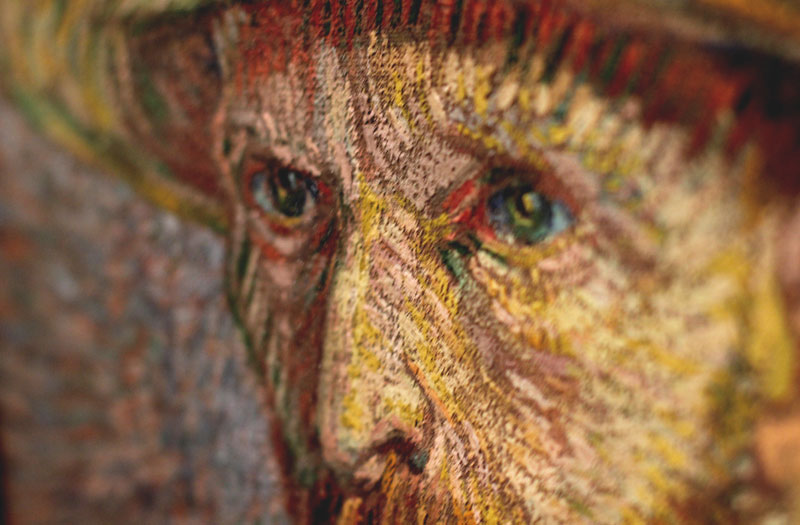
    Close up of portrait of Vincent van GoghAs far as I’m aware, Vincent van Gogh never shared any explicit advice about writing. (If he did and you know of it, I’d be delighted to hear it.) What van Gogh did was draw and paint. A lot. He also wrote very many letters. One of these, to his brother Theo in July 1882, contains this engaging thought:

    One must work long and hard to arrive at the truthful. What I want and set as my goal is damned difficult and yet I don’t believe I’m aiming too high. I want to make drawings that move some people … In short, I want to reach the point where people say of my work, that man feels deeply and that man feels subtly.

    Whether or not you believe van Gogh achieved what he sought will depend on your perspective on his art. Regardless of this, his words to Theo hold wisdom for writers and creators of all kinds.

    What is clear in these brief lines is the entwined importance of truth and diligence. The language in this letter shows that Vincent van Gogh knew how challenging being guided by truthfulness can be, and yet it is through devotion to truth, despite the discomfort it can bring, that we may create works that embody those qualities of deep and subtle feeling.

    As artists, writers and makers, truth offers itself to us in a range of ways. The most vital of these concerns our honesty with ourselves. It is my belief that we need to know our own truth and affirm the integrity of our intentions in order to create works of genuine meaning. Only then can we engage in authentic communication with our audience.

    This is not to say that everything we make must be based on empirical fact or that we ought not invent or contrive. Bringing the vibrant sparks of imagination to life is, after all, the task of the artist. Still, there must be truth in it.

    The sort of truth that I—and perhaps also van Gogh—speak of here goes beyond simple veracity. It has an emotional or even a spiritual essence that resonates within us despite its guise. We know this truth, intrinsically and viscerally, when see, hear or feel it in art. In its presence, we perceive, consciously or not, that the person who crafted its expression did so with dedication and an awareness of reaching towards something ineffable.

    That’s the kind of art I want to experience.
    It’s the kind I aspire to make.

    The search for this truth and our desire to proclaim it must be at the heart of our creations. We need to become attuned to it in the themes we choose, the ideas we explore and the words we use. This means we must be willing to become more aware of those moments when we feel our integrity waver, whether through fear or uncertainty or doubts about our ability. It is in such moments that we decide what kind of artists we are.

    Later in the same letter to Theo, Vincent van Gogh acknowledges that art “demands persistent work, in spite of everything, and unceasing observation”. He goes on:

    By persistent I mean in the first place continued labour, but also not abandoning your approach because of what someone else says. I have hopes, brother, that in a few years, and even now already, you’ll gradually see things by me that will give you some recompense for your sacrifices.

    I hope that as writers and creators we can commit to our work with honesty and courage, not varying our vision due to the opinions of others. I hope we find recompense in our efforts, yet even more, I hope that what we do moves people in some way by offering them a glimpse of what we know to be true.

    A damned difficult goal it may be to pursue the truthful. But it is a wholly worthy one too.

    Now it’s your turn…

    What are your views on art and truth? When have you faced a moment that challenged your integrity? What do you do as a writer to explore, express and experience truth?

  • The insistent question: How much editing is too much?

    Unfurling fern frondPerhaps it is a quirk—or maybe a perk—of the job, but you’ll find that editors ask a lot of questions. We must, if we are to understand what writers are trying to say and to help them in the best possible way. Many of these questions concern the text and the author’s intentions, but there are others that whisper more insistently in the adytum of our minds.

    One of these, inevitably, is how much is too much when it comes to the extent of our editing?

    It’s a question I guess most editors will ask at some point in a project. It’s certainly one that I ponder often. This may have something to do with the type of manuscripts I edit, but it may also relate to my approach as an editor. It could be that I engage more directly with a document than some of my colleagues. If I see how a piece of writing could be improved, my inclination is to do it; always keeping in mind, of course, the importance of maintaining the author’s voice.

    But truthfully?

    Those improvements I make are based on my personal perspective. Even with seemingly straightforward matters like sentence structure and punctuation (which are never really that simple), another editor may view the whole thing differently and edit accordingly. It’s the nature of the work. Editing is interpretative, creative and subjective, all of which makes it difficult to answer that nagging question of quantity.

    I have been fortunate that none of my clients have so far expressed any anguish about the approach I have taken with their writing. It is possible they are all polite enough to keep any dark mutterings to themselves, but it is just as likely that I have not interpreted any comments I have received from them as complaints, simply because I believe it is part of the editing process to engage in a constructive dialogue in order to achieve the desired result.

    In practice, that means I will ask if it is okay to proceed before proposing any major revisions. I explain my intentions as well as my actions to my clients, and I expect them to inform me of any concerns they may have. If a client does express doubt or suggest some other solution, I adapt my approach.

    Still, the question lingers. How do I know how much is enough?
    What tells me how deep and how far I can go?

    The answer is trust.

    I trust in my insight and expertise as an editor. I trust in my ability to communicate clearly and sensitively with my clients. And I trust my clients to tell me if and when they need me to soften—or strengthen—my intervention.

    Although it occupies my mind, the funny thing about all this solicitude over the depth and extent of my editing is that it is actually immaterial, because in the end, the choice is always yours. Or rather, it is a decision we reach together.

    That’s one thing you can trust. Between us, we will find your writing’s sweetest and most fluent rhythms. We will divine its brightest shape and clearest tone. We’ll get it to the form and place it needs to be.

    And you can be absolutely assured that I will ask you many, many pesky questions along the way.

    Now it’s your turn…

    Have you ever been uncomfortably over-edited? Do you get frustrated by your editor’s endless questions? And be honest now: have you ever encountered the word “adytum” before?

  • More thoughts on voice
    from an editor’s perspective

    Flock of flying birdsThere is a saying that good editing is invisible. Since my Zen-inspired musing on voice and how to find it, I’ve been wondering if editing is—or should be—inaudible too.

    Just in case you missed it, my earlier article advised that the way to find your voice as a writer is to use it. However, looking at this from a writer’s viewpoint is only one part of the story. Editors have a perspective on voice too, although it is one that does not get discussed nearly as much.

    In a simplistic definition, editing can be described as the art of tidying up a text to ensure its message is clear, concise and compelling. This includes consideration of the structure, content, style and syntax of the document, all of which involves working with the author’s voice. But before we get too concerned about this, let me assure you that it does not mean an editor’s job is to change that voice. In most cases, the opposite is true.

    As an editor, I will not alter your voice unless you explicitly ask me to do so. I may make observations and offer suggestions about it, but these are always done in consultation with you. It could be that the tone you are using is too formal or informal for your intended audience, or perhaps there is a shift in the voice that has resulted from the many (many, many) different drafts you have penned. In such cases, I would alert you to the issue and offer suggestions for how to remedy it. We would work together to ensure that your voice is both appropriate and consistent for your purpose and audience.

    Rather than change an author’s voice, a skilful editor will enhance it.

    How exactly this happens is part of the mysterious magic that is editing. The best way I can describe it is that an editor ‘tunes in’ to the voice in a manuscript, becoming conscious of its cadence and responsive to its rhythm.

    Being attuned like this to the voice in a manuscript is an essential skill for editors. Without an awareness of how the voice sounds, it is difficult to make insightful recommendations or adjustments. Remember how I mentioned that good editing is invisible? This is because it amends a text without leaving any sign of the process involved. It takes expertise to achieve this and can only be done when an editor has an excellent sense of the author’s voice.

    The changes an editor suggests to a text should blend in imperceptibly, appearing as if they were always supposed to be there. When reflecting on editing in terms of audibility, however, I’m not sure the same aim applies.

    One way to think of it is that an editor lends a voice to the chorus that allows an author’s words to soar. By adding a few key notes and harmonising with you, your editor contributes to the overall artistry of your voice in terms of its fluency, sensitivity and melody.

    Basically, editors make you sound better.

    Yet while it may be vital to the final, shining version of your writing, an editor’s voice should never dominate. In this sense, editing is audible, but only just. Although its resonance may be there, the true voice—the one that sings distinctly and is heard most purely—is always and uniquely yours.

    Now it’s your turn…

    Have you had a harmonious relationship with an editor? How did that editor help to enhance your voice? What observations or advice do you have about working with voice for writers and editors alike?

  • Advice on finding (and using)
    your voice

    White Buddhist statue against cloudy blue skyExcuse me if I get a bit Zen for a moment. I’d like to share with you some thoughts on voice.

    Perhaps it is the association we make between words and their sounds that gives rise to the idea of the writer’s voice. In most cases, we develop the ability to speak before we learn to write, so it may be that the value we put on voice derives from some sense of veracity.

    Our spoken voice may be considered as one of our most distinctive features, and the same can be true of our writing too. When we talk of voice in relation to writing, we are referring to an author’s characteristic and sometimes idiosyncratic style of expression. It’s about how you put your sentences together and includes elements such as the level of formality and complexity you employ, the images or metaphors you use or don’t use, and even the individual words you choose. All of this combines to create the voice in your texts.

    Really, your voice is that precise parcel of poetry and peculiarity that distinguishes your writing as being undeniably your own.

    Voice is an important quality for any author to possess, and the question of how to find one’s voice is asked by emerging and established writers alike. Even a cursory search on this topic reveals that the internet is bristling with tips and tricks, step-by-step guides, instructions, injunctions and assorted exhortations. Alongside these are the inevitable articles that contest or reject the whole concept. (It’s kind of blunt, but one way to let your voice sound is to disagree with any opinion that is commonly accepted.)

    My perspective on all of this is not particularly original, which in some ways may be the point. Simply put, I believe that your voice is not out there somewhere, waiting for you to find it. Instead, it is inside you, waiting for you to use it – and this is where things get a little Zen.

    The way to find it is to use it.

    Think of it this way: your voice is the part of you that comes through in your writing, whatever your theme happens to be. If you are the person putting one word after another on a page or a screen and you are expressing some kind of truth in doing so, then your writing will contain your voice.

    It’s that simple. Except maybe it’s not. It can’t be, otherwise there wouldn’t be so much advice on the internet about it, right?

    If you have ever fretted about finding – or indeed losing or not ever having – your voice as a writer, please understand that I don’t mean to dismiss your anguish. However, chances are that your real concern in worrying about this is either that you don’t believe your writing is good enough or that you fear it sounds like someone else.

    The solution in both cases is the same. The way to find your voice and to feel confident that it is yours is to use it.

    The more you write, the more aware of your own style you become. If it seems like that style is in need of some refinement, then practice and play. Keep writing, keep trying, keep exploring. Similarly, if you find yourself emulating an admired writer or adopting an unaccustomed tone because you think it is more appropriate than your natural approach, try experimenting with your word choice, your sentence length, the structure of your text, the level of formality, the imagery.

    It is by writing and by reading back over our own words (again and again, and sometimes aloud) that we become familiar with our work. From there, we can rewrite and revise, making subtle adjustments or dramatic transformations. In time, with dedication and attention, we learn what feels most authentically ‘us’. We find our voices by using them, just as we find ourselves by being who we are.

    It’s simple and complex. It’s obvious and elusive.

    It’s kind of Zen, but really, the only thing you need to do is to write and keep on writing, until you hear the sound of your self in your words.

    Now it’s your turn…

    What’s your perspective on the whole question of finding your voice as a writer? How did you find your voice and how did you know it was truly yours? Has this article given you any insight or encouragement on this topic or is just another drifting echo on the internet?