Category: art of editing

  • Why I provide sample edits

    Why I provide sample edits

    Editors are curious individuals—almost as quirky as authors. While there are certain principles of clear communication and grammatical accuracy to which most editors will adhere, each of us has our own idiosyncrasies and inclinations. When it works, the relationship between a writer and an editor can be enjoyable, enlightening and inspiring for both people. But how can you tell if it’s going to be like this?

    One way I try to address this question is by providing my potential clients with a sample edit.

    Here’s how it works. When you contact me, I get an initial sense of whether or not I am the right editor for you. If I think we may work well together, I will ask you to send me your manuscript, assuring you that I’ll keep it safe and confidential while it is in my care. I then edit part of the text, generally beginning at the beginning. I use track changes in Microsoft Word when editing. This allows you to see the changes I make, and it enables me to include comments, questions, observations and suggestions within the document.

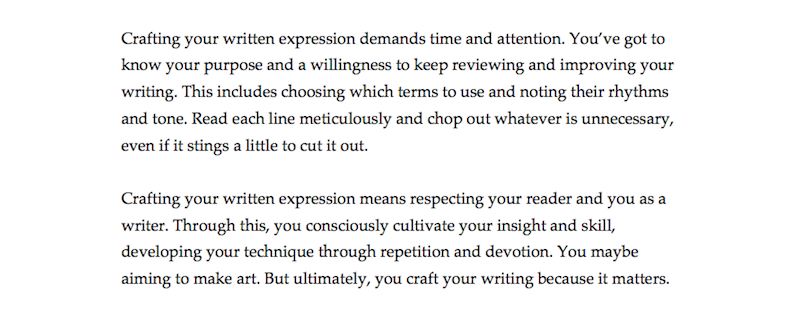
    The image below shows an example of an original draft, adapted from an article previously published on this website.
    The image shows two paragraphs of text. The text reads: "Crafting your written expression demands time and attention. You’ve got to know your purpose and a willingness to keep reviewing and improving your writing. This includes choosing which terms to use and noting their rhythms and tone. Read each line meticulously and chop out whatever is unnecessary, even if it stings a little to cut it out. Crafting your written expression means respecting your reader and you as a writer. Through this, you consciously cultivate your insight and skill, developing your technique through repetition and devotion. You maybe aiming to make art. But ultimately, you craft your writing because it matters."

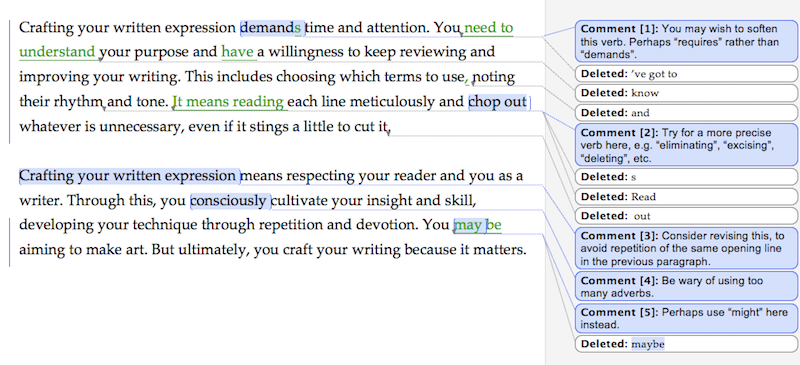
    And this is what the text looks like when it is marked up using track changes.

    The image shows the same two paragraphs as before, but this time with tracked changes. Some words appear in green with underlining, to show that they have been altered from the original. Deleted words appear in white boxes on the right-hand side of the page. Comments are also shown on the right-hand side of the page, in blue boxes. An example of a comment is: "You may wish to soften this verb. Perhaps 'requires' rather than 'demands'".

    As you can see, I have made a few corrections (shown in the text in green), along with some suggestions (in the blue comment boxes on the right-hand side).

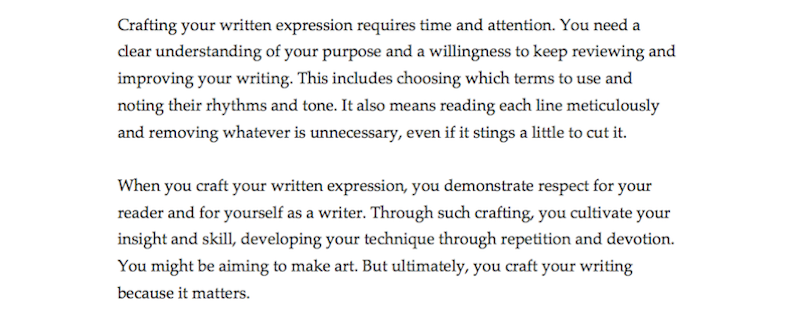
    Taking these corrections and suggestions into consideration, here’s how the revised version might read.

    The revised paragraphs now read: "Crafting your written expression requires time and attention. You need a clear understanding of your purpose and a willingness to keep reviewing and improving your writing. This includes choosing which terms to use and noting their rhythms and tone. It also means reading each line meticulously and removing whatever is unnecessary, even if it stings a little to cut it. When you craft your written expression, you demonstrate respect for your reader and for yourself as a writer. Through such crafting, you cultivate your insight and skill, developing your technique through repetition and devotion. You might be aiming to make art. But ultimately, you craft your writing because it matters."

    Of course, if you had written these paragraphs and had received this sample edit from me, you might have made different decisions about their final form. That’s the delightful thing about writing and editing: they are both expressions of unique creativity and are both so open to interpretation and invention.

    By providing you with a sample edit, I give you the opportunity to see if your creativity and mine align. When they do, we each have the chance to engage in an artful and enjoyable experience of editing.

    Photo by Joanna Kosinska on Unsplash

  • When editing gets distressing

    When editing gets distressing

    Try as we might to avoid it, editing can sometimes be distressing. After putting their hearts into their craft, writers can feel slighted and even assaulted by the comments, questions, corrections, and suggestions that editors strew through their manuscripts. Although it is never an editor’s intention to cause anguish, the distress that writers might feel at having their words so closely scrutinised is real.

    If you ever find yourself in this situation, here are some points to keep in mind.

    1. Time

    Artful writing requires time, but skilful editing does too. While some people relish a last-minute rush, many of us respond less well to such pressure. Distress can arise when you do not allow yourself enough time to consider and implement your editor’s suggestions. This is especially so if significant or structural changes are proposed.

    You may, on the first reading, disagree—even vehemently—with what your editor has done and said. But if you let the ideas settle a little and return to them at a different time, in a different frame of mind, you might find they have some merit. Notice your reactions, but do not act on them immediately. Nor is it advisable to fire off an instant and upset message to your editor, whose focus is on achieving the best outcome for your manuscript.

    Wait a bit. Take a breath. Have a think.

    If you still feel overwhelmed or aggrieved after some time has passed, compose yourself and get in touch with your editor. A calm response is likely to produce a better result for you and your writing.

    2. Communication

    From the first contact between writer and editor, clear and honest communication is vital on both sides. In addition to describing your project and your passion for it, you need to tell your editor your concerns and aspirations regarding your manuscript. At the same time, your editor should articulate her approach and explain the suggestions and corrections she makes. This exchange must continue throughout the process to enable the writer and editor to understand one another. Each will then have a sense of how revisions are evolving and where adjustments need to be made. Sometimes changes to the text are necessary for reasons of clarity or grammar, but without explanation from the editor, such corrections can appear capricious.

    If you feel your editor has misunderstood an aspect of your story or has indicated alterations that you feel compromise your writing, it is important to discuss this. After allowing yourself some time and inhaling those few deep breaths, share your concerns with your editor. None of us gets into this with intention of causing harm to anyone, and confusion or conflict can often be resolved through conversation.

    3. Respect

    As vital as time and communication are when dealing with distress that may arise from editing, the key to it all is respect. You need to respect your editor as someone who loves good writing and has specialised knowledge of language and how it works. This is not to say that editors always have the right answers, never make mistakes, and do not let personal preferences influence their work. We’re human too. But if you have asked an editor to help you with your writing, trust in her expertise and show respect for her ideas before you react against them.

    At the same time, give yourself respect as a writer. You know your story, your style, your topic, and your purpose better than anyone else. Although you may not be able to spot the flaws in your own words, you know their truth, and it is this that enables you to see which of your editor’s suggestions will enhance your writing and which may hinder it.

    Be willing to listen and remain open to possibilities that you might not have imagined. The gift of working with an editor is that you engage in a relationship with an expert who is both professional and partisan, objective and interested.

    In the end, we’re always on your side.

    Writing is a joyful, difficult, beautiful, challenging, invigorating endeavour, and so is editing. The process of having your writing edited can sometimes be confronting, but if writers and editors alike embrace the grace of time, communication, and respect, it need not be the cause of any distress.

  • Artists need editors too

    Sticks of coloured chalk pastelsI have such admiration for artists. Painters, illustrators, photographers, sculptors, musicians, designers, dancers, and more: they all reflect and refract the world through their work, providing us with insight, delight and occasionally a new perspective on life.

    Yet, like writers, artists sometimes need editors too.

    A large—and sometimes unwelcome—part of being an artist today is the necessity to promote oneself and one’s work. In addition to dedicating themselves to their practice, artists must also compose copy for their websites, engage with social media, apply for grants and residencies, craft clever statements about their inspirations and intentions, summarise their lives into pithy bios, and explain themselves and their work in essays, articles and interviews.

    Most of these activities involve writing of some kind and all require a proficiency with language.

    For some creative people, writing is simply another form of art, as enjoyable and innate as their primary practice. For others, however, it is far from their preferred medium, and the process of translating thoughts into words can be daunting.

    Artists impart their vision through their art,
    but sometimes they need help with their written expression.

    Often in their writing, artists are trying to turn the cryptic into the concrete. It doesn’t always succeed.

    Sometimes what is written about art—by artists and critics alike—is so convoluted and abstruse that it is almost incomprehensible. This may, on occasion, be a deliberate device to demonstrate the complexity of the concept or the erudition of the author, but it is of little use if the meaning is rendered unintelligible.

    At other times, the difficulty lies in simply framing a clear statement. Ungainly phrases struggle to convey intangible ideas and elusive truths, and again the meaning is lost. This is especially problematic when artists seek to convince judging panels through written submissions that their art is worthy of recognition or funding. If the panel members can’t make sense of what they are reading, they are unlikely to view the application favourably, regardless of how much merit it might have.

    The key for artists, and for all astute writers, is to use words that are considered, creative, precise and persuasive, which of course is easier said than done.

    It takes effort to achieve such artful writing, and it’s not a skill every artist wishes to develop. Nor do they need to.

    If you are an artist, then rather than worrying about where the full stops go or doubting your chance to get that grant because you are not confident with your written expression, a better approach is to find a sympathetic editor who can help you communicate your intention clearly and effectively. It won’t relieve you of the need to wrangle your tangled thinking into words, but it will mean that ones you produce are more purposeful and professional.

    That way, you can go back to doing what you love, and we can enjoy your wonderful creations.

    Now it’s your turn…

    Do you struggle with writing as an artist? Have you ever asked a language expert for help? What do you wish you understood better, in order to improve your written expression?

  • Is perfection in editing possible?

    Close up of peacock featherI could make this an incredibly short article by just writing the word ‘No’, but of course there’s more to the story than that. In this case, there is also a story behind the story. It explains why this issue is currently on my mind.

    Last month, I had the unpleasant experience of discovering some mistakes in a document I had edited and sent back to a client. By the time I found them, the material had already been sent to production, so it was too late for any remedy. I was embarrassed and apologetic but also disappointed in myself. I regard all my work seriously and strive to ensure it is as free of errors as possible.

    And I guess that is the point: as free of errors as possible.

    I could recite a list of reasons why this oversight occurred, but to my ears they sound like excuses and poor ones at that. Nor would recounting them change what has happened. A more useful approach is to offer some reminders—for myself as much as for you—that may help prevent such situations from arising.

    Here, then, are a few suggestions for doing a final check of your document before handing it over to an audience, your boss, a publisher, or even your editor.

    1. Give yourself time

    This is the simplest advice, and I’m sure you’ve heard it before. But you know what? It works. You first need to allow a reasonable amount of time to complete a thorough edit of your manuscript. The more practice you have with this, the more accurate you will be in determining how long this will take. When you have a fair estimate of the time required, grant yourself a bit extra. This is especially advisable for important documents. Then, whenever possible, allow a full day or at least a night between the penultimate and final proofreads of your text. You really do see things differently and will pick up on minor errors when you have some distance from the words.

    2. Read it aloud

    Yes, I know you’ve been told this one too. I find this strategy is effective for some people and less so for others. The trick is not just to read out loud but to actually listen to what you are saying. You won’t notice flaws in syntax and flow if you’re just droning away without paying attention. Read slowly and pause between paragraphs. Let your mind absorb the words and the way they work together. Hearing your writing can help you improve it, but do remember that that this approach may not enable you to spot typos or other visual inaccuracies.

    3. Change how it looks

    We’ve all had the experience of spotting a slip up just after printing sixty copies of a document, right? (Please tell me it’s not just me!) There you stand, papers in hand, staring at the error and wondering how you could have missed it during the twenty-eight read-throughs you did before printing. Why did you not notice it before? The answer is that you are now seeing it differently. If your material is brief enough to print, try doing that for your final proofread. If it is a longer document, change the size or colour of the type or put the text into a different font. You might also try saving it as a PDF and reading it onscreen. Sometimes that’s all it takes for mistakes to make themselves known.

    4. Use a spelling and grammar checker with extreme caution

    This tip comes with a hefty warning. Please do not under any circumstances rely solely on the built-in spelling and grammar checkers in your word processing program. While they may be useful in pointing out the odd grammatical glitch, their proposed corrections can be—with alarming frequency—just plain wrong. My advice is that you review with a measure of skepticism each item identified by the checker and really consider whether or not its recommendations are relevant, appropriate and accurate. If you are unsure, seek further clarification, either online or from someone who has some expertise with language.

    5. Embrace subjectivity

    Editing, like writing, perspective and style, is subjective. Although there are numerous rules governing language, their interpretation can be quite individual—not to mention idiosyncratic. In practice, this means that what appears incorrect to me may be perfectly acceptable and even preferable to someone else. Perhaps in that sense, mistakes themselves can be considered as subjective, existing only in the eyes of those who behold them.

    6. Be human and humble

    These ideas are hopefully helpful, but in the end, my friends, it comes down to a simple truth. None of us is perfect and nor will our endeavours ever be, despite our best and most dedicated efforts. Mistakes in editing can be annoying, embarrassing and unfortunate, but they are very rarely fatal. When they do happen, acknowledge them, apologise for them, and amend them if you can. Above all, accept that you won’t always get it entirely right. It’s okay, though. You’re in good company.

    For myself, I plan to practice all of the prompts I’ve shared here. Doing so won’t make me a perfect editor, but it will mean I am a human one, which is as good as I can be.

    Now it’s your turn…

    Have you ever made an editing error that you’re willing to share? Or has an editor ever missed a mistake in one of your manuscripts? What do you do to recover from such uncomfortable bungles?

  • The true essence of editing

    Sunlight through spiderwebHere’s a puzzle for you to ponder. In your view, which of the following is most true?

    Editing essentially involves:
    a) wrangling unruly words into smooth sentences
    b) telling authors all the things they are doing wrong in their writing
    c) stifling creative expression by imposing boring conformity on written texts
    d) having a licence to act snooty about possessing a superior grasp of grammar
    e) wincing a little whenever commas, semicolons or apostrophes are misused
    f) establishing happy and harmonious relationships.

    If you guessed options a or e, you are partly right. If you picked b, c or especially d, then we need to talk. If you were confused by option f, you’re probably not alone, but actually, that is the correct the answer.

    Yes, despite all that fussing over spelling and sentence structure, editing is essentially about relationships.

    The primary one of these, and the one I discuss a lot, exists between the author and the editor. There are many reasons why this relationship is important, not least of which is the fact that without authors there can be no editors. Of course the opposite is not true. Although editors need an author’s words in order to edit, authors can cheerfully (if at times inaccurately) write without editors. That’s what makes it a privilege, in my view, whenever an author elects to work with an editor.

    In addition to the relationship between an editor and an author, there is also one between the editor and the author’s ideas. While connection and collaboration among individuals is a wonderful thing, an editor must also engage with the ideas in a document in order to ensure they are conveyed clearly and completely. This is where the first relationship can be crucial, as the editor seeks to discern the author’s intentions and helps to craft their written expression.

    Beyond this, there is a relationship between the author’s ideas and the readers’ understanding. Having a conscious comprehension of this guides editors in their work. The purpose of most writing is to share insight, imagination or information, and the role of the editor is to amend the text where necessary so this can be done effectively.

    And now we get into some more subtle relationships, because an editor addresses the processes that occur between sentences in a text and between words in a sentence. Here, we are touching upon the fundamentals of syntax, those accepted patterns of word order that enable us to express meaning. When coherence breaks down from one paragraph to another or words go awry within a sentence, the meaning of a text is lost. An editor’s job is to fix this by understanding and improving the relationships amid words and sentences.

    This leads us to one further relationship, which is between words and ideas. The author’s task is to use the most potent and poetic words possible to articulate an idea. For an editor, the focus is on enhancing the eloquence of words and ideas alike. This is done through a deep appreciation not only of the author’s objective but also of language itself.

    From the personal to the conceptual, and from the meaningful to the syntactical, editing is all about relationships. Each one is like a single strand of a intricate web that in its entirety and complexity links ideas, words and people together.

    Achieving harmony in each and all of these relationships is what editors do. This is the true essence of editing, and it is what makes our skills so vital and so valuable.

    Now it’s your turn…

    What relationships do you perceive between writing and editing? What do you consider to be the essential elements of these? And you don’t really believe editors are snooty, do you?

  • The insistent question: How much editing is too much?

    Unfurling fern frondPerhaps it is a quirk—or maybe a perk—of the job, but you’ll find that editors ask a lot of questions. We must, if we are to understand what writers are trying to say and to help them in the best possible way. Many of these questions concern the text and the author’s intentions, but there are others that whisper more insistently in the adytum of our minds.

    One of these, inevitably, is how much is too much when it comes to the extent of our editing?

    It’s a question I guess most editors will ask at some point in a project. It’s certainly one that I ponder often. This may have something to do with the type of manuscripts I edit, but it may also relate to my approach as an editor. It could be that I engage more directly with a document than some of my colleagues. If I see how a piece of writing could be improved, my inclination is to do it; always keeping in mind, of course, the importance of maintaining the author’s voice.

    But truthfully?

    Those improvements I make are based on my personal perspective. Even with seemingly straightforward matters like sentence structure and punctuation (which are never really that simple), another editor may view the whole thing differently and edit accordingly. It’s the nature of the work. Editing is interpretative, creative and subjective, all of which makes it difficult to answer that nagging question of quantity.

    I have been fortunate that none of my clients have so far expressed any anguish about the approach I have taken with their writing. It is possible they are all polite enough to keep any dark mutterings to themselves, but it is just as likely that I have not interpreted any comments I have received from them as complaints, simply because I believe it is part of the editing process to engage in a constructive dialogue in order to achieve the desired result.

    In practice, that means I will ask if it is okay to proceed before proposing any major revisions. I explain my intentions as well as my actions to my clients, and I expect them to inform me of any concerns they may have. If a client does express doubt or suggest some other solution, I adapt my approach.

    Still, the question lingers. How do I know how much is enough?
    What tells me how deep and how far I can go?

    The answer is trust.

    I trust in my insight and expertise as an editor. I trust in my ability to communicate clearly and sensitively with my clients. And I trust my clients to tell me if and when they need me to soften—or strengthen—my intervention.

    Although it occupies my mind, the funny thing about all this solicitude over the depth and extent of my editing is that it is actually immaterial, because in the end, the choice is always yours. Or rather, it is a decision we reach together.

    That’s one thing you can trust. Between us, we will find your writing’s sweetest and most fluent rhythms. We will divine its brightest shape and clearest tone. We’ll get it to the form and place it needs to be.

    And you can be absolutely assured that I will ask you many, many pesky questions along the way.

    Now it’s your turn…

    Have you ever been uncomfortably over-edited? Do you get frustrated by your editor’s endless questions? And be honest now: have you ever encountered the word “adytum” before?

  • More thoughts on voice
    from an editor’s perspective

    Flock of flying birdsThere is a saying that good editing is invisible. Since my Zen-inspired musing on voice and how to find it, I’ve been wondering if editing is—or should be—inaudible too.

    Just in case you missed it, my earlier article advised that the way to find your voice as a writer is to use it. However, looking at this from a writer’s viewpoint is only one part of the story. Editors have a perspective on voice too, although it is one that does not get discussed nearly as much.

    In a simplistic definition, editing can be described as the art of tidying up a text to ensure its message is clear, concise and compelling. This includes consideration of the structure, content, style and syntax of the document, all of which involves working with the author’s voice. But before we get too concerned about this, let me assure you that it does not mean an editor’s job is to change that voice. In most cases, the opposite is true.

    As an editor, I will not alter your voice unless you explicitly ask me to do so. I may make observations and offer suggestions about it, but these are always done in consultation with you. It could be that the tone you are using is too formal or informal for your intended audience, or perhaps there is a shift in the voice that has resulted from the many (many, many) different drafts you have penned. In such cases, I would alert you to the issue and offer suggestions for how to remedy it. We would work together to ensure that your voice is both appropriate and consistent for your purpose and audience.

    Rather than change an author’s voice, a skilful editor will enhance it.

    How exactly this happens is part of the mysterious magic that is editing. The best way I can describe it is that an editor ‘tunes in’ to the voice in a manuscript, becoming conscious of its cadence and responsive to its rhythm.

    Being attuned like this to the voice in a manuscript is an essential skill for editors. Without an awareness of how the voice sounds, it is difficult to make insightful recommendations or adjustments. Remember how I mentioned that good editing is invisible? This is because it amends a text without leaving any sign of the process involved. It takes expertise to achieve this and can only be done when an editor has an excellent sense of the author’s voice.

    The changes an editor suggests to a text should blend in imperceptibly, appearing as if they were always supposed to be there. When reflecting on editing in terms of audibility, however, I’m not sure the same aim applies.

    One way to think of it is that an editor lends a voice to the chorus that allows an author’s words to soar. By adding a few key notes and harmonising with you, your editor contributes to the overall artistry of your voice in terms of its fluency, sensitivity and melody.

    Basically, editors make you sound better.

    Yet while it may be vital to the final, shining version of your writing, an editor’s voice should never dominate. In this sense, editing is audible, but only just. Although its resonance may be there, the true voice—the one that sings distinctly and is heard most purely—is always and uniquely yours.

    Now it’s your turn…

    Have you had a harmonious relationship with an editor? How did that editor help to enhance your voice? What observations or advice do you have about working with voice for writers and editors alike?

  • I am your editor,
    not (always) your friend

    Green leaves in glass vaseFriendly and professional. That’s what I am to be in my business. In my interactions with clients and the care I give to my work, I am guided by those two qualities. However, despite my best intentions, it is not always possible for me to embody them.

    Being professional is important to me, in terms both of my proficiency and how I manage my business. While I am confident in my expertise in the areas of editing and writing, I am consistently seeking to learn and improve. That, to me, is a more professional – and realistic – attitude to hold than one that assumes I already know everything and can do it perfectly.

    Another way I aim to be professional is through being honest and respectful in my communication. I am truthful about the nature, scope and timing of the assistance I can offer prospective clients. I am not the right editor for all writers, and I value the relationship between editor and writer too highly to just accept every job that comes my way. When I do enter into arrangements with writers, I keep them informed of my progress with their manuscripts and discuss any concerns either of us may have. If something takes longer than anticipated or is delayed for any reason, I let my clients know.

    When it comes to being friendly, things get a little trickier.

    As anyone who has perused the pages of this website has hopefully found, my tone is approachable and perhaps even affable. I don’t want to seem like a scary, scolding sourpuss who will disapprove of the way you use commas, because that’s not who I am nor what I do. I appreciate creative people and the work they make. I especially admire those who find meaning and joy in their process, as their dedication to their creations is often conveyed to those who encounter them.

    I choose to be friendly when I engage with writers because I know how intimidating it can be to share something as personal as a story or a poem. I am honoured that people trust me with their words and consider it a privilege to develop a rapport with my clients.

    But being professional means that I can’t simply be a friend.

    If I see something in your manuscript that bugs me, I will tell you. If I think you have used a few too many anecdotes or, yes, too many commas, I’ll advise you to excise some. If the bit of your book that you love so dearly somehow doesn’t work, then I will gently propose that you shorten, shift or ditch it.

    My job as your editor is not to approve everything you do. It is to help you refine your writing so that it reaches its readers in the most effective, expressive and meaningful way possible.

    You won’t always agree with my suggestions. You might not always like my advice. And you know what else? I won’t always be right. Nevertheless, the relationship we have when we work together involves me giving you my insight, my ability and my opinions. This can be done courteously, and I hope that is how you perceive it. But it’s not always ‘nice’ and nor is it benign. I want to encourage you to think and make decisions about your writing, regardless of whether you find that comfortable or not.

    Maybe the distinction I am drawing here falls between the adverb and the noun. In other words, it is the difference between being friendly and being a friend. I will be friendly to the extent that I can, but if you ask me, I will not recoil from telling you where and how you can improve.

    Perhaps that is what good friends do. In any case, it is what you can expect from me as a friendly and professional editor.

    Now it’s your turn…

    What characteristics do you value in life and in business? What qualities do you look for in an editor? What matters most to you in the relationship between writer and editor?

  • Thanks and best wishes in 2016

    Starry sky with the words "thanks and best wishes" overlaid on itI’ve said it before. I’ll say it again. There are many things I love about my job.

    One of the best aspects is the diversity of manuscripts that I get to edit. This year’s assortment included everything from picture books to PhD theses, and from personal development texts to post-apocalyptic epics. There were also meditative coming-of-age stories, quirky short fiction, and philosophical musings on loneliness, fate, geology and love, with a bit of sci-fi thrown in as well.

    Distinct as each of these manuscripts is from any other, what is constant in all of them is the heart that has gone into their creation. Some of the texts I’ve edited this year have been deeply personal, and all contain a powerful sincerity. The courage each writer has shown in expressing and sharing these truths has been a privilege to witness.

    This leads me to another wonderful quality of my job. I’m fortunate to have some incredible clients, who are not only amazing and dedicated writers but simply lovely people as well. This year, a number of them experienced the joy of becoming published authors for the first time. Others successfully completed their PhDs, entered their stories into competitions, saw their novels move closer to completion, realised their dreams of creating a print magazine, and were offered multi-book publishing deals.

    I am grateful to have been invited to share in these journeys, to support my clients in their endeavours, and to celebrate their achievements with them.

    Already, the new year is brimming with more exciting editing projects. I’m honoured to be involved in every one of these, and I’m looking forward to seeing what else will evolve as the months of 2017 unfold.

    For now, I want to give my thanks and best wishes to all my clients, all my readers and all my colleagues. You are the ones who make this whole thing matter, and it means a lot to me.

    As the year ends, I hope you find time both to reflect and to imagine. The past twelve months are sure to have brought pleasures, regrets, lessons and remembrances for every one of us. With the new year soon to begin, my hope is that we will all enjoy new adventures, new discoveries and the delightful surprises that life offers us.

    Be well, my friends. And thanks for everything.

    Now it’s your turn…

    What are your highlights of 2016, writing or otherwise? What plans, projects and possibilities are you contemplating for 2017? What are you giving thanks for now?

  • Say what? Editing spoken texts

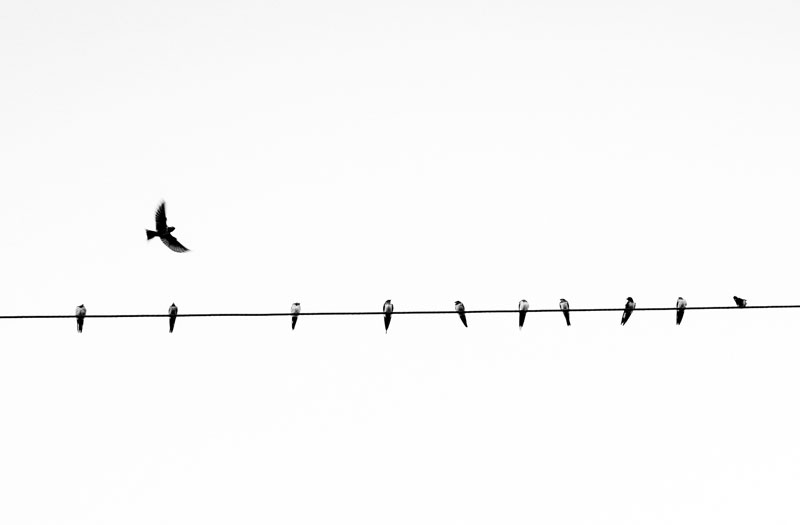
    Birds perched on a wire with one in flightI mean because the thing is because um like well you know how we don’t people don’t like talk like we write we sort of you know oh I’m going off over here and then I’m over here something else and it all kind of runs together whatever and then kind of because what it is is that you talk as you think you don’t really think about it you just well maybe sometimes you do but most of the time it’s just say it you don’t don’t think about it you know and I guess that maybe that kind of makes it a bit hard

    Well, yes, actually. It does make it a bit hard.

    If you’ve ever tried to turn spoken utterances into written text, then you will know it is not as simple as it sounds. The transformation involves a number of steps, usually beginning with transcription. Already this can present difficulties, as there are different ways to transcribe audio files. Even in their raw form, some transcripts require an exacting accuracy, while others can afford more flexibility.

    The presentation of the transcription can vary as well, depending on who does it and for what purpose. Linguistic transcription, for instance, is sprinkled with cryptic symbols that signify all those meaningful parts of speech that are not words. These include, entertainingly enough, the use of the “@” symbol to indicate laughter, while the “#” symbol is applied to utterances that are deemed unintelligible or uncertain. (And suddenly hashtags make way more sense to me.)

    Where things get interesting from an editor’s perspective is after the words are turned from speech into script. This is often when they need to be emended – whether slightly or significantly – to ensure they appear in an orderly form for their audience.

    As the sample text above endeavours to explain, we do not speak in neatly punctuated sentences. We hedge and garble, we pivot and maunder. We cram our conversation with all manner of fillers, with the result that much of what we say isn’t really what we mean.

    The editor’s task is to tidy up the clutter of our spoken discourse and make our utterances more coherent. Or is it?

    Quiz a scribble of editors about this and you’ll get a range of responses, shared with varying degrees of vehemence. Some will insist that no changes can be made to the text. None. Every “er”, “um”, “like” and “you know” must be retained in their original form to avoid any risk of misrepresentation. Others might argue that the inclusion of such phrases is disrespectful to the speaker, who would surely prefer to seem lucid and intelligent in print. You’ll also find editors who will cheerfully change the odd spoken word or two in order to bend a sentence into a correct grammatical form. Their colleagues may do so too, but more warily.

    Depending on the context, any and all of these approaches could be appropriate. In determining what to do, editors must take into consideration the preferences of their clients, the needs of the readership and the nature of the publication, as well as their own inclination. In some cases, a verbatim presentation of the speech as spoken is the only ethical option. Yet even here, complexity arises, as the words must still be shaped into written discourse. At the very least, this involves the application of some punctuation, and even the most benign of these marks can change the interpretation of a phrase.

    One illustration of this involves the words “you know”. These are often heard in speech, but can prove problematic to punctuate. Note the difference in the following:

    It can be an interesting process, you know? It’s not always as obvious as it seems.
    It can be an interesting process. You know, it’s not always as obvious as it seems.
    It can be an interesting process. You know it’s not always as obvious as it seems.

    The absence or addition of the question mark, comma and full stop alters the nuance of this utterance. In the first version, the words “you know” are used to seek confirmation of understanding or agreement. In the second, they seem to express a reflective insight, while in the third they serve as an instructive or even didactic mechanism. While the overall meaning of the remark may be similar in all three, the mood decidedly is not.

    Without hearing the intonation of the speaker, it would be difficult to determine which is the most exact rendition. The answer may be apparent in the transcription itself, but transcribers do not always add all relevant textual details. Editors therefore need to be prudent when placing punctuation in the written version of a spoken source. If necessary, they should check for accuracy with the client, transcriber or speaker.

    Ellipses can be interesting in this regard too. Otherwise known as those three little dots (“…”), they are used to indicate omissions, such as when words are left out of a direct quotation. You may also have seen them beetling off the end of a sentence, as if to show uncertainty or an unfinished thought or an idea that just kind of trails away… A bit like that, really. They can be troublesome when present in the written account of a spoken text because they could be interpreted as serving either of their functions. Again, it’s best that editors confirm their usage is correct.

    One other piece of punctuation to mention is square brackets. These are used in cases of of editorial insertion and contain something that did not appear in the original. Instances of this may include introducing a person’s full name in place of a personal pronoun or adding a word for the purposes of precision or grammatical clarity.

    This brings us to the question of how to edit the rather garbled passage at the start of this piece. If I were editing the text as a quotation in an article and had consent to make changes, I may do something like this:
    People don’t talk like we write. We sort of go off over here and then over here to something else, and it all kind of runs together. You talk as you think, and you don’t really think about it. Well, maybe sometimes you do, but most of the time you just say it, and I guess that kind of makes it a bit hard.

    If I needed to maintain a closer adherence to the original utterance, it might look like this:
    I mean, the thing is, well, you know how we don’t, people don’t, like, talk like we write. We sort of, you know, ‘Oh, I’m going off over here and then I’m over here [to] something else’, and it all kind of runs together, whatever. And what it is is that you talk as you think. You don’t really think about it, you just – well maybe sometimes you do – but most of the time, [you] just say it. You don’t think about it, you know? And I guess that maybe that kind of makes it a bit hard.

    It is worthwhile reflecting on the difference that would be made in the above example if a question mark rather than a full stop ended the first sentence. As it is, the phrase “you know how we don’t” appears as more of a definitive statement than a query. Similarly, a semicolon could be used instead of the full stop after “talk as you think”, and a full stop could replace the comma after “don’t really think about it”. Would that change the meaning or emphasis at all?

    One other oddity to note is the repeated “is” in the third sentence. This known as a double copula, a reduplicative copula, a ‘double is’ (sometimes ‘double-is’) or, neatly, as an ‘isis’. Debate surrounds whether or not these can be judged as acceptable grammatical constructions, while a whole separate squabble circles around how to punctuate them. If I encountered one of these in writing, I would most likely try to revise it. They are yet another illustration of the issues that can emerge when editing the written form of spoken words.

    This discussion has raised a number of these conundrums, but there are of course many more for editors to ponder and resolve. We have also dipped into some (hopefully edifying) digressions here, all of which bear some relevance to the matter at hand.

    The reality is that when it comes to editing texts that derive from speech, there’s quite a bit to consider. You know?

    Now it’s your turn…

    What challenges have you faced when turning speech into text? Have you ever had your spoken words edited by someone else? What was that experience like? And just between us, you did find those little diversions about linguistic transcription, ellipses and reduplicative copula interesting, didn’t you?

  • The pleasures of editing poetry

    Brilliant yellow tulips in sunshineOne of the wonderful things about my job is the opportunity I have to work with authors in a variety of genres. From novels to memoirs to academic texts, each style of writing presents a different challenge, and although I wouldn’t like to pick a favourite, I do find a definite pleasure in editing poetry.
    There is something in the rhythm and precision of a poem that really appeals to me, both as a reader and an editor. At its best, poetry presents a new or skewed vision of the world we know, inviting us to encounter the familiar in wondrous ways. It does this partly by playing with language – exploring it, inciting it and ultimately enlivening it – and that’s what makes it so intriguing to edit.

    Regardless of the material before me, my aim as an editor is always to ensure the text is clear, consistent and correct. Crucial to my work is an ability to see what needs to be altered and to identify what could be improved. I am confident in my understanding of how language works and will happily make changes to grammar, punctuation and spelling in most styles of writing. I will also rephrase sentences as necessary, although the writer may decide whether to accept these revisions or not.

    When it comes to poetry, however, my approach is different. In a poem, the usual rules of form and even meaning may be set aside. Perhaps more so than other kinds of writing, poetry is idiosyncratic. It can be very personal as well, and it is for these reasons that I edit it with a greater sense of deference.

    In most texts, I make changes. With poetry, I offer observations.

    These observations could relate to the tone or imagery of the poem. They may question the position of a line break or highlight a shift in cadence. I could offer you my perception of the metaphor you are using, or encourage you to be braver and take your poem even further. Such reflections are made as comments on your document, and any changes are usually accompanied by an explanation.

    With all my clients, I am happy to discuss my corrections and suggestions. I hold strongly to the value of shared respect between author and editor. It is a reciprocal process, a dance of response; yet here again, the sensibility differs a little when I work with a poet.

    Editing poetry involves being guided more by instinct. I consider my impressions and then share them with the poet, who can in turn affirm or adjust the poem. It is a distinct way of thinking and of engaging with a text, and it fascinates me.

    Perhaps if I were a poet myself, I could express the sense of it more cogently. For now, I will continue to search for the words to convey that allure, and I’ll welcome the chance to do more of this kind of editing.

    Now it’s your turn…

    Have you ever had your poetry edited? What was the experience like for you? What matters to you when an editor engages with your poems?

  • The time it takes – and why it may be longer than you might think

    Close up image of cardboard clock facesFirst, you have to live.

    Before you can hatch an plot, be struck by inspiration or pursue that yearning to share your ideas with the world, you need to spend some time being alive. You have to discover who you are, how you think, and how language and vision and imagination work. All of that takes time. At some point, you need to decide what form your insight or the story you dreamed up might take, and whether or not you are prepared to create it.

    Then, you need to write.

    Chances are you don’t need me to tell you that can take a while too, but just in case you were dwelling in any doubt or delusion, it’s true. Writing takes time. So do redrafting, refining and revising, not to mention revisiting the original premise, changing direction completely, realising that you’ve been writing a whole other thing entirely, giving it up, thinking it over, coming back to it later, trying it from a different angle, cutting it in half or doubling its size, turning it inside down and upside out, and writing, writing, writing, until at last you can hear it singing.

    And that’s not even counting the procrastinating.

    It takes time.

    Finally, it’s done. But it isn’t, of course, because that’s when (if you’re smart) you get it edited, and yes, that takes time too. It may take you a while to find the right editor for your words, and then you might need to wait until you can work with that person. The editing itself needs time and possibly more of it than you first expect.

    You might think you are ready to go, but your editor could suggest there is structural work to be done. Sometimes more than one round of editing is required. Whole chapters may be missing or unnecessary. Ideas might need more explanation, examples or illustrations.

    It takes time to sort all of that out and it has to happen before any further editing can occur. And you’re the author, don’t forget. That means you need to check through and approve or refuse every suggestion and correction your editor makes. This can take a while and could even lead to more revisions requiring more editing which also needs approval from you.

    It all takes time.

    At last, you have your final draft and you’re ready to publish. Guess what? Time. You’ll be needing more of it. Whether you opt for print publication, create an ebook or have a deadline to meet, your document has to be formatted. Other experts may need to contribute their skills. There’s cover art and typesetting to be arranged, and don’t forget that proofreading is a separate step in the process.

    The message is simple, my friends. Writing, editing and publishing all take time and probably more of it than you think.

    Sure, each of these stages can be rushed, but why do that if you care? And if you don’t care, why do them at all?

    It’s at this point you might expect me to spin you that line about how everything worthwhile takes time. That may be true in a lot of cases, but some of the most amazing and enduring things that have ever happened did so in only a few days or in a minute or in an instant. Clichés are not always correct.

    There are authors out there who are disciplined and prolific. They write quickly and confidently and very productively. You can also find editors who will finish jobs with aplomb in squeakily tight timelines. Even publishing itself is becoming an ever more expedient process, but sometimes, sometimes it’s not quite as quick as you might like.

    And some good things do take time.

    I’ll happily tell you that I’m not the fastest editor out there, but I’m thorough and I care. Maybe more than most people, I know that time cannot be vanquished. It happens at its own pace and being in the flow of it is easier than constantly wrestling with it.

    By the time your work reaches me, you are usually beyond eager to get it out there and into the hands of its readers. I understand that and I want to help. But sometimes it takes time.

    How about we agree to give your words the respect they deserve? Let’s recognise that time is one factor at play, but quality matters more to me than speed and I hope it does to you as well. It may be that your journey as a writer from first word to finished product takes longer than you expect, but that’s ok.

    While that time continues to flow, we can all keep on living, learning and writing some more.

    Now it’s your turn…

    What expectations or experience do you have of the time it takes to write, edit and publish? Which bits go fast for you and which ones slow? What advice would you give to others about cultivating patience when creating a book or other significant document?