Author: artful words

  • How to start a food business with limited financial capital

    How to start a food business with limited financial capital

    Starting a food business can feel like a huge challenge, especially when you do not have a lot of money. Many people dream of opening a restaurant or a small food stand but worry about the high costs. The good news is that you can begin with a small budget. Success depends on careful planning and smart decisions, not on having a large amount of cash from the start. It requires creativity and a solid understanding of what your customers want.

    Your passion for food is the most important ingredient, but it needs a good plan to grow into a successful business. This means you have to be resourceful and focus your spending where it matters most. You can avoid many of the traditional startup costs by starting small, perhaps from your home kitchen or a local market. This approach lets you test your ideas and build a customer base without taking big financial risks. It is about making progress one step at a time.

    Focus on your menu and costs

    A simple menu is your best friend when you have limited funds. Instead of offering dozens of items, concentrate on a few dishes that you make exceptionally well. This focus helps you perfect your recipes and reduces waste. It also makes buying ingredients much easier and cheaper since you can buy in larger quantities from fewer suppliers. A smaller menu allows for faster service and ensures that every dish you serve is high quality, which is key to building a good reputation.

    Managing your costs is critical to your survival and growth. Look for affordable equipment, even if it is secondhand, as long as it is in good condition. Compare prices from different suppliers to get the best deals on ingredients. You can also form relationships with local producers, which can sometimes lead to better prices and fresher products. Track every expense carefully so you always know where your money is going. This financial discipline will help you stay in business and plan for future expansion.

    Build your brand and find customers

    Creating a strong brand does not have to be expensive. Start with a clear name and a simple logo that reflects the food you make. You can use free online tools to design something professional. Social media is a powerful and low-cost way to reach people. Share photos of your food, tell the story behind your business, and engage with your followers. Consistent posts will help you build an online community around your brand and attract new customers.

    Getting your first customers is about being visible in your local area. Consider selling at farmers’ markets, food festivals, or community events. These places let you interact with customers directly and get immediate feedback on your food. Word-of-mouth is your most effective marketing tool, so always provide great food and friendly service. Happy customers will tell their friends and family about you, which helps your business grow naturally without a large marketing budget.


  • Launching your successful business journey

    Launching your successful business journey

    Every successful business begins with a single idea. You might see a problem that needs a solution or a way to make something better. This initial spark is exciting, but turning it into a real business can feel overwhelming. Many people have great ideas but never act on them because the path forward seems unclear or too difficult. The journey from idea to launch is a process of taking small, manageable steps, not one giant leap.

    The key is to start where you are and with what you have. You do not need a perfect plan or a large amount of money to begin. What you need is a clear vision and the willingness to take the first step. This journey is about learning and adapting as you go. It involves testing your assumptions, listening to feedback, and making adjustments along the way. Every step forward, no matter how small, builds momentum and brings you closer to your goal.

    Create a simple roadmap

    Before you start your journey, you need a map. A business plan is that map. It does not have to be a long or complicated document. A simple plan that outlines your goals, your target customers, and how your business will make money is enough to get started. This process forces you to think through the important details and identify potential challenges before they arise. It gives you a clear direction and helps you stay focused.

    Understanding your customers is the most important part of your plan. Who are they, and what do they need? Answering this question will shape everything from your product design to your marketing message. Research your market to see what competitors are doing and find a unique space for your business. This knowledge helps you create something that people actually want to buy. A clear understanding of your customers and market turns your idea into a viable business concept.

    Take the first small steps

    The best way to see if your idea works is to test it. You can start small without building a full product or opening a big store. Create a basic version of your product, often called a minimum viable product, or MVP. This allows you to get your idea into the hands of real customers quickly. Their feedback is incredibly valuable. It tells you what is working, what is not, and what you need to change.

    Launching your business is not the end of the journey; it is the beginning. Use the feedback you receive to improve your product and your processes. This cycle of launching, learning, and improving is how you build a strong and resilient business. Do not be afraid to make mistakes, because they are often the best learning opportunities. Stay flexible and be ready to adapt as your business and the market evolve. This approach reduces risk and increases your chances of long term success and sustainable growth.

  • The blueprint for artisan entrepreneurs

    The blueprint for artisan entrepreneurs

    As an artisan, you have a unique talent for creating beautiful, high quality products with your hands. Your passion and skill are poured into every item you make. But turning that craft into a successful business requires a different set of skills. The journey from maker to entrepreneur can feel like a big leap, as it involves moving from the workshop to the marketplace. It is about learning to think like a business owner without losing the creative spirit that makes your work special.

    Building a business around your craft is entirely possible with the right plan. It does not mean you have to become a corporate expert overnight. Instead, it is about adding new tools to your skill set, from understanding your customers to pricing your work fairly. This blueprint is designed to help you navigate that transition smoothly. It provides a clear path to follow so you can grow your passion into a profitable and sustainable business.

    Build your business foundation

    Every strong business starts with a solid foundation. For an artisan, this means defining your brand. Your brand is the story you tell about your work. It includes your unique style, the values you stand for, and what makes your products different from others. A clear brand identity helps customers connect with you and understand the value of what you create. It guides your decisions on everything from packaging to marketing.

    Next, you need to identify your ideal customer. Who are the people that will love and appreciate your work the most? Understanding your target audience helps you focus your efforts and resources effectively. Instead of trying to appeal to everyone, you can tailor your products and your message to a specific group. This focused approach makes it easier to build a loyal customer base that will support your business as it grows.

    Price your work and reach customers

    Pricing your handmade products can be one of the biggest challenges. It is important to value your time, skill, and the cost of your materials. Many artisans underprice their work, but this can make it difficult to run a profitable business. A good pricing strategy ensures that you cover your costs and earn a fair wage for your expertise. It reflects the true value of your craft and allows you to invest back into your business.

    Once you have your pricing, you need to find the best way to sell your products. This could be through an online store, at local craft markets, or by partnering with retail shops. The right sales channels will connect you with your ideal customers. Building an online presence through social media can also be a powerful way to share your story and showcase your work. Consistent marketing helps you reach a wider audience and build a strong, recognizable brand over time.

  • How our reading culture drives results

    How our reading culture drives results

    At Vendome, we see books as essential tools for our work. Our bookshelves are not just for decoration; they are an active part of our company’s culture. We encourage everyone on our team to read regularly, from business strategy books to novels. This habit of reading helps us stay curious and sharp. It is a simple practice that brings powerful results, shaping how we think, collaborate, and solve problems for our clients every day.

    A commitment to learning is one of our core values, and our reading culture is how we bring that value to life. It is not about assigning books or tracking pages. Instead, we foster an environment where sharing ideas from what we read happens naturally. This continuous learning keeps our minds active and open to new possibilities. It ensures that the advice we give is not just based on our past experiences but also informed by the latest thinking and diverse perspectives from around the world.

    New ideas for better solutions

    Reading widely gives our team a constant stream of fresh ideas. When we encounter a difficult challenge for a client, the solution is often inspired by a concept we discovered in a book. This could be a new marketing framework, a project management technique, or a different way to think about sales. Books allow us to learn from the successes and failures of others, which helps us provide more effective and innovative strategies for the businesses we support.

    This culture of learning directly benefits our clients. Because we are always exploring new ideas, we do not rely on one size fits all answers. We bring a creative and flexible mindset to every project. Our ability to draw on a wide range of knowledge means we can develop custom solutions that truly fit a client’s unique situation. This approach helps us deliver practical advice that leads to real, measurable growth and lasting success.

    A shared language for our team

    When we read and discuss books together, we build a shared understanding and a common language. This makes our internal collaboration much stronger and more efficient. A concept from a book can become a shorthand for a complex idea, allowing us to communicate more clearly and work together seamlessly. This shared knowledge base helps align our efforts and ensures that everyone on the team is working towards the same goals with a unified approach.

    This collaborative spirit extends to our client relationships. When our team is aligned, we present a united and confident front. We can explain our strategies more clearly because we have a deep, shared foundation for our recommendations. This builds trust and shows our clients that we are not just a group of individuals, but a cohesive team dedicated to their success. Ultimately, our reading culture helps us build stronger partnerships and achieve better results together.

  • Why a motivated team is your greatest asset

    Why a motivated team is your greatest asset

    In any business, you can have a great product and a solid strategy, but your success ultimately depends on the people who execute the work. A motivated team is the engine that drives your company forward. They do more than just complete tasks. They innovate, solve problems, and care about the quality of their work. This level of engagement is what separates a good company from a great one.

    True motivation is not about offering temporary perks or bonuses. It comes from creating a work environment where people feel valued, respected, and connected to a larger purpose. When your team members understand how their contributions make a difference, they become invested in the company’s success. This deep, internal drive leads to higher productivity, lower turnover, and a culture of excellence that benefits everyone.

    Motivation fuels innovation and problem solving

    A motivated team is a creative team. When people are engaged and passionate about their work, they are more likely to think outside the box and suggest new ideas. They do not just wait for instructions, they actively look for opportunities to improve processes and find better ways to serve customers. This proactive mindset is a powerful source of innovation that can give your business a significant competitive edge.

    This same energy helps your team face challenges with confidence. Business is full of unexpected obstacles, and a motivated team is far more resilient. Instead of getting discouraged by setbacks, they come together to find solutions. Their collective drive and positive attitude turn difficult situations into opportunities for growth. This ability to adapt and overcome is essential for long term stability and continued business success.

    How to build and sustain motivation

    Building a motivated team starts with clear and consistent communication. It is vital that every team member understands the company’s vision and the goals you are working towards. When people see the bigger picture and know how their specific role fits into it, their work feels more meaningful. This sense of purpose is a powerful and lasting motivator that inspires commitment.

    Trust is the foundation of a motivated team. Empower your employees by giving them the autonomy to manage their own work and make decisions. When you show that you trust their judgment, it builds their confidence and sense of ownership. Acknowledging their hard work and celebrating their achievements, both big and small, reinforces that their contributions are valued. This culture of recognition and respect is key to keeping your team engaged and performing at their best.

  • What to expect from your first consultation

    What to expect from your first consultation

    Deciding to seek outside help for your business is a significant step forward. Your first consultation is a crucial meeting, but it is natural to feel a bit uncertain about what the process involves. This meeting is not a sales pitch. It is a working session designed to lay the foundation for a successful partnership. The main goal is for us to understand your business on a deeper level and for you to see how we can help you move forward.

    Think of this first conversation as the beginning of a collaboration. It is an opportunity for you to share your vision, your goals, and the specific challenges you are currently facing. We are there to listen and ask questions, not to offer instant solutions. A productive consultation is built on open and honest communication. It is a dedicated time to focus on your business and explore the potential for growth with an experienced guide.

    It all starts with your story

    The first consultation is centered around you and your business. You are the expert in your field, and our primary role is to listen and learn from your experience. We will invite you to share your story: how you started, where you are now, and where you want to go. This is your time to talk about your successes, your frustrations, and the opportunities you see ahead.

    There is no need to prepare a formal presentation. The conversation is most effective when it is open and honest. We want to understand your vision in your own words. The more we learn about your specific situation and your goals, the better we can assess how to help. This initial discussion is the foundation for any potential work we might do together in the future.

    Our role is to listen and clarify

    During this first meeting, our main job is to ask thoughtful questions. We are not there to judge your decisions or provide quick fixes. Instead, we aim to guide the conversation to uncover the root of your challenges and clarify your objectives. Our questions are designed to help you articulate your thoughts and to ensure we have a shared understanding of the situation.

    By the end of the consultation, our goal is for you to feel heard and understood. You should leave the meeting with a clearer perspective on your own business and a sense of the potential path forward. This first step is all about establishing a connection and determining if we are the right fit to help you on your journey. It is a conversation, not a commitment.

  • Courage to overcome the impostor: Advice for writers

    Courage to overcome the impostor: Advice for writers

    Who do you think you are? What makes you think you can call yourself a writer? You know they were just being polite when they claimed they liked your writing. It’s only a matter of time before everyone realises you have no talent. Nobody wants to read what you write. You’ve got nothing original or interesting to say.

    Let me be clear: I am not saying these horrible things to you, and I never would. But I bet you’ve said something like this to yourself at some point. I know I have.

    It would be a rare writer indeed who did not wrestle with some level of self-doubt. For some, however, those uneasy feelings go deeper, leading us to believe that we are genuinely unworthy of our efforts and achievements. If heeded, such feelings can fool us into thinking we are nothing more than fakes, frauds, phonies—not ‘real’ writers at all.

    Impostors, in fact.

    Known by various names, the impostor complex is a treacherous tangle of thoughts that seek to convince you any success you experience is due to luck or chance or circumstance—or maybe it was the weather? Whatever the case, it was not the result of any effort, skill, or ability on your part. And by the way, you know you’re never going fluke a win like that again, right?

    The impostor complex exhorts you to believe that any minute now—indeed, any second—you will be exposed as the incapable, inadequate, talentless charlatan you feel yourself to be. And it keeps viciously insisting, against all evidence, that you’re not ready, you’re not good enough, you don’t deserve it, you shouldn’t, you mustn’t, you can’t.

    Honestly? It’s exhausting just writing about it, let alone having those ideas gnawing remorselessly at you.

    If such erroneous notions are eroding your confidence, here are a few things to keep in mind.

    1. According to Tanya Geisler, an expert in this area, the impostor complex affects high functioning, high achieving people who hold strong values of integrity, mastery, and excellence. That’s you, incidentally, even if you don’t recognise yourself in that description. (You see how this works?)

    2. The impostor complex only shows up when something really matters to you. It diminishes your existing accomplishments and makes shaky every potential new venture. If you feel it in relation to your writing, take it as a sign of how important your words and your role as a writer are to you.

    3. Three effects of the impostor complex are to make you doubt your capacity, to prevent you from acting, and to keep you isolated. Clearly, none of that is fun, and nor is it particularly conducive to writing.

    4. Appearances to the contrary, it’s highly likely that everyone you have ever respected, most of the people you have met, and all those you wish you could be more like feel this way too. Yes. All of them. You are in good company.

    5. While it is unlikely that the impostor complex can ever be completely defeated, there are ways to curtail its effects. I strongly recommend that you start identifying and practising these.

    Some suggestions for overcoming the impostor complex include:

    • recognising it for what it is: a malicious mess of conjecture that is as unhelpful as it is untrue
    • understanding that your doubts are not proof of your inability but rather an indication of your desire to meet your own (almost certainly unfeasibly) high standards of integrity, excellence, and mastery
    • questioning the accuracy of the messages you receive about yourself, your work, and your worth, whether these arise internally or come from external sources
    • giving yourself generous evidence of your abilities, resources, achievements, and brilliance, because you have an abundance of these, even if you don’t always acknowledge them
    • making meaningful and supportive connections, and—here’s the tricky bit—actually believing these people when they encourage and praise you
    • developing the capacity to encourage and praise yourself; after all, if your mind can persuade you to think you’re an impostor, it can also point out that you’re not.

    There are lots of other strategies you might try, but my advice to help you face the impostor complex is to just keep writing.

    Keep making, keep doing, keep creating, despite what those vicious whispers tell you. Use your voice and cultivate the courage to trust that your work matters—that YOU matter—because it’s true.

    Truer than any impostor could be.

    Note: Much of the information for this article came from the work of Tanya Geisler. If you’d like to know more, please visit her online. And for those pondering the correct spelling of impostor/imposter, have a read of this.

  • Why I provide sample edits

    Why I provide sample edits

    Editors are curious individuals—almost as quirky as authors. While there are certain principles of clear communication and grammatical accuracy to which most editors will adhere, each of us has our own idiosyncrasies and inclinations. When it works, the relationship between a writer and an editor can be enjoyable, enlightening and inspiring for both people. But how can you tell if it’s going to be like this?

    One way I try to address this question is by providing my potential clients with a sample edit.

    Here’s how it works. When you contact me, I get an initial sense of whether or not I am the right editor for you. If I think we may work well together, I will ask you to send me your manuscript, assuring you that I’ll keep it safe and confidential while it is in my care. I then edit part of the text, generally beginning at the beginning. I use track changes in Microsoft Word when editing. This allows you to see the changes I make, and it enables me to include comments, questions, observations and suggestions within the document.

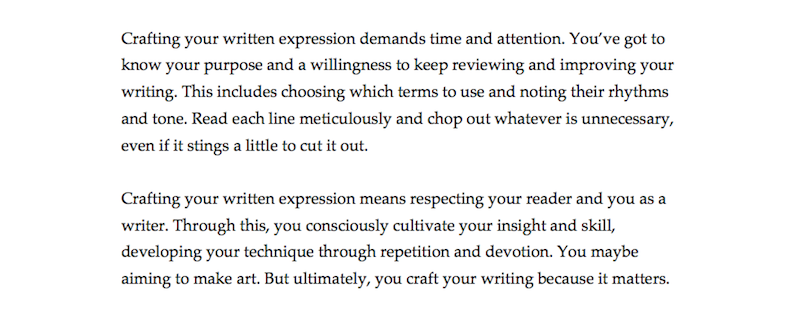
    The image below shows an example of an original draft, adapted from an article previously published on this website.
    The image shows two paragraphs of text. The text reads: "Crafting your written expression demands time and attention. You’ve got to know your purpose and a willingness to keep reviewing and improving your writing. This includes choosing which terms to use and noting their rhythms and tone. Read each line meticulously and chop out whatever is unnecessary, even if it stings a little to cut it out. Crafting your written expression means respecting your reader and you as a writer. Through this, you consciously cultivate your insight and skill, developing your technique through repetition and devotion. You maybe aiming to make art. But ultimately, you craft your writing because it matters."

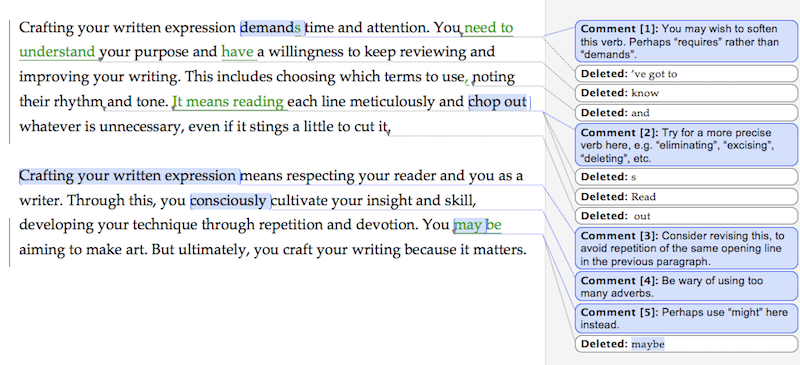
    And this is what the text looks like when it is marked up using track changes.

    The image shows the same two paragraphs as before, but this time with tracked changes. Some words appear in green with underlining, to show that they have been altered from the original. Deleted words appear in white boxes on the right-hand side of the page. Comments are also shown on the right-hand side of the page, in blue boxes. An example of a comment is: "You may wish to soften this verb. Perhaps 'requires' rather than 'demands'".

    As you can see, I have made a few corrections (shown in the text in green), along with some suggestions (in the blue comment boxes on the right-hand side).

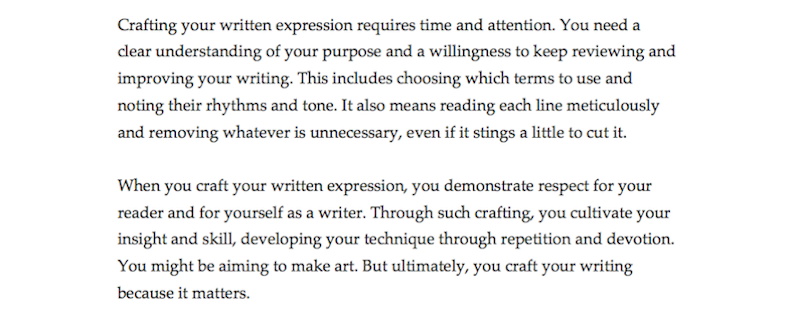
    Taking these corrections and suggestions into consideration, here’s how the revised version might read.

    The revised paragraphs now read: "Crafting your written expression requires time and attention. You need a clear understanding of your purpose and a willingness to keep reviewing and improving your writing. This includes choosing which terms to use and noting their rhythms and tone. It also means reading each line meticulously and removing whatever is unnecessary, even if it stings a little to cut it. When you craft your written expression, you demonstrate respect for your reader and for yourself as a writer. Through such crafting, you cultivate your insight and skill, developing your technique through repetition and devotion. You might be aiming to make art. But ultimately, you craft your writing because it matters."

    Of course, if you had written these paragraphs and had received this sample edit from me, you might have made different decisions about their final form. That’s the delightful thing about writing and editing: they are both expressions of unique creativity and are both so open to interpretation and invention.

    By providing you with a sample edit, I give you the opportunity to see if your creativity and mine align. When they do, we each have the chance to engage in an artful and enjoyable experience of editing.

    Photo by Joanna Kosinska on Unsplash

  • When editing gets distressing

    When editing gets distressing

    Try as we might to avoid it, editing can sometimes be distressing. After putting their hearts into their craft, writers can feel slighted and even assaulted by the comments, questions, corrections, and suggestions that editors strew through their manuscripts. Although it is never an editor’s intention to cause anguish, the distress that writers might feel at having their words so closely scrutinised is real.

    If you ever find yourself in this situation, here are some points to keep in mind.

    1. Time

    Artful writing requires time, but skilful editing does too. While some people relish a last-minute rush, many of us respond less well to such pressure. Distress can arise when you do not allow yourself enough time to consider and implement your editor’s suggestions. This is especially so if significant or structural changes are proposed.

    You may, on the first reading, disagree—even vehemently—with what your editor has done and said. But if you let the ideas settle a little and return to them at a different time, in a different frame of mind, you might find they have some merit. Notice your reactions, but do not act on them immediately. Nor is it advisable to fire off an instant and upset message to your editor, whose focus is on achieving the best outcome for your manuscript.

    Wait a bit. Take a breath. Have a think.

    If you still feel overwhelmed or aggrieved after some time has passed, compose yourself and get in touch with your editor. A calm response is likely to produce a better result for you and your writing.

    2. Communication

    From the first contact between writer and editor, clear and honest communication is vital on both sides. In addition to describing your project and your passion for it, you need to tell your editor your concerns and aspirations regarding your manuscript. At the same time, your editor should articulate her approach and explain the suggestions and corrections she makes. This exchange must continue throughout the process to enable the writer and editor to understand one another. Each will then have a sense of how revisions are evolving and where adjustments need to be made. Sometimes changes to the text are necessary for reasons of clarity or grammar, but without explanation from the editor, such corrections can appear capricious.

    If you feel your editor has misunderstood an aspect of your story or has indicated alterations that you feel compromise your writing, it is important to discuss this. After allowing yourself some time and inhaling those few deep breaths, share your concerns with your editor. None of us gets into this with intention of causing harm to anyone, and confusion or conflict can often be resolved through conversation.

    3. Respect

    As vital as time and communication are when dealing with distress that may arise from editing, the key to it all is respect. You need to respect your editor as someone who loves good writing and has specialised knowledge of language and how it works. This is not to say that editors always have the right answers, never make mistakes, and do not let personal preferences influence their work. We’re human too. But if you have asked an editor to help you with your writing, trust in her expertise and show respect for her ideas before you react against them.

    At the same time, give yourself respect as a writer. You know your story, your style, your topic, and your purpose better than anyone else. Although you may not be able to spot the flaws in your own words, you know their truth, and it is this that enables you to see which of your editor’s suggestions will enhance your writing and which may hinder it.

    Be willing to listen and remain open to possibilities that you might not have imagined. The gift of working with an editor is that you engage in a relationship with an expert who is both professional and partisan, objective and interested.

    In the end, we’re always on your side.

    Writing is a joyful, difficult, beautiful, challenging, invigorating endeavour, and so is editing. The process of having your writing edited can sometimes be confronting, but if writers and editors alike embrace the grace of time, communication, and respect, it need not be the cause of any distress.

  • May or might: A helpful guide

    May or might: A helpful guide

    If you have ever wondered about when it’s right to say “may” and when to use “might”, you may find this article interesting. Then again, you might not. Either way, let’s investigate.

    Both “may” and “might” are modal auxiliary verbs. This means they accompany other verbs and indicate inclination, intention, potential, necessity, actuality, ability, and so on. For example:

    I might have already confused you suggests the potential that I have caused confusion.
    You may disagree with this implies that this outcome is not absolute or certain.

    In these examples, the words “might” and “may” could be switched without causing a significant shift in meaning:

    I may have confused you.
    You might disagree.

    Indeed, when referring to possibility or permission, these two verbs are often used interchangeably, but there is a subtle difference between them. In most cases, “may” infers a higher likelihood of something, whereas “might” implies that it is less probable.

    There are, however, other instances when either “may” or “might” is more correct, so here is a hopefully helpful though by no means definitive guide to choosing between them.

    Use “may”

    • when granting or refusing permission (You may speak, but you may not leave)
    • when expressing a hope or wish (May you be well)
    • to concede a point (Be that as it may, I couldn’t possibly agree)
    • to acknowledge something before putting forward an opposing opinion (You may find this boring, but it is useful to know).

    Use “might”

    • as the past tense form of may (Perhaps I might have explained that better)
    • when referring to hypothetical situations (If I wrote a musical about apostrophes, it might delight audiences)
    • when talking about things that did not happen, to avoid confusion with “may have” when it means to give permission (compare I might not have thought that musical idea through properly with I may not do that, noting that the former expresses the possibility of my not doing something, while the latter implies that I am not allowed to do it)
    • to indicate irritation over something someone could have or should have done (You might have warned me).

    Use either

    • when referring to possibility or expressing uncertainty about events in the present or future (keeping in mind that “may” generally suggests something is more likely, and “might” implies it is less so)
    • when politely making a request or seeking permission (noting that “might” is more formal, as in Might I trouble you for a cup of tea?)
    • to indicate an intention (I explain this so you may understand it better or so you might understand it better).

    It is important to note that while “might” is the past tense of “may”, many grammarians argue that either word is acceptable when referring to past actions and events, but only if the truth about those actions and event is unknown. I could therefore say:

    I may have inspired you to learn more about language after reading this article, or
    I might have inspired you to learn more about language after reading this article.

    Much as I hope that I have inspired you, I do not know if this is true, so both sentences may be considered correct. When talking about events that definitely did not happen, however, “might” is the better choice:

    I might have been a famous writer of musicals, but I became an editor instead.

    Now that I’ve (maybe) explained the nuances of “may” and “might”, I’m off to find a word that rhymes with “apostrophe”.

    You never know. I might find one.

  • The role of rhythm in lively and enticing writing

    The role of rhythm in lively and enticing writing

    There are moments in life that echo with unexpected resonance. They arise like reminders of a truth held deep in your being that you may not recognise or express until it is brought to light by an external catalyst. Such moments occur for me when I’m wandering through an art gallery and find myself drawn to certain works that rouse a powerful response. They happen, too, when I’m reading and I encounter an image or phrase that renders the world more lucid or beautiful. Then there are the times when a comment from an admired author illuminates an intrinsic understanding.

    A recent instance of this arose from an observation by Philip Pullman on the significance of rhythm in his process. In an interview with the BBC, he said:

    “When I’m writing, I’m more conscious of the sound, actually, than the meaning. I know what the rhythm of the sentence is going to be before I know what the words are going to be in it. That’s a very important factor in the way I write … I have to have silence, so I can hear the rhythm.”

    This reflection resonated with me because it describes, to some extent, the way that I write, but it also alludes to how—and sometimes what and why—I edit. Much of my work involves sensing and finessing the rhythm in sentences, paragraphs and whole manuscripts.

    Punctuation has a role in this, of course. There are the varying pauses offered by commas, semicolons, dashes and full stops. There’s the space that is made by a paragraph or line break, as well as the emphasis implied by an exclamation mark, the rising note of a question mark, the trailing off of an ellipsis… The length of sentences and placement of phrases in relation to their neighbours also alter the tone.

    But mostly it’s the words themselves, how they interplay and the way they sound.

    Beyond the simple yet undeniable effects of syllables and stress, many rhetorical devices may contribute to the melody of a text. Assonance, consonance and alliteration can all be employed; variety, repetition and rhyme too. There is an abundance of techniques that will give rhythm to your writing, but the best approach is to nourish an individual instinct for it.

    Tuning in to the rhythm in writing begins with listening to how it sounds. Always read your words aloud, and pursue opportunities to hear good writing by others, either at live events or in the form of audiobooks, podcasts and so on. You might also seek out speeches—as both recordings and transcripts—delivered by eloquent orators, or consider the way that music might inform the balance, pacing and inflection of your sentences.

    Better yet, listen to poetry.

    There is perhaps no better way to cultivate an appreciation of rhythm in writing than to immerse yourself in poems. Let the musicality of the words, their pitch and lilt, their harmony and sonority, and even their dissonance reverberate through you.

    Philip Pullman lauds the potency of poetry, noting that it, initially more than stories, was “the great key” for him. Speaking with Michael Williams from the Wheeler Centre, he commented that:

    “I loved poetry; I loved the sound it made. I didn’t understand it always, but I didn’t need to understand it because I’d got the idea that if I just spoke it, if I read it aloud, it would communicate something to me, and it did, and it still does.”

    We may not all have the ability to write like the author of His Dark Materials, but whether you craft your sentences by placing cadence before content or you tinker with the tempo later when editing, having an awareness of rhythm is, in my view, vital for devising lively and enticing writing.

    It invites readers in, guides and beguiles them, and it may even help kindle those glorious moments of resonance.

  • Commas around names: Necessary or not?

    Commas around names: Necessary or not?

    Despite their demure demeanour, commas can be perplexing. They pop up where they’re not needed, and their absence can cause confusion and misreading. One source of uncertainty about commas is their use around names. Sometimes they are required and sometimes not, but once you understand the principles at play, you will find it easier to determine when to include them.

    Commas are used around names in two main ways. The first is a comma of address, and it appears when a name or a noun or phrase that stands in for a name is used in a sentence. Here are a few examples.

    It’s a pleasure to see you, Emily.
    Dear lady, can you help me?
    It is clear, Irene, that our adventures are just beginning.

    As the first two examples show, only one comma is needed when the name or phrase appears at the start or end of the sentence. If it occurs elsewhere, however, it is separated from the rest of the sentence by a pair of commas.

    While the comma of address might seem like a petty point of punctuation, it can be necessary to establish clarity. Compare the following two statements.

    I don’t know, Dorothy.
    I don’t know Dorothy.

    In the first instance, the comma before ‘Dorothy’ shows that she is the person being addressed. I am telling Dorothy that I don’t know something. In the second case, where no comma appears, Dorothy is the object of the sentence. She is the thing I don’t know. The presence or absence of the comma of address alters the meaning of the sentence. That is why it is vital to understand when and how to use it. Fortunately, it is easy to learn this.

    If someone or something is being addressed in a sentence, then a comma or pair of commas is necessary. But if someone or something is the object of the sentence—the thing to which an action is done—then no commas are required.

    The second way that commas can appear around names is in an appositive sense. Grammatically, an appositive is a noun or phrase that gives additional information about another noun or phrase in the same sentence and serves the same function as it. The information can be essential or extra, and this is what determines whether or not commas are needed.

    If the information is essential, no commas are necessary. If it is extra, it needs commas.

    Think of it like this: essential information must be part of the sentence in order for the meaning to be conveyed. Extra information can be removed from the sentence, and the meaning would remain the same. The bit that is extra, but not essential, gets framed by commas.

    Let’s see how this rule relates to names.

    Author Bella Li won the prize for poetry with her book Argosy.
    A published poet, Bella Li, will be in attendance.
    My sister Leanne loves lemurs.
    My brother, Bertie, bites bananas.

    The name ‘Bella Li’ is essential information in the first example. Without it, the sentence reads as ‘Author won the prize for poetry’. Not very meaningful. In the second sentence, the subject is ‘A published poet’, and the name of the poet is an extra detail. As such, it is enclosed by commas. If the name were removed, the sentence would still make sense: ‘A published poet will be in attendance.’

    In the final two examples, the use of commas may seem inconsistent. Why should Bertie get them around his name when Leanne does not for hers? The answer, as before, is that ‘Leanne’ is essential information and ‘Bertie’ is extra.

    The absence of commas from the phrase ‘my sister Leanne’ means that I have more than one sister, so it is essential that I use her name in the sentence to identify which of my sisters loves lemurs. In contrast, the commas around ‘Bertie’ indicate that the information being given is the same as in the noun phrase ‘My brother’ that is appositive to it. By saying ‘My brother’ and ‘Bertie’, I am repeating the same thing, and I am also signalling that I have only one brother.

    Just in case this is all sounding too straightforward, let me point out that distinguishing the essential from the extra is not always simple. Returning to the first of our examples above, we may ponder whether a comma is required before the title ‘Argosy’. On the one hand, the sentence ‘Author Bella Li won the prize for poetry with her book’ is arguably meaningful. The title could be considered as extra information, thus requiring a comma to be added before it. But don’t we need to know which book won? Wouldn’t that make the title essential information?

    Furthermore, using the same logic as we applied in the last two examples, the omission of the comma suggests that Argosy is not Bella Li’s only book. (It’s not, as it happens.) If it were, the terms ‘book’ and ‘Argosy’ would mean the same thing, and a comma would be required to separate them.

    So is the comma before the title necessary or not?

    I leave that for you to decide, my friends, with a gentle reminder that although punctuation is often prescriptive and sometimes perplexing, it is also more subjective than you might think.