Author: artful words

  • Developmental editing: What it is and why I love it

    New leaves of a hakea tree shown against a clear blue skyIf you have spent any time at all exploring this website (and I do invite you to do so), you will be among the clever few who already know there are different levels of editing. While I happily offer my services in structural or substantive editing as well as copyediting, I have a definite delight in doing developmental editing too.

    This kind of editing happens at an earlier stage in the writing process. It occurs closer to the spark that ignites the original idea, which means the words I’m working with when I edit developmentally are often in a more raw or tender form.

    Writers who approach me for assistance with developmental editing are excited by their projects and committed to their creation. Often, however, they have not yet found the precise shape or content for their concept. While they care deeply about their topic and the message they want to share, many find themselves getting tangled up in the complex possibilities of expression and composition.

    This is where developmental editing can help.

    As with other kinds of editing, the focus of this approach is on ensuring a writer’s voice and vision are made clear. Where developmental editing differs from structural editing or copyediting is that the editor is more intimately involved in the actual formation of the text.

    This can include things like helping you clarify your main point or purpose and devising a structure for its elaboration. Developmental editors may also propose new directions for you explore, based on either an early version of your manuscript or discussions about your topic. We can assist you with expanding your vision too, but it is just as likely that we will advise you on areas to reduce or exclude.

    Most importantly, a developmental editor will work with you to establish a plan for your writing and support you on your journey.

    Undertaking an effective developmental edit can be a daunting venture for editor and writer alike, yet it is an exciting one too. It is not always an easy procedure, nor is it a speedy one, but it can be incredibly valuable.

    The reasons why I enjoy developmental editing are many. There is the thrill of engaging with emerging ideas and the privilege of working so closely with writers. There’s the elation of sensing the rhythm that is hidden within the content, and the pleasure of guiding the writing into a cogent flow. Personally, I also relish the sincere satisfaction of turning a bundle of genuine but jumbled jottings into a comprehensible document with a compelling proposition.

    Creative and intuitive, challenging and rewarding, developmental editing is the means by which an idea becomes a manuscript. It is the process that allows me to help writers like you shape your unruly ideas and language into lucid, expressive and poetic texts.

    If you are curious about this kind of editing or want to discuss your project with me, please get in touch. It would be my pleasure to help you.

    Now it’s your turn…

    Have you had any experience with developmental editing? What was it like? How did it help you?
  • Exhausting or exhaustive?

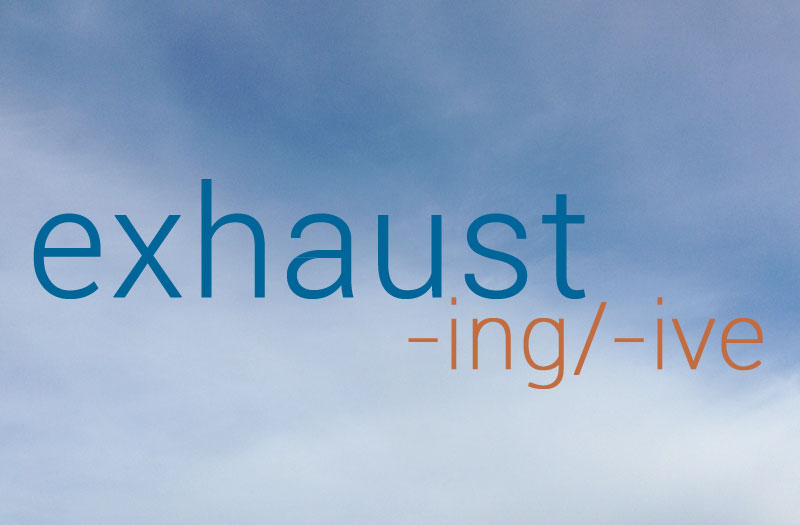
    Image of the word "exhaust" with alternate endings of "-ing" or "-ive"It is an easy mistake to make, especially when you’re tired. Nevertheless, there is a difference in meaning between the words “exhausting” and “exhaustive”, and astute writers know which one to choose.

    The word “exhausting” may be used either as a verb (as in exhausting all possibilities) or as an adjective (an exhausting day). In either case, its meaning is to use or consume, to drain of strength or resources, or to draw out all that is essential or interesting. Often, it denotes tiredness or fatigue.

    While it is true that the word “exhaustive” may also refer to the draining of strength, energy or resources, its more typical meaning is thorough, complete or comprehensive. An exhaustive examination of something, for instance, would be extensive and meticulous, leaving nothing out.

    Thus, “exhausting” typically means tiring, while “exhaustive” usually means entire.

    There are occasions when both words can be applicable. An exhausting search, for instance, may well be an exhaustive one. Likewise, an exhaustive line of questioning could also be exhausting – for interrogator and interrogated alike.

    Clever writers might like to play around with these simultaneous meanings. For the sake of simplicity, however, I suggest that it is best to select the one word of these two that most accurately reflects your intended meaning. Is it more important, for instance, to imply a certain tiredness or to evoke a level of diligence?

    As always, it is wise to keep your reader in mind. Rather than impressing your audience with your stylistic decision to use one of these words in place of the other, you could risk causing confusion. Worse still, you might end up looking like you don’t know the difference between them. If conveying both meanings matters to you, try finding a way to do it more precisely.

    This brief explanation of these similar but distinct terms is itself not exhaustive. Yet hopefully it is not exhausting either. It is merely intended to assist you in choosing the best word for your purpose and to help you become a more artful writer.

    Now it’s your turn…

    Is the difference between “exhausting” and “exhaustive” clear to you? Which other words that seem or sound alike do you often get confused?

  • Finding the right editor for you

    Sharpened pencils in a row - so many colours to choose fromIt has taken a bit of time and a lot of effort. You’ve poured your devotion, attention and even your heart into writing your book, your thesis, your website, your poetry. Now at last it is finished.
    Almost.

    After all that dedication and occasional frustration, you know how important it is that your message is clear. That’s why you understand the next step is to employ the expertise of an editor who will check, correct and improve your written expression.

    But how do you find the right editor for you?

    If you are reading these words, you have already discovered this website. (Hello, by the way, and welcome. I’m so glad you’re here.) Perhaps you were referred to me by a friend or you found my details on the Editors Victoria freelance register. These are both great ways to locate an editor.

    Other options are to ask writers you know or admire for their recommendations or check the acknowledgements in books similar to the one you have written yourself. Authors often mention their editors here. You can also try using a search engine but your results might be a little mixed. Use detailed keywords and you may have better luck.

    Of course, finding an editor’s website or contact details is one thing. Working out whether or not that person will best meet your editing needs is a different and more delicate process. It is also exceptionally important.

    Any editor can improve your writing. But the right editor will make your experience enlightening, enjoyable and ultimately rewarding.

    To help you choose the right editor for you, here are some questions you might ask.

    • Does the editor have experience with your particular type of document or publication?
    • Are any areas of special interest or skill noted?
    • What do other people say about their experience of working with the editor, either through recommendations or testimonials?
    • How promptly does the editor respond to your initial email or phone call?
    • What is the tone of the editor’s communication with you (for example, brisk, informative, reassuring, casual, professional)?
    • Has the editor shown you a sample of work? Are you happy with it?
    • Is the editor able to complete the work you need within your preferred timeframe?
    • Has the nature and process of the editing been explained to you?
    • What level/s of editing does the editor do (for example, copyediting, structural editing, developmental editing)?
    • Does the cost of the work reflect the value you will receive?
    • Will the editor offer flexibility in your payment arrangements if necessary?
    • What sense do you get of the editor from a website or social media presence?
    • What feeling do you get from your interactions with the editor, either in person or online?

    This last question may seem somewhat vague but it is perhaps the most important of all, as each editor will have an approach that is both personal and particular. Where one may be firm and direct, another could be more intuitive and supportive. Neither is wrong, but nor would these different styles both be appropriate for the same writer or project.

    In my own work, I focus on being friendly and professional. I like to be thorough, which means I may not be as quick to finish your job as another editor. I tend to teach too. (Can’t help it.) This means I will often explain the suggestions I make and offer you more information about any issues I see recurring in your writing. Another aspect of my work is providing you with options to choose from. My belief is that you are responsible for your words, which is why you must make your own decisions about what you will do with them.

    This approach works for me but it may not suit you or the specific piece of writing for which you are seeking assistance. That’s fine. You can look for someone more aligned with your requirements using one of the methods mentioned above.

    The crucial point is this: a good engagement between writer and editor requires trust and patience on both sides. It is a subtle and sensitive relationship, so it is important you are happy with your choice.

    Finding the right editor may take you some time. But like your writing itself, it is worth the effort. In both cases, when it happens well, the outcome can be a truly beautiful thing.

    Now it’s your turn…

    What has been your experience of working with an editor? What do you look for in an editor? How do you discover and nourish those qualities?

  • The politician, the preposition and the donation of blood

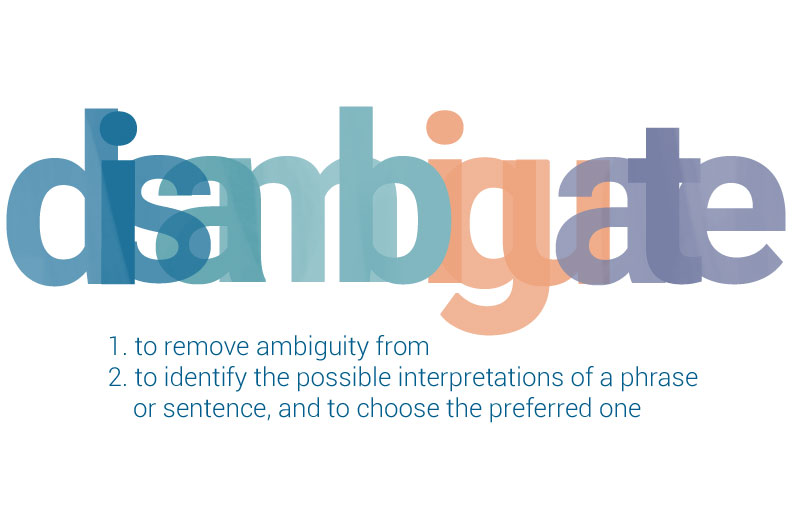
    Disambiguate means to remove ambiguity from, or to identify the possible interpretations of a phrase or sentence, and to choose the preferred one. It's an essential practice for writers and editors alike.
    Here, friends, is the latest in our explorations of interestingly misphrased sentences.

    “Residents are being encouraged to roll up their sleeves and donate blood by a local politician.”

    Admittedly, there is little that is ambiguous about this. The meaning here is clear, and yet I could not help laughing out loud when I read it. Surely I’m not the only one tempted to replace the word “by” with “of”. Am I?

    It is possible the journalist who penned this sentence was having a bit of fun by structuring it this way. Even so, my view remains that it is risky to rattle your reader with any phrase or expression that disrupts the otherwise focused flow of their attention, unless that is your express intention.

    Good writing sometimes does this, of course, by presenting us with a particularly striking image or an exquisitely sinuous sequence of words. This is why we appreciate such writing so much.

    Most of the time, however, our central intention is to communication information. To do this effectively, it’s often best keep things simple.

    There is an easy way to achieve this in our sanguinary sentence above. All that is required is for the prepositional phrase “by a local politician” to be nudged immediately after the word “encouraged”, thus:

    “Residents are being encouraged by a local politician to roll up their sleeves and donate blood.”

    This keeps the agent of the encouragement (“a local politician”) close to the verb (“encouraged”), while the additional details (“roll up their sleeves and donate blood”) are appended at the end.

    It’s true that the meaning of the sentence is evident in either version. However, one approach makes it clear who is being asked to do what by whom, while the other invites (in my mind at least) the image of zealous residents rolling up their sleeves to merrily shed the blood of their local politician.

    Not that I’m saying that’s a bad thing, necessarily…

    Now it’s your turn…

    I’m really not the only one who secretly imagined that sentence read “donate blood of a local politician”, am I? Really?

  • Paint chip poetry

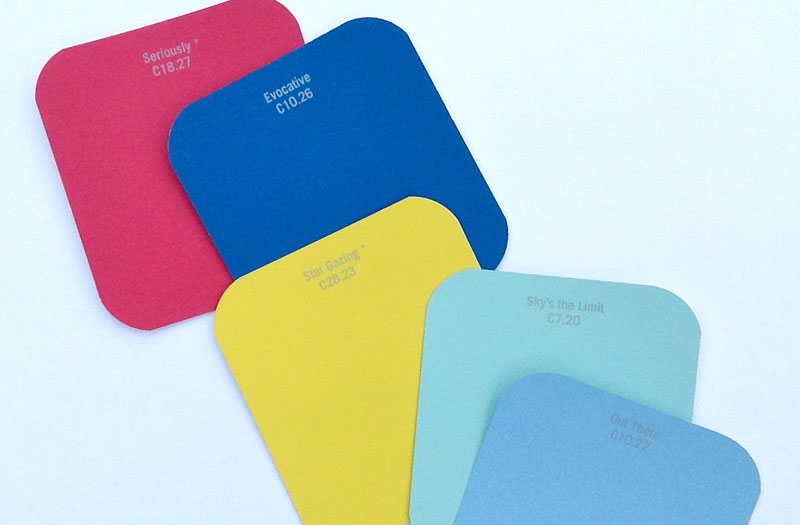
    Paint chips arranged to make the poem "Seriously Evocative Star Gazing / Sky's the Limit / Out There"How did I not discover this until now?
    Paint chip poetry. Utterly wonderful!

    It seems there are a couple of  ways to play this game – and I do invite you to play.

    Start by gathering a spectrum of paint chips or colour cards. Then use them to make poems. You can do this by arranging the chips so the paint names make a sort of poetic sense, as I’ve done in the image above. Or you can write tiny poems on the cards that relate in some way to the colour or name or… well, anything at all, really. Another approach invites you to combine these two techniques by incorporating the name of the poem into the lines you write.

    It’s fun, right? And useful too.

    Making poems in this way can be a prompt for all kinds of writerly creativity. If you’re a novelist, you may find a certain colour evokes one of your characters. Could the poem you write on that chip tell part of that person’s story?

    For non-fiction writers, the (let’s face it, sometimes lurid and even ludicrous) paint names may stir images or associations that encourage different ways of thinking about your topic. Or just different ways of thinking, which might also help with your writing.

    Indeed, for writers of all kinds, a frolic with paint chip poetry can be a spark to awaken the imagination. You might like to make it part of your writing ritual, sort of like a warm up. Alternatively, you may simply enjoy playing with words and colours. Either way, I encourage you to give it a go.

    Now it’s your turn…

    Have you ever played with paint chip poetry? Care to share your fabulous creations? What other fun writing prompts can you recommend?

  • The book you must write and the one you can publish

    A book lying open in the grassSo, Elizabeth Gilbert has a podcast. And that’s fun because she has a lovely voice and valuable insights to share. Take, for instance, this gem from her first episode.

    “There is the book that you must write, and then there is the book that you can publish. And those may be two different books.”

    This exact thought has been on my mind lately. It is an issue that often arises among writers, especially those penning memoirs and life stories.

    Being brave enough to tell your own tale and communicate your truth is one thing. But what about the other people who may be embroiled in your story? What right do you have to write about them? And, perhaps more pointedly, what are people going to think if you open up and express what you really feel?

    The understandable fears of being judged or causing harm to others are enough to convince some writers to stay silent. Yet I believe it is possible to tell difficult stories with integrity and still protect ourselves and others. More than that, I think it is important for us to do so. Not easy, but important.

    It’s where writing a conflicted thing. On the one hand, it can be intensely intimate; an act so personal it allows us to glimpse the deepest, most secret and sacred parts of ourselves. But it can also be about as public as you can get. Words can communicate anything to anyone who has the ability to interpret them.

    This is why we need to be careful, even respectful, of our writing. We need to appreciate its dual nature and utilise it wisely.

    Writing can either reveal or conceal. At its best, it does both at once.

    The way I see it, and the way I talk about this with my clients, is that there is the story of what happened and the story you tell about it. There are the words you choose to use, with consideration and precision, and the images and metaphors you decide to place around them. There are structures, perspectives and approaches you can adopt that enable you to narrate your experiences honestly but without exposing anything too perilous or tender.

    In short, there are ways to say what you need to convey both truthfully and thoughtfully, and this is what makes the difference between the book you must write and the one you can publish. Of course, the trick lies in navigating your way between the two.

    My advice about this is to listen to what Liz Gilbert says and begin by writing the book you need to write. All of it, however rough or raw and sore it may be. Write it for yourself first, with no other reader in mind. Be courageous. Be tenacious. Be unflinching.

    After that, give yourself some time. Put your work away and only look it later. Find a mindful reader and perhaps a sympathetic editor. See your story through new eyes.

    Then take a deep breath, remind yourself you are a writer and get to work on the book you can publish.

    Now it’s your turn…

    What differences do you think exist between the book you must write and the one you can publish? What strategies do you use to move from one to the other?

  • Seeing what is there: How editing and art exhibitions are surprisingly alike

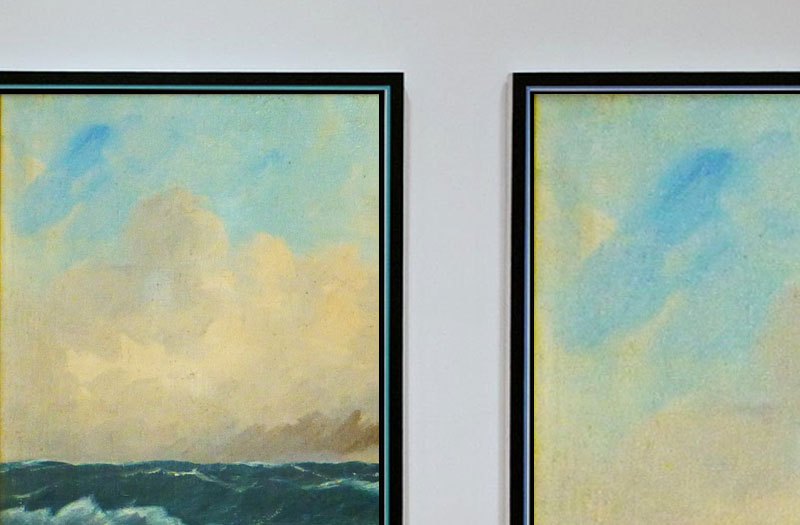
    Two paintings with the same scene of sea and sky in distant and detailed view
    At first glance, there might not seem to be much similarity between the practice of editing and the act of viewing an art exhibition, yet to my mind they are alike. Let me explain how.

    When I visit an exhibition, my first impression is of the space I am in. I become aware of dimensions, distances, shapes and shades. I identify whether the art is painting, photography, sculpture, drawing or some other interesting form and I reflect on the way the works are displayed. Are they grouped in close clusters or are there generous stretches between each? I give myself time to feel what it is like to be in the exhibition until something specific draws my eye.

    I’ll move towards that particular piece, noticing how it looks from across the room and how my sense of it changes as I approach. As before, I will begin by gaining an overall impression, taking in, for instance, the subject and scale. I may glance at the title or any notes appended alongside it, but by now the art has grasped my attention and I’m absorbed in my examination of it.

    Smaller details will present themselves to me, like the harmony of colours or one small but striking sliver of the image. I’ll become conscious of how various elements of the composition echo and reflect each other, sometimes providing balance while at other times inciting tension. It all contributes to the effect of the piece.

    Leaning in further, I’ll be drawn to explore distinct brushstrokes or textures. My gaze is now engaged and I am fascinated by what I can see in such close proximity. After a while, I’ll step back and regard the work again in its entirety. I may shift my position, choosing to view the art from a new angle. I’ll cross the floor and look it from a distance once more, only this time with an increased appreciation of how each tiny touch by the artist has created the eventual expression. By this time, I’m often smiling.

    Surprisingly – or perhaps not – it is the same with editing.

    When I’m gifted a new manuscript to work with, I begin by obtaining the same initial impression of scope and shape. I look into the form and content of the writing, as well as its mood and tone. As I read, I let the voice of the piece reach me and I find myself leaning towards it. The deeper I get into the text, the clearer my sense of its structure becomes. I can see how each section works and discern the purpose in every paragraph.

    I consider individual sentences and words, noting marks of punctuation and even the spaces between symbols. I appraise the role that all of these play and the contribution they each make.

    Throughout this process, as happens in a gallery, my perspective is constantly shifting. It moves from a close focus to take in the bigger picture before gliding back again to centre on a certain detail or to contemplate the overall flow. I am mindful always of the relationships between different elements of the text and how they blend together to generate the desired effect.

    Again, by this stage, often I’m smiling. But I am also attentive, sliding into the writing itself, making deft alterations, settling any ruffles, always ensuring the words are accurate as well as artful.

    It’s a delicate process, and a deliberate one too. In both cases, I find it delightful.

    Whether my view is precise or expansive, and whether I’m absorbed by art or by words, it is all about seeing, appreciating and admiring what is in front of me.

    Now it’s your turn…

    How do you view art exhibitions? Are there any similarities between how you approach art and how you view other activities in your life?

  • Simple comma makes an outstanding contribution

    Disambiguate means to remove ambiguity from, or to identify the possible interpretations of a phrase or sentence, and to choose the preferred one. It's an essential practice for writers and editors alike.Sometimes a simple comma can make all the difference. This is what they do most of the time, of course. It’s sort of their job. When laid in the right place, these modest pieces of punctuation give clarity to your expression. Their absence, meanwhile, can cause ambiguity, as shown in the example below.

    “In between wing defence Gabi Simpson and goal attack Tippett were outstanding contributors in helping the home team build a telling 30-20 lead at the main break.”

    Yes, this is a sentence about sport, and no, it probably doesn’t mean what you think it does.

    As written, the sentence suggests that there were “outstanding contributors” who presumably did amazing things on the netball court between the players Simpson and Tippett. A slight shift in phrasing could help demonstrate this, such as: In between wing defence Gabi Simpson and goal attack Tippett, there were outstanding contributors who helped the home team build a telling 30-20 lead at the main break.

    Or to put it another way: Outstanding contributors between wing defence Gabi Simpson and goal attack Tippett helped the home team build a telling 30-20 lead at the main break.

    The problem is that this is not the intended meaning.

    The sentence that appeared before this one in the original article mentions two other players (goal shooter Romelda Aiken and goal keeper Laura Geitz) whose positions place them at either end of the court. Tippett and Simpson play in positions between Aiken and Geitz and are themselves the “outstanding contributors” who helped the home team build that telling lead.

    The simple addition of a comma at the start of the sentence makes this plain, removing any confusion and thus attributing the contribution correctly.

    In between, wing defence Gabi Simpson and goal attack Tippett were outstanding contributors in helping the home team build a telling 30-20 lead at the main break.

     See the difference?

    What’s happening here is that the words “In between” are a prepositional phrase that introduces and modifies the rest of the sentence. It could easily – and meaningfully – be read without the opening phrase, but its inclusion links the sentence with the one that preceded it and helps provide both context and cohesion.

    When sentences begin this way, with a few words of introduction, it is often sensible and sometimes essential to place a comma before the main clause. This is always necessary when the phrase is a subordinate clause – as with the phrase “When sentences begin with an introduction in this way” which commences the sentence you read just before this one.

    Sometimes, if the introductory phrase is just one or two words long, the comma may be omitted, providing that the meaning remains obvious. Some people also choose to drop the comma when prepositional phrases appear at the start of sentences.

    Such tendencies towards using fewer commas reflect a recent trend towards more minimal punctuation. Yet whether it’s fashionable or not, I cheerfully encourage their inclusion, especially when they help achieve better clarity in a text.

    In this regard, they do make an outstanding contribution, after all.

    Now it’s your turn…

    Are you enamoured with commas? Do you use them sparingly or sprinkle them liberally? What contribution do commas make to your writing?

  • Those monsters who live in the air

    Those monsters who live in the air

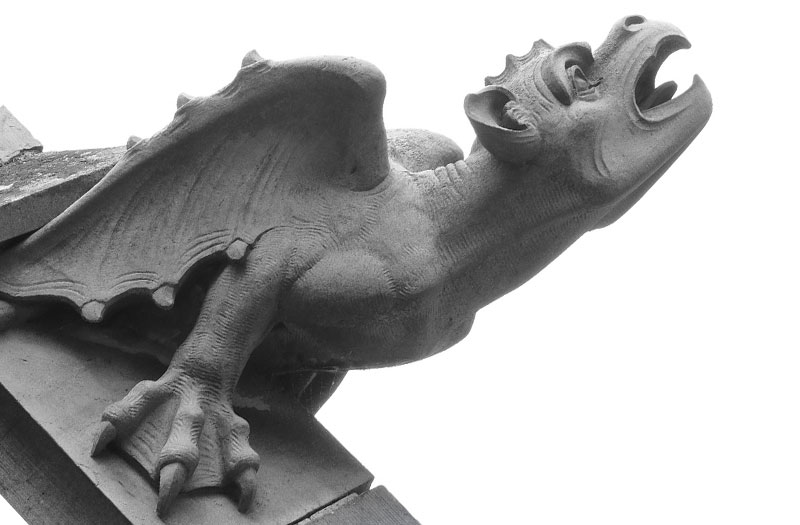
    Winged gargoyle stretching its neck towards the skyYou know that delicious shiver which good writing can deliver? This passage from Hilary Mantel’s Wolf Hall does it for me. It describes the scene of the procession through London for Anne Boleyn’s coronation.

    The route is hung with tapestries and banners, and at his orders the ground beneath the horses’ hooves is graveled to prevent slipping, and the crowds restrained behind rails in case of riots and crush; every law officer London can muster is among the crowd, because he is determined that in time to come, when this is remembered and told to those who were not here, no one is going to say, oh, Queen Anne’s coronation, that was the day I got my pocket picked. Fenchurch Street, Leadenhall, Cheap, Paul’s Churchyard, Fleet, Temple Bar, Westminster Hall. So many fountains flowing with wine that it’s hard to find the one flowing with water. And looking down on them, the other Londoners, those monsters who live in the air, the city’s uncounted population of stone men and women and beasts, fanged rabbits and flying hares, four-legged birds and pinioned snakes, imps with bulging eyes and ducks’ bills, men who are wreathed in leaves or have the heads of goats or rams; creatures with knotted coils and leathery wings, with hairy ears and cloven feet, horned and roaring, feathered and scaled, some laughing, some singing, some pulling back their lips to show their teeth; lions and friars, donkeys and geese, devils with children crammed into their maws, all chewed up except for their helpless paddling feet; limestone or leaden, metalled or marbled, shrieking and sniggering above the populace, hooting and gurning and dry-heaving from buttresses, walls and roofs.

    from Wolf Hall by Hilary Mantel
    (Fourth Estate, London, 2010, pp.463-64)

    There’s so much to enjoy here. Mantel piles detail upon detail, creating a cavalcade of creatures while dishing up some dextrous linguistic tricks to delight her reader. The use of assonance in this excerpt is especially pleasing. This is the rhyming of the accented vowel sound in words, as demonstrated in “horned and roaring”, “lions and friars” and those disturbing “fanged rabbits”.

    Alliteration is at play as well, with “metalled and marbled, shrieking and sniggering”, and who does not revel in the unexpected occurrence of the word “gurning”? There’s not even a listing for this in my New Shorter Oxford English Dictionary, nor in either edition of the Macquarie I own. Online sources assure me, however, that it refers to the pulling of grotesque faces, which is fitting for the image Mantel’s language evokes.

    Indeed, Wolf Hall is rich with many such magnificent images and descriptions. I love it when writing like this causes me to catch my breath, to stop and read again, slowly and appreciatively, certain sentences, scenes or phrases. It’s one of the reasons my job is such fun.

    There is always the chance that I’ll discover something wondrous like this.

    Now it’s your turn…

    What is your impression of this description by Hilary Mantel? What do you find most striking or enticing? What other exceptional texts have you been reading lately?

  • Not feeling confident?
    I’m delighted to hear it!

    Pretty pink paper daisy
    I received an email from one of my wonderful clients recently. It went something like this:

    Feeling worried about this book. I am not going to give up, but it’s so hard to be consistent with the tone and keep it simple and interesting. Not feeling confident tonight…

    My response?

    That’s wonderful! The fact that you’re not feeling confident, while certainly uncomfortable for you, is actually a good thing. It means you care about your words and your work, and you want them to be good. So do I. And between us, that’s exactly what we’re going to make them.

    Sharing our words with others can be intimidating. We can feel raw, awkward and exposed, especially if we believe in the value of our message but know we haven’t quite written it as gracefully as we’d wish.

    Even so, something prompted – or perhaps inspired – us to write. We devoted our time and thought to it, and in most cases, we’re still hoping that someone, someday, will read and respond to it. But no one can do this until it is published, in whatever form that may take. If getting to that point means you need to trudge through discomfort for a while, then so be it.

    Often our lack of confidence derives from the (um, maybe not so realistic) expectations we have of ourselves, or from our concern about the opinions of others. That’s why the other message I gave my client was this:

    I don’t judge you. I just don’t.

    My principal role as your editor is to ensure your writing is as clear, consistent and correct as possible. That’s it. I simply see what you say and then work to make certain you have expressed your intention effectively.

    So if, like my client, you’re feeling concerned about your words, be glad. I’m impressed that you care. Just don’t dwell too long in that doubt. Instead, remember this: You need your book to exist in the world and so do your readers. Handing it over to me is the next step in making that happen.

    So take a breath.

    Hit send.

    Then let me do what I’m good at, ok?

    Now it’s your turn…

    When you do feel most assured about your writing and when do you feel least so? What techniques do you use to give your confidence a firm but friendly nudge when necessary?

  • Choosing a word of the year the Macquarie Dictionary way

    The Concises Macquarie Dictionary, artfully arranged with a pen and a cup of teaWhile devising new words and wrangling existing definitions into curious contortions can be considered all manner of fun, it is only cautiously that such linguistic innovations make their way into official dictionaries. Yet the value of these terms lies in their ability to reflect the practices and preoccupations of the societies that generate them.

    This, at least, is the claim made by the people who bring you the Macquarie Dictionary. Since 2006, they have assembled an annual panel of experts to select the one word from the dictionary’s online update that most potently expresses the tone or focus of the preceding year. Past winners have included ‘infovore’ (2013), ‘burqini’ (2011), ‘googleganger’ (2010), ‘shovel-ready’ (2009) and ‘muffin top’ (2006). Of course.

    Shortlisted words are sorted into categories including arts, communications, social interest, technology, politics, business, health and (everyone’s favourite) colloquial. The word of the year is determined by an esteemed assortment of academics, librarians, editors and authors. However, we more ordinary folk can also join in the fun by nominating our selection in the People’s Choice.

    It’s dictionary meets democracy.
    (Would that be ‘dictiocracy’? ‘Democtionary’?)

    Voters are invited to select the word in each category that they think has made the most valuable or striking contribution to Australian English in the previous year. It’s a serious business – or at least it might be.

    In truth, it’s hard not to just plump for the most absurd or appealing word on each list, and believe me, there are quite a few.

    Words like ‘wikiwash’ (meaning to edit Wikipedia for the purposes of self-promotion) and ‘emoji’ (denoting ideographs used in electronic messages, from the Japanese e for picture and moji for character), from the communications category, indicate the direction of our online interaction. The slightly snarky ‘generation XL’ (referring to any generation characterised by high levels of obesity) in the social interest category also reflects a certain broadening trend.

    One for writers and editors to watch out for is ‘atomic typo’, listed in the arts category. This is the result of those slips of fingers on keyboard that produce a real – though incorrect – word a spellchecker will blithely ignore. (Another reason why human proofreaders are so valuable.) The phrase derives from the idea that the mistake is usually very small, often with only one letter absent or transposed. Even so, I would argue that the potential impact of such errors echoes in the more sobering associations of the word ‘atomic’.

    Meanwhile, the practice of concocting awkward nouns from other word forms lurches ever onward, as the phrase ‘to fly by the seat of one’s pants’ is transmogrified into the uneasy ‘pantser’. This term, also located in the arts category, describes a fiction writer who improvises without a definite outline, in contrast to a ‘plotter’ who writes to an established structure.

    Other shortlisted words show a more sombre side of the past year. These include:

    • ‘precariat’ in the politics category, which blends ‘precarious’ and ‘proletariat’ to describe a social class comprised of people who lack security in their work, income and material wellbeing
    • ‘defund’ (also in politics) to indicate the cancellation of government funds to organisations, programs or enterprises
    • ‘ambulance ramping’ (health) which occurs when a lack of hospital resources prevents patients from being transferred from an ambulance, with the result that the ambulance is unable to attend others in need
    • ‘bamboo ceiling’ (business), describing a kind of prejudice which impedes the progress of Asian Australians to leadership positions in business and government. (It wouldn’t be an Australian list without a hint of racism now, would it?)

    And in just case you dreamed that misogyny and homophobia miraculously disappeared from our lexicon last year, you’ll be discouraged to discover such terms as: ‘mansplain’ (colloquial), which occurs when a man delivers a patronising explanation to a woman with the assumption that she will be ignorant of the matter at hand; ‘dude bro’ (colloquial), referring to a man who demonstrates overt masculinity through dress, behaviour, and sexist and homophobic attitudes; and the contemptible ‘girlie man’ (politics) to denote an effeminate male. We can apparently thank Arnold Schwarzenegger for that one. Or not.

    Although certainly diverting, filtering through these lists and picking your word of choice from each could deliver you a dose of ‘decision-fatigue’ (general interest). If affected, don’t get all ‘flappity’ (colloquial). Just take yourself down to your local ‘cat cafe’ (general interest) and seek solace in a nibble from a ‘share plate’ (eating and drinking) or a bracing cup of ‘cold-brewed coffee’ (eating and drinking).

    I’m sure you’ll feel much better after that.

    Voting for the Macquarie Dictionary’s word of the year closes on 30 January, with the winning words announced on 4 February. To enact your dictiocratic right, head over to the Macquarie Dictionary website and let them know what you really think.

    Now it’s your turn…

    What nifty neologism, pointed phrase or twisted definition captured your attention this year? Which words from the Macquarie Dictionary’s 2014 lists most tickle your linguistic fancy?

  • That or who? Which is correct and which is best?

    That or who? Which is correct and which is best?

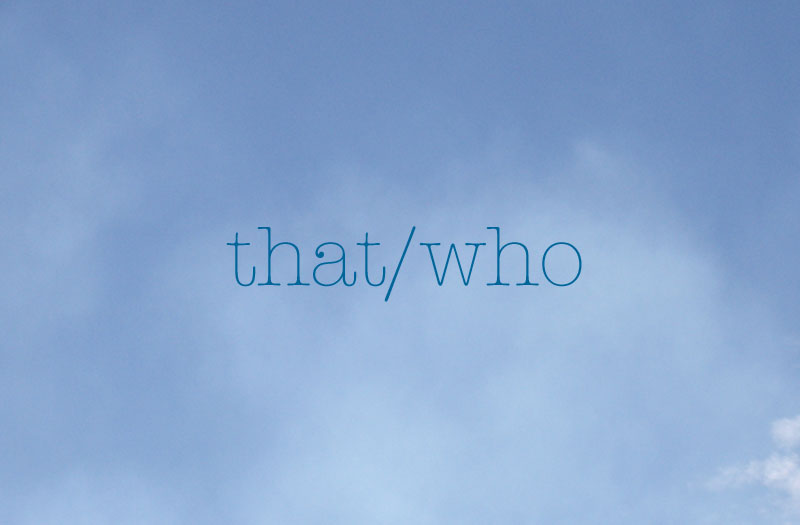
    The words "that/who" on a background of blue skyIt may be a shiny new year but you’ll be pleased (won’t you?) to know my instinct to pick at grammatical inaccuracies, linguistic inconsistencies and inelegant expression is as keen and ready as ever.

    Here’s one example I recently swooped upon:

    “Website content will need to be written by influential authors that display
    high authority in their fields based on social signals and high quality writing.”

    Despite eliciting a mild wince through its repetition of the word “high”, this sentence is not technically incorrect. Even so, if I were to encounter it in a document I was editing, I would make one small but meaningful alteration.

    I would change “that” to “who”.

    Both “that” and “who” serve a number of functions, depending on the context and sentence in which they appear. In this case, “that” is used as a relative pronoun. As with all pronouns, it stands in place of a noun.

    The noun or noun phrase to which a relative pronoun refers is called an antecedent. Here, the antecedent for “that” is “influential authors”. And this is the bit that niggles.

    The influential authors under discussion are, presumably, people. Therefore, the relative pronoun that to my mind more precisely – if not more correctly – refers to them is “who”. While “that” is equally accurate, it is also less particular. It could just as readily indicate objects, places or concepts. This is not the case with “who” and that’s why I would use it.

    It’s a matter of preference. But it’s also a matter of respect.

    Introducing a relative clause with “who” rather than “that” acknowledges the agency – and indeed, the personality – of the actor in the sentence. It adds a tiny touch of humanity that I believe lends greater integrity to the phrase and the idea being expressed.

    Your inclination may be to use “that”, and this is perfectly acceptable. I merely invite you to consider the subtle implication it carries.

    Never forget that words are powerful. As a writer, you can choose how considerately you use them. Even a simple decision between “who” and “that” can make a difference.

    Now it’s your turn…

    Do you prefer “that” or “who” as the relative pronoun when the antecedent is a person or other living being? In what other ways can the words we choose demonstrate respect or its lack?