Author: artful words

  • Talented head chef in need of editorial assistance

    Disambiguate means to remove ambiguity from, or to identify the possible interpretations of a phrase or sentence, and to choose the preferred one. It's an essential practice for writers and editors alike.Here’s a perplexing sentence which recently caught my eye. It appeared on the front page of a local newspaper that shall remain nameless.

    “As the current head chef of Melbourne’s fine dining, the European Restaurant, the 28 year-old’s growing talent and potential has been recognised this week in The Age 2015 Good Food Guide, earning the Young Chef of the Year.”

    Say what?

    While a certain sense can grudgingly be gleaned here, the meaning is unclear and the expression inelegant. It’s precisely the kind of grammatical jumble I yearn to unscramble. Let me show you how I’d do it.

    We’ll begin with the modifier. This is the bit which appears at the start of the sentence (“As the current head chef of Melbourne’s fine dining”) and which modifies or provides more detail about what is to follow. In this case, it is dangling.

    And yes, that is as painful as it sounds.

    What has gone wrong here is that the words following the modifier (“the European Restaurant”) do not refer to the thing being modified. Simply put, the European Restaurant is not the current head chef of anything. Nor, despite any heartfelt hopes it may harbour, is it ever likely to be.

    Awkwardly dangling modifiers like this can provide hours of blameless entertainment for linguistically-minded types. Yet they are also the source of genuine confusion and are best avoided by writers who want to have their words taken seriously.

    It is reasonably easy to un-dangle a modifier. All you need to do is ensure that the subject of the modifier (the person, object or concept being described) is placed immediately adjacent to the modifier itself.

    One way to do this in the current example is to nudge the words “the European Restaurant” to elsewhere in the sentence. Another option is to contain that phrase within a stronger form of punctuation – such as a set of dashes or brackets. However, either of these possibilities would make “the 28 year-old’s growing talent and potential” the subject of the modifier.

    And that leads us to the next problem.

    The “current head chef” in this sentence – who is also the subject being modified – is the 28 year old himself, not his “growing talent or potential”. This means that the words appearing adjacent to the modifier need to be “the 28 year old” and nothing else.

    Other issues requiring editorial attention are whether or not the hyphen is necessary in “year-old” (it isn’t), if the words “Good Food Guide” should be in italics (they should because it is a title), and what to do with the phrase “earning the Young Chef of the Year” which sounds like it is incomplete (because it is).

    A number of adjustments are thus required to disambiguate this sentence, and while it is certainly possible first to untangle and then to wrangle some meaning from it, a more efficient solution is to just begin anew.

    Here’s what I would do:

    “As current head chef of the European Restaurant in Melbourne, the 28 year old this week earned the Young Chef of the Year award in The Age Good Food Guide 2015.”

    If a sprinkle of extra spice were required, one might try:

    “As current head chef of the esteemed European Restaurant in Melbourne, the talented 28 year old this week earned The Age Good Food Guide’s 2015 Young Chef of the Year award.”

    See what I mean?

    Now it’s your turn…

    Have you ever been muddled or misconstrued by a deceptively dangling modifier? Care to share any entertaining examples you’ve encountered?


  • The three things editors see (and why you need our expertise)

    The three things editors see (and why you need our expertise)

    View of the sky, looking up through the trees.Writers of all kinds are often advised to have someone look at their work before they publish it, post it, submit it or otherwise share it. Such readers are typically colleagues or friends who can spot a missing word or fix a misplaced piece of punctuation.


    For documents that really matter, however, it is best to engage a professional editor. Based on our expertise, there are three things that editors see which a more casual reviewer will not.

    1. Editors see what is there

    We read your words. Every one of them. More than once. We do this carefully, even scrupulously. We note the content of your document. We see its scope and shape. We observe its complexity and texture. We go further, discerning patterns and repetitions, recognising rhythms and inconsistencies.

    We perceive the meaning you aim to convey and assess how well you have achieved this. We engage with your turn of phrase. We enjoy your use of metaphor but we are also attuned to your grammatical quirks. We detect those regular errors you make that can distract your reader and dent your expression. (Fortunately, we know exactly how to address those. It’s all part of our brilliance. Also our charm.)

    Most of all, we see – and believe me, we appreciate – the effort and dedication you have put into your work. We see it and we respect it. That’s why we give your words the care they deserve.

    Yet this is just the beginning.

    2. Editors see is what is not there
    It might be as simple as a subheading or as necessary as an explanation. Maybe it’s a definition that will make clear your use of a certain term, or a lively example to illustrate the point you are making. Perhaps your character needs a bit more backstory to reveal more clearly why she acts in the way she does. Or it could be that you need to be a little more generous with your commas, or include a few additional transition signals to guide your reader easily from one idea to the next.

    Whatever is missing from your text and is diminishing the effectiveness your message, we will see.

    We know good writing. We know how it works. We can tell if your words are behaving at their best and can identify what is lacking when they’re not. We know what to do to improve them.

    But even that’s not all.

    3. Editors see what could be there
    This is where the magic happens. This is your editor’s gift.

    It’s the ability to envision just how good, indeed how very much better your writing could be. It’s the belief that your words and your message are important enough to resound more meaningfully.

    From our appraisal of what appears in your writing and what is absent from it, we know and can show you how to reach that level of excellence.

    Sometimes the slightest adjustment is all that is required. Other times, our skill lies in finding the gem in the midst of the mess and holding it close while transforming the rest.

    We can see what your words can achieve even when you can’t. And we are more than happy to show you.

    These three kinds of insight set professional editors apart from all your other readers. They enable us to distinguish writing that is good enough from writing that truly shines. If your words matter, having them professionally edited does too. Want to see the difference?

    Now it’s your turn…

    Have you worked with a professional editor? What insight did that editor bring to your writing?

  • How to look more professional

    How to look more professional

    Want to know the simplest way to look more professional in your writing? Ultimately, my friends, it’s all about style.

    I’m not talking here about grace or glamour, nor the seemingly effortless ease with which chic beings glide among us. My kind of style is more editorial. It involves a nifty little list called a style sheet. This records your preferred version of words that can be written in different ways.

    It notes, for instance, whether you’re searching for more color or colour in your life. It advises you what to do with words like alphabetise, contextualise and extemporise that can end in either –ise or –ize. It reveals when to wield a hyphen, how to format numbers and dates, and whether single or double quotation marks apply. It even indicates if the government or Government has your best interests at heart. (Personally, I have my doubts about that.)

    A style sheet provides you with a personalised guide to using the right words every time.

    It may seem that choosing and methodically using a single version of a word is a little bit petty. It’s the sort of thing that may not even be noticed. Which, actually, is kind of the point.

    When you are consistent with your usage, you spare your readers from trivial distractions. They may not realise why their minds flinch from an unsteadily worded message. But on some level those capricious capital letters and erratic spellings still niggle. They give off a whiff that something’s not quite right, and that’s mostly because it’s not.

    It’s not accurate. Not considered. Not professional and it is definitely not the look you want in your writing.

    The easiest way to avoid this is to use a style sheet. I’ve created a simple one for you. Just note down next to the appropriate letter which version of a word you prefer, remembering that it’s best to stick with a single style of spelling. Elect either –ize and –or word endings, which are typical in American writing, or opt for a more British flavour with –ise and –our. Both varieties are equally acceptable. If in doubt, select a suitable dictionary to use as a reference.

    These are all small choices but they do make a difference – if only a subtle one. Then again, it’s often the subtle differences that can be the most meaningful. In my view, it is worthwhile taking the care and making the effort to write consciously and consistently.

    After all, that’s what professionals do.

    Now it’s your turn…

    What tools or techniques do you use to ensure your writing looks shiny and bright? What do you struggle with when trying to give a professional impression with your words?

    Photo credit: The exquisite orchid image by brainchildvn via photopin is used stylishly on this site under a Creative Commons licence.
  • Are you excited? (It’s a question of prepositions)

    Are you excited? (It’s a question of prepositions)

    There is a curious linguistic trend I’ve observed. It concerns the preposition linked with the word “excited”.

    Before we get too enthused, let me remind you that a preposition is a word which indicates a relationship in time or space between two elements of a sentence, clause or phrase. Nifty little words like at, on, into, amid, between, toward and beyond are prepositions that show us where or when a thing is in relation to a noun or pronoun.

    What I have been bumping into lately is the phrase “excited for”, as in “I’m excited for this tasty breakfast” or “I’m excited for this exhibition of abstract art”.

    My editor’s instincts wince at this. They assert quite firmly that the correct preposition to use here is about.

    To be excited for something means to be excited on behalf of it. I may, for instance, be excited for you right now because I know learning about prepositions is so useful and interesting to you. The important thing to note is that I am not excited for learning about prepositions. I am excited about it. You are too, right?

    The exception (and of course there is one) is when “excited” functions as an adjective in a sentence and is followed by a prepositional phrase. This is what’s happening if I say “I was excited for an hour at least.”

    Of course, about is not the only acceptable preposition to use with “excited”. You may also be excited by a given thing. I myself am excited by bright ideas, insightful writing and engaging conversations. And the adept selection of prepositions, it would seem.

    A person might also be excited to do something. Excited to explore the world or to try new things. Excited to write with greater skill and dexterity. Likewise, people can be excited at something, although this use is generally reserved for ideas or concepts. Perhaps you are excited at the prospect of a holiday or the chance to get lost in a really good book?

    Each of these options situates the elements of the sentence with subtle variations. It’s a case of ascertaining which preposition works best for your purpose. Once you delve into the implications of each one, you can begin to have fun.

    Switching your prepositions can be as entertaining as mixing your metaphors and can have a similar stylistic effect. But it must be done knowingly. Don’t repeat a phrase like “excited for” merely because other people have said it. Instead, consider what you want to say then choose the words that enable you say it in the most meaningfully expressive way.

    That’s how you get people excited about – and indeed by – your writing.

    Now it’s your turn…

    Do correctly selected prepositions excite you? What do you think of being excited for, to, by or about something?

    Photo credit: The dazzling image that accompanies this post is by Kevin Dooley via photopin and is used on this site under a Creative Commons licence.
  • The importance of crafting your written expression

    A collected of empty wooden picture frames, painted in a range of colours, leaning up against each other.It happened in an art gallery. Of course. Amid the burble of opening night chatter, surrounded by inspiring artwork, an idea arrived surprisingly in my mind.
    “I could start a business,” I thought. “I’ll call it Artful Words.”

    So I did.

    Deciding on a tagline for my business, however, wasn’t so intuitive. I had to go looking for one. I sifted through a variety of phrases. They were mostly awkward, lumpy things. Yet when the words “crafting your written expression” came to me, I knew that they were right.

    I like the pleasant resonance between “artful” and “crafting”. I appreciate the way these two terms allude to a view of writing, editing and proofreading as activities involving both art and craft.

    More than this, the phrase states what I will do for you and what I hope to help you do for yourself.

    It affirms the value I hold in being careful and intentional with your words.

    I’m not saying it’s easy, though.

    Crafting your written expression requires time and attention. You need a clear understanding of your purpose and a willingness to keep reviewing and improving your writing. This includes cleverly selecting which terms to use, noting their rhythm and tone. It means meticulously reading each line and excising whatever is unnecessary, even if it stings a little to cut it out.

    When you craft your written expression, you demonstrate respect for your reader and yourself as a writer. Through such crafting, you consciously cultivate your insight and skill, developing your technique through repetition and devotion. Your aim may be to make art. But ultimately, you craft your writing because it matters.

    You do it because it can be better. Because it will be better. Because you make it better.

    Perhaps not all your words need to be so finely wrought. However, any writing that aims to sway or persuade, that aspires to enchant or impress, that seeks meaningfully to tell a story or share an idea will always be more vibrant when both art and craft mingle in its composition.

    At the core of my business is a desire to help you communicate your ideas more elegantly and effectively. In that way, “crafting your written expression” is more than just a tagline. It’s an articulation of the way I work with your words, using expertise, insight, precision and care.

    That is what you can expect – and what you will get – from Artful Words.

    It’s something I believe you can expect and achieve for yourself too.

    Now it’s your turn…

    What craft do you practice? What art do you make? How do you view the interplay between the two?

    Photo by Jessica Ruscello on Unsplash

  • Disambiguate this! Who are “they”?

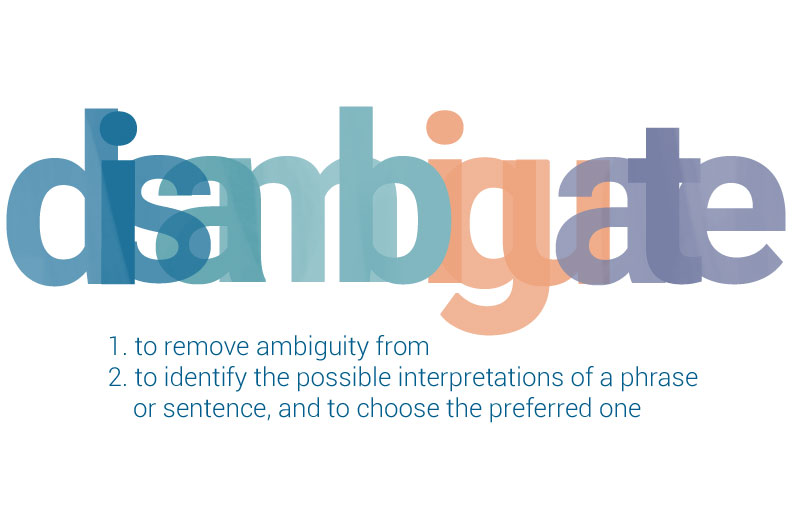
    Disambiguate means to remove ambiguity from, or to identify the possible interpretations of a phrase or sentence, and to choose the preferred one. It's an essential practice for writers and editors alike.This is the first in an occasional series of posts focusing on disambiguation, which is an essential element in effective writing and copyediting. And before we go any further, let me assure you that “disambiguate” is a real word with a proper definition and everything. The one above comes from our friend the Macquarie Dictionary.

    Disambiguation alludes to the editor’s art of untangling the multiple possible meanings in a sentence and proposing alternative versions that express the writer’s intention simply and unequivocally.

    A recent ambiguous sentence I encountered asserted that:

    “The media should tell the public they got it wrong.”

    But who exactly got it wrong? The media or the public? The sentence could be read either way.
    If the intended meaning is that the media should tell the public when the media has got it wrong, a more precise phrasing could be: “The media got it wrong and they should tell the public this.”

    Or perhaps: “When the media gets it wrong, they should inform the public.”

    Or even: “The media should tell the public when incorrect information has been given.”

    If in contrast it is the public who has got it wrong, the revised sentence could be: “The media should inform the public when the public gets it wrong.”

    Or alternatively: “When the public gets it wrong, they should be informed by the media.”

    However, this latter version contains its own ambiguity. Does it mean the public should be told (informed) by the media that the public is wrong? Or rather that the media should be the instrument for enlightening for the public by providing them with information (informing them) rather than simply admonishing them?

    I’ll leave you to choose which of the above options you think best expresses the intended meaning of the original sentence.

    Meanwhile, I’ll keep trying to decide whether I’m a pessimist or a realist for using “when” instead of “if” in relation to the media (not to mention the public) getting it wrong.

    Perhaps I’m secretly optimistic for believing that the media would ever tell the public of their error?

    No, wait! Whose “error” is that?

    Now it’s your turn…

    Sentences with multiple meanings can be confusing but also amusing. (Have you heard the one about the dog that was too hairy to eat?) Which ambiguous sentences or phrases have you found? Share them in the comments below.

  • Books that live on my desk

    Books that live on my desk

    To begin with, there’s the dictionary. It’s always a good place to start. I have a thicket of dictionaries (collective noun, anyone?) scattered about my shelves, including a hefty, two volume New Shorter Oxford. But the one that’s in residence on my desk is The Macquarie Concise Dictionary. Together with The Australian Oxford Dictionary, the Macquarie is generally accepted as the standard for Australian spelling. It’s the one I refer to when copyediting and proofreading.

    Next come the classy couple of Penguin Working Words and The Cambridge Australian English Style Guide. Between them, these two debonair texts tell me (almost) everything I need to know about correct and preferred language use. I could probably refer to just one or the other, but I enjoy exploring the variations in their explanations of various linguistic topics. While I may refer to them less often than my dictionary when working, I’m always enlightened by what I find in their pages.

    The other two books on my desk are a little different. One is very old. The other is very new. Both are gifts from friends I cherish.

    The old book is a genuine gem. It’s a small but erudite text on etymology, the study of the roots and origins of words. This text is so impressive it has not one but two semicolons in its title. In full, it is The Pupil’s Guide to English Etymology; containing the Principle Roots from the Latin, Greek, and Other Languages, with their Derivatives; together with Copious Exercises on Prefixes and Affixes by George Manson. “Copious Exercises”? Why, yes!

    Published in 1848, its cover is grimed and almost worn through. The pages crackle peevishly when turned and the print is small enough to cause a hawk to squint. Even so, this book simultaneously intrigues, delights and inspires me.

    It is perhaps not entirely necessary to delve into the roots of words in order to use them judiciously. However, there is power in understanding the true meaning that lies at their heart. Such knowledge can make one’s choice of words more conscious and also more creative.

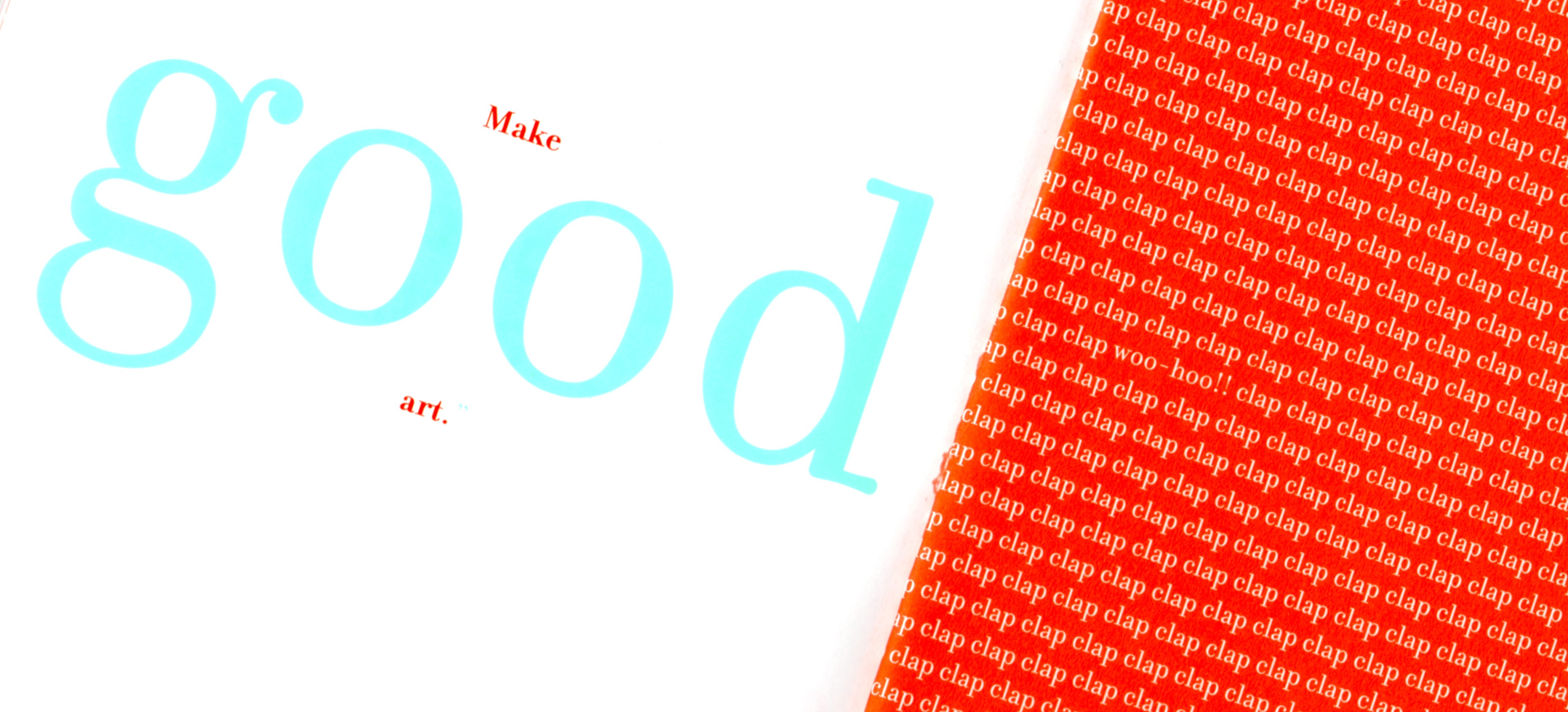
    The new book arrived just a few weeks ago. It is a copy of Neil Gaiman’s ‘Make Good Art’ speech, originally delivered at Philadelphia’s University of the Arts. The book is designed by Chip Kidd and features artfully arranged text in a striking palette of turquoise, red and white.

    The design is engaging but the ideas presented are even more so. Gaiman’s kind and wise advice can not help but make the reader feel reassured about the value of art and effort and experimentation. Above all, this speech is a celebration of both making mistakes and making it up as you go along.

    I don’t look to this book for rulings on spelling or usage. I don’t investigate it for insights into the origins of language. Instead, I open it when I’m feeling uncertain or discouraged. I read a page, then usually another, enjoying the energy of the typesetting and the encouragement in the tone of voice. When I feel better, I close the book and go on with whatever task is at hand.

    It’s that simple. And it works.

    These five books live amicably on my desk. They each reflect my appreciation for words and they aid me in my work. In their own ways, all affirm the extraordinary effect that well chosen and carefully crafted language can have.

    They also ensure that I learn ever more about its subtlety, power and pleasure.

    Now it’s your turn…

    Which books do you keep near you for guidance or sustenance? Which give you the most insight and delight?

  • A few words on failure

    A few words on failure

    It happens to the best of us. To the worst of us. To all of us. We make plans, devise resolutions. We have goals and responsibilities. Deadlines loom on not so distant horizons and obligations hover heavily upon us.

    We mean well. We try hard. We begin with hope and go on with grit. But even so. Sometimes our best efforts aren’t quite enough. Sometimes other things happen and we’re utterly unable to make it work.

    We fail.

    It’s a human thing.

    Whether our reach was too great or our grasp too slight, whether it was within our control or a capricious trick of circumstance, we fail. We do it often and messily. We do it miserably and regretfully. On some occasions we do it spectacularly. On others, more quietly and sorrowfully.

    We are human so we fail. But that’s not the point.

    It’s what we do next that matters.

    Among the many writers I admire is an expatriate Irishman whose face in older age is an ode to endurance. He wrote some of my favourite words. Among them he wrote these:

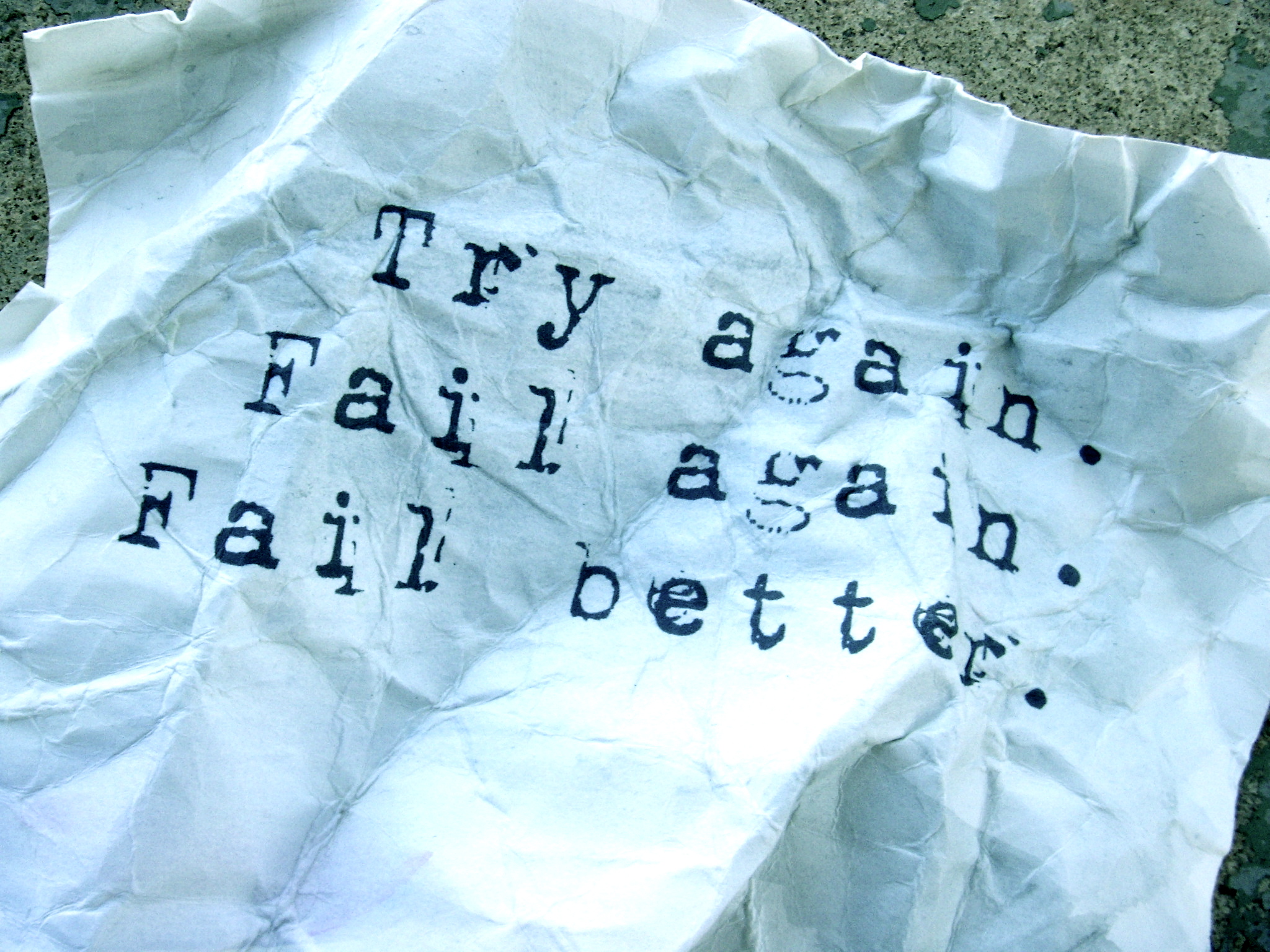
    Try again. Fail again. Fail better.

    His name is Samuel Beckett, by the way. And while some might doubt his propensity as a poster boy for motivation, I personally find rugged comfort in the idea – and practice –  of trying again after failing and failing again after trying.

    Ultimately, I like the thought of failing better than before. It’s hopeful in strange kind of way, wouldn’t you say?

    The notion of “failing better” could of course be read to suggest failing in a more definitive, defiant or flamboyant manner next time around. And why not, if that’s how you choose to do it?

    But for me, failing better means doing so with a certain gentleness and grace. It means having enough courage and compassion to accept the outcomes of my efforts, whatever shape they take, and being willing to go on anyway. A better failure is one in which I’ve tried. I’ve fumbled and stumbled, recovered, and discovered something that might make my future failures easier to forgive.

    This may not be what Samuel Beckett meant. But it’s how I choose to interpret his words.

    I fail often, both secretly and openly. I carry my regrets with me. But as long as I try to fail better each time, I’ll keep on going. I’ll try again and fail again. And again and again and again, doing it better whenever and however I can.

    I’ll go on.

    And you?

    Now it’s your turn…

    What keeps you going following a failure? In what words or wisdom do you find solace and strength?

  • New year’s advice for writers

    New year’s advice for writers

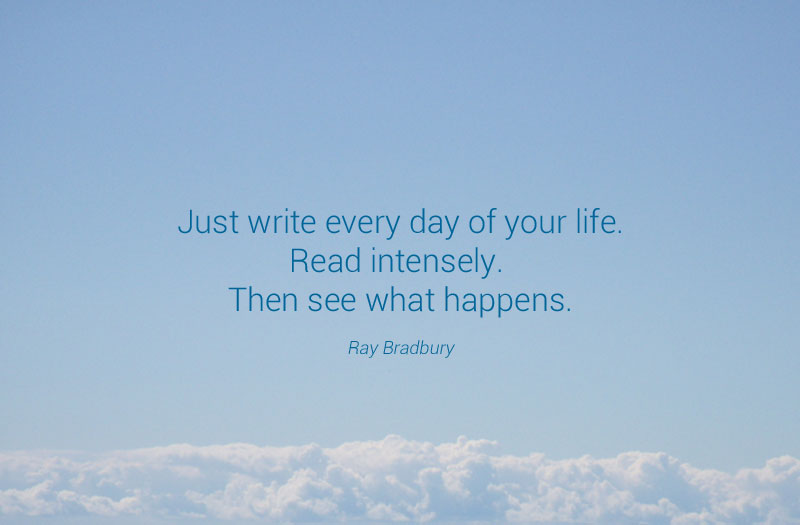
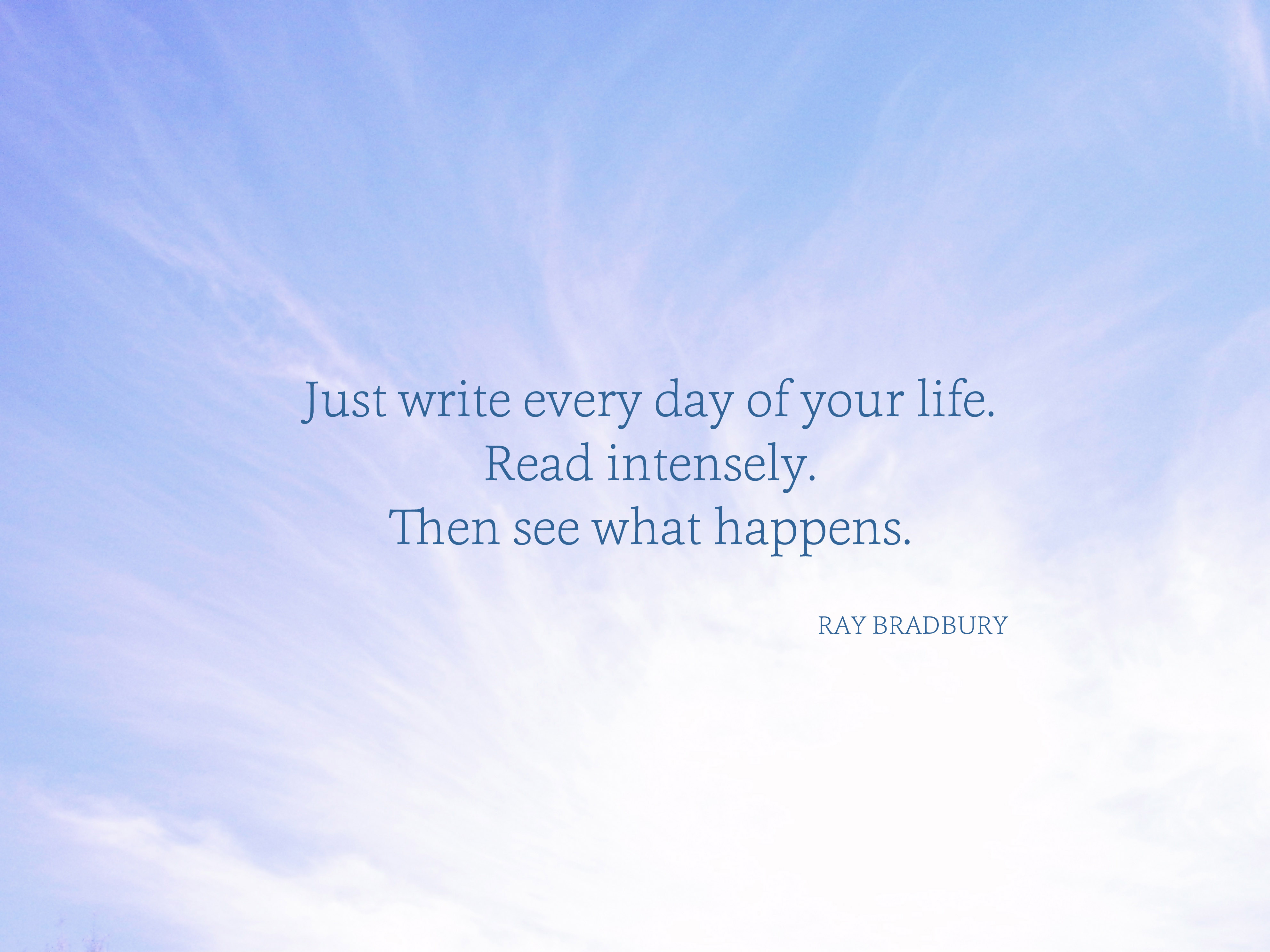
    "Just write every day of your life. Read intensely. Then see what happens." - Ray BradburyI’m not really one for making new year’s resolutions. I don’t see the point. If you’re hoping to change your habits, your activities or the whole glorious jumble of your life, why wait until 1 January?
    Even so, I can’t help finding the optimism of a new year enticing. There’s that delicious feeling that this is the year you will get it right. You’ll figure it out – the system, the magic, the knack. The trick to keeping everything beautiful and smooth.

    It doesn’t matter that you thought the same thing last year, or the year before that, or even (since we’re being honest here) the one before that. Nor is it important that while you’re envisioning a life brimming with grace and ease, you remain entirely aware that it’s not going to work out that way.

    New years are about beginnings, however wishful, and I’m all in favour of that.

    Perhaps this brightly shining new year is the one in which you will finally commit to writing that book. Or maybe 2014 will see you complete that project which has absorbed your time and your mind for so long.

    If you have a resolute nature and a desire to write, you might try taking Ray Bradbury’s advice. Writing daily and reading fervently are two excellent ways to spend your days or nights in the coming year. And while delightful activities in themselves, they are also highly likely to make you a better writer. Perhaps even a better human being.

    Grasp the optimism of the new year and give it a go. Then, as Bradbury says, see what happens.

    My own reservations about resolutions do not stop me from making a wish for the year ahead. That wish is to assist you in whatever way I can to find the art in your words and to craft your written expression.

    Artful Words is open for business in 2014.

    Tell me how I can help you.

    Now it’s your turn…

    Do you make new year’s resolutions? Care to share? What do you resolve to create this year?

  • A Christmas poem

    A Christmas poem

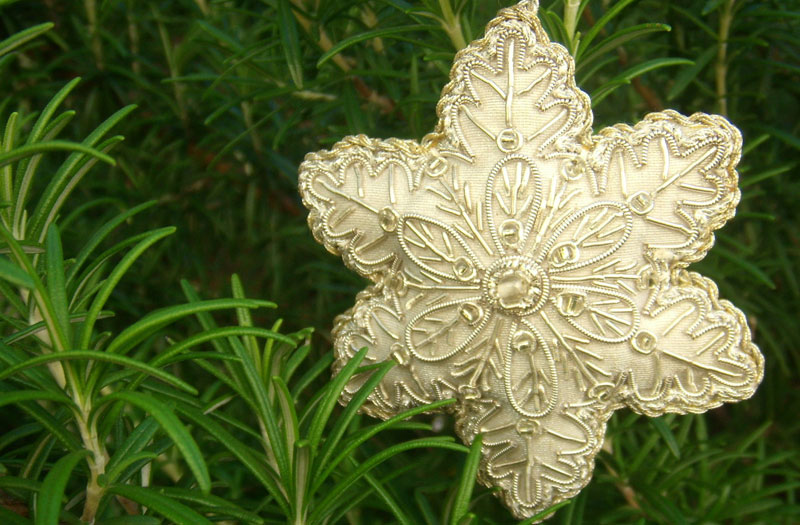
    An ivory coloured, fabric Christmas star with gold beading hangs amid green foliageIn my last post, I mentioned a collection of poems by e.e. cummings among the books I stole from my parents. In it I found this treasure which I’m happy to share with you today.

    little tree
    little silent Christmas tree
    you are so little
    you are more like a flower

    who found you in the green forest
    and were you very sorry to come away?
    see      i will comfort you
    because you smell so sweetly

    i will kiss your cool bark
    and hug you safe and tight
    just as your mother would,
    only don’t be afraid

    look       the spangles
    that sleep all the year in a dark box
    dreaming of being taken out and allowed to shine,
    the balls the chains red and gold the fluffy threads,

    put up your little arms
    and i’ll give them all to you to hold
    every finger shall have its ring
    and there won’t be a single place dark or unhappy

    then when you’re quite dressed
    you’ll stand in the window for everyone to see
    and how they’ll stare!
    oh but you’ll be very proud

    and my little sister and i will take hands
    and looking up at our beautiful tree
    we’ll dance and sing
    “Noel Noel”

    Here’s to taking out our spangles and allowing them to shine! And here’s to a Christmas filled with poetry and joy.

  • Reflections of a literary pilferer

    Reflections of a literary pilferer

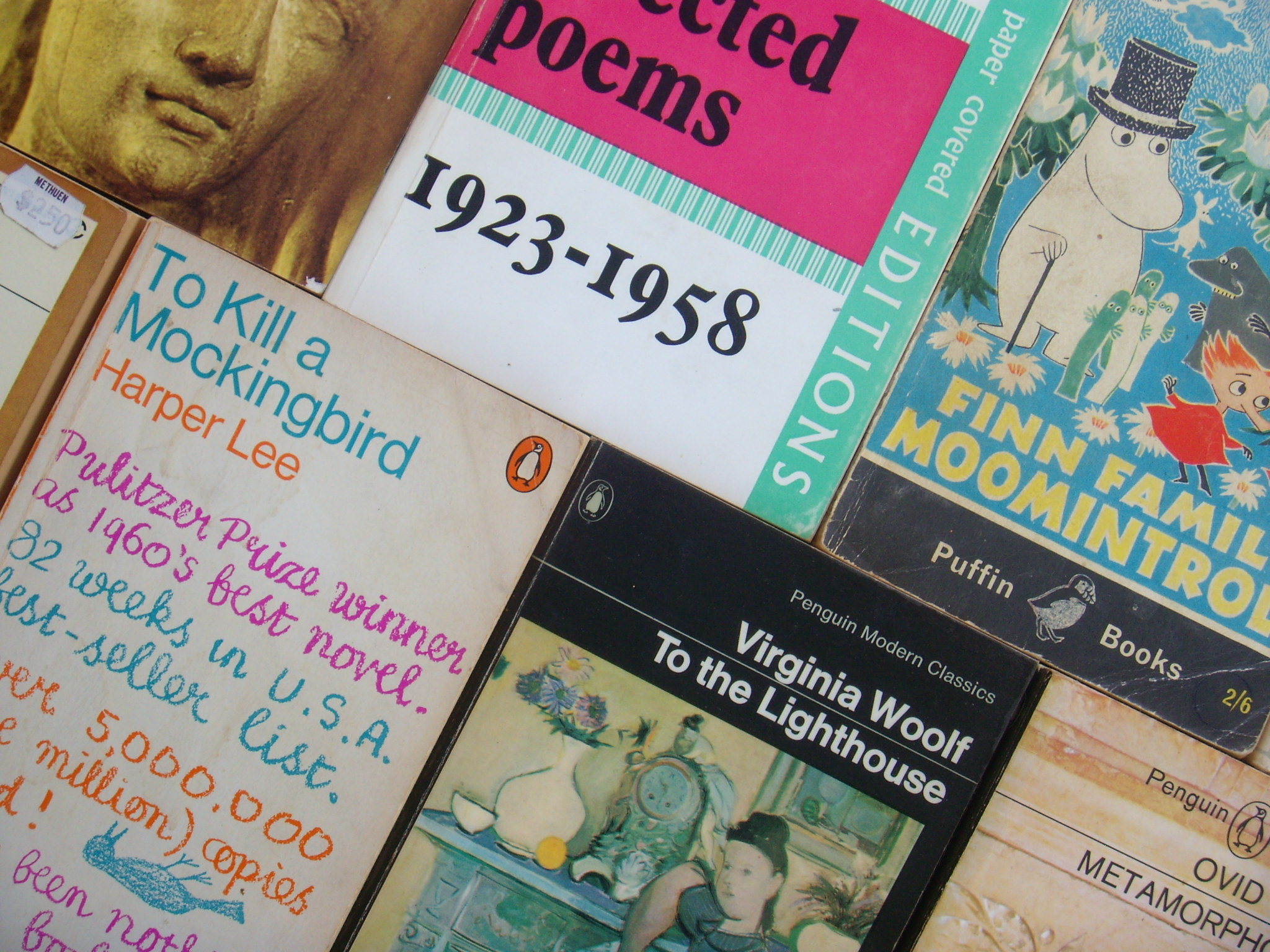
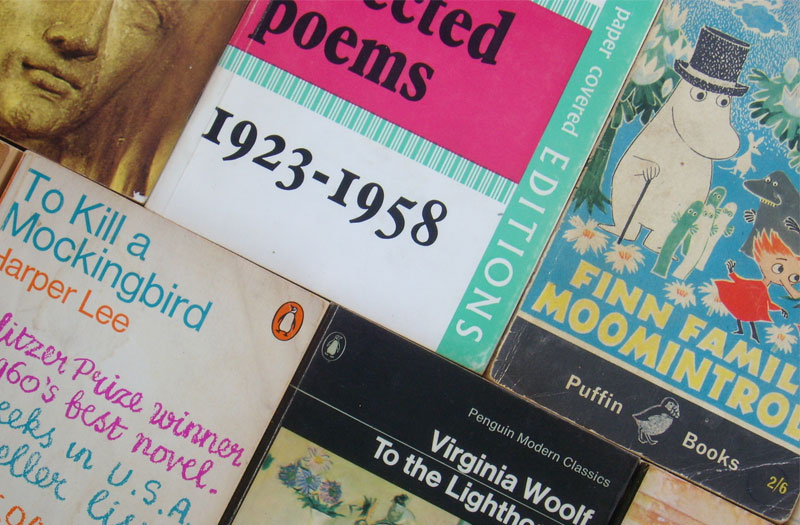
    The colourful covers of books I've stolen from my parents, including Selected Poems by e.e. cummings, To Kill a Mockingbird by Harper Lee, To the Lighthouse by Virginia Woolf and Finn Family Moomintroll by Tove Jansson Here’s a question you won’t find popping out of a Christmas cracker any time soon: What do Winnie-the-Pooh, Japanese haiku, Tove Jansson’s Finn Family Moomintroll, Brewer’s Dictionary of Phrase and Fable and the complete works of Shakespeare have in common?
    At first glance, not a lot. But as it happens, they are all books that have taken up illicit residence on my shelves. Most of them belonged to my parents. Did I use the past tense there? Guilty! Over time, I have borrowed, read, enjoyed and learned from these books.

    I just somehow never managed to return them.

    I could pretend they are the only ones I’ve nicked, but sadly it’s just not true. There are more. Many more in fact. Strunk and White’s classic The Elements of Style is one. To the Lighthouse by Virginia Woolf is another. I’ve got novels by Kafka, Melville and Camus, along with poems by Janet Frame, e.e. cummings and a wondrous bunch of others.

    Even my trusty copy of Roget’s Thesaurus – the subject of a previous post – belongs in this list and is not, strictly speaking, mine.

    I admit it. I’m a book thief. And you know, I’m not even sorry about that.

    In saying this, I am in no way endorsing any raids you may be inclined to stage on the next well stocked set of shelves you find. It’s just that when I reflect on the various volumes I’ve stolen over the years, I see there’s a reason I’ve never returned them and it’s more than mere inertia.

    Sure, some of these books now get contentedly left on the shelf. But others I refer to and return to often, whether I am seeking to write or just seeking delight. They’ve become my companions and I value their presence. For all their inherent treasures, they contain additional gems of discovery and memory for me.

    More than anything, I think it is through this curious collection of filched literature that I first began to read like a writer. That’s a lesson worth learning but it needs repeated practice. Maybe that’s why I hang on to these books, why I keep reading them and why I treat them like my own.

    It’s because each has in some way contributed to making me the writer and editor I am today.

    So I’m sorry, Mum and Dad and anyone else I may have appropriated books from, but I’ll be keeping them for now. You’re welcome to borrow them of course.

    Just as long as I get them back.

    Now it’s your turn…

    Confess. Which books do you have that are not quite entirely yours? What led you to steal them and why do you keep them? What love or learning have you found through being a book thief?

  • From a distance of 2.54cm

    From a distance of 2.54cm

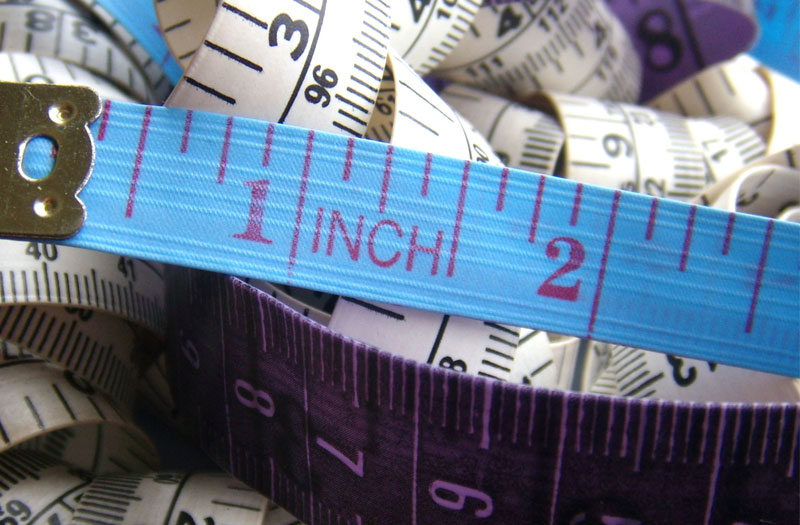
    A jumble of blue, white and purple tape measuresI heard an interesting phrase the other day and it’s been gliding around in my mind ever since. It was in a TED talk delivered by Elizabeth Gilbert. You know, the one who wrote Eat Pray Love.

    As it happens, she wasn’t talking about eating, praying or loving. Rather, her topic was creativity, and in particular the correlation so often and so effortlessly made between artistry and anguish. She asked her audience if they were ok with the idea that creativity and suffering are inextricably linked. She invited them to consider that notion, even from an inch away.

    Even from an inch away.

    That’s the phrase I’ve been contemplating.

    It is not that it’s an especially new idea. Nor is its expression in any way astonishing – although it’s true Liz Gilbert does have a lovely way of saying things. Nevertheless, for some reason it resonated with me and perhaps it will with you too.

    An inch is not big. It’s 2.54 centimetres. Really not far at all. Even so, it can sometimes be difficult for us to shift even that small distance. And that’s a shame, because we all need to be able to view things anew.

    The view of artists that Elizabeth Gilbert encouraged her listeners to examine, even from an inch away, is a troubling one. Yet implicit in her invitation lies a hint of liberation. For even the small distance of an inch affords space to observe and examine, to literally re-view a circumstance or situation, and thus to embrace a different outlook.

    This potential exists in many areas of our lives. It applies to our writing too.

    Sometimes the words we write are so precious to us, we see only how they glisten and not where they are flawed. Other times we wrestle so fiercely with forcing our ideas into language that we forget they need room to breathe.

    In both cases, the ability to shift our perspective even a little is critical. Doing so may be as simple as setting your writing aside for a few days before revisiting and revising it. However, it can also be as demanding as questioning your topic, your writing process, your ability, and even your beliefs.

    Editors and proofreaders intrinsically bring a professional distance to your text. It’s why we’re able to see what is vital in your writing and to smooth it so it flows. It’s how we spot the errors your brain persuades you are not there. (Also, we have superpowers. We’re handy that way.)

    Whether the landscape you look upon is your own writing, a daily routine or some broader cultural assumption, it can be worthwhile trying to find even a small distance from which to reconsider it.

    And if you’re struggling to shift your vision even an inch from your writing, you can always let me know.

    Me and my superpowers are happy to help.

    Now it’s your turn…

    Do you have any techniques you use to help you shift your view? What have you observed about viewing your writing even from a small distance away?