Category: wonderful words

  • The question you will ask yourself

    Wooden bridge over riverSo here we are, at the beginning of a fresh new year. Let’s start it artfully with a bit of poetry. I found this poem in Cate Kennedy’s collection The Taste of River Water (Scribe, 2011), and it has lingered in my mind. It’s called ‘Makeover’.

    The one certainty is that whatever you want to reveal
    will be covered in lead-based paint.
    When you apply the heat gun
    it smells like the fumes could kill you.

    Sometimes you find your eyes fill with tears,
    your head spinning with nauseating stars;
    after a while your hand aches
    just with scraping.

    Re-entering the room,
    you stop in your tracks
    think: is this it?

    Occasionally your hand (the muscles remembering)
    will sweep over it gently
    and there will be a residue, flakes of paint.
    You’ll have to live with it now.

    So step back and get it in perspective
    get a hammer and nail and hang a picture there
    or just keep banging until
    you knock your way into another room.

    Is there natural light?
    Could you make a home here?
    That’s the question you will ask yourself,
    standing ghostly with plaster dust
    absently swinging your hammer, a great new idea
    suddenly occurring to you.

    Much of the beauty of poetry lies in its inspired use of language, but its potency also resides in its capacity to offer us a slantwise insight into the world both around and within us. That’s how this poem is for me. While it is ostensibly about the process of home renovation, I read it as an analogy for writing.

    It begins with the idea of what we want to reveal. This is sometimes clear to us when we write, but it might be buried in convoluted expression. At other times, we know what we hope to disclose, but we’re terrified of sharing it. And then there are times when it is only by burning away the “lead-based paint” that we can discover what our writing is truly about.

    Whichever version of this may be present for you, working through it could cause your eyes to “fill with tears” and your head to spin with “nauseating stars”. Your hand—and sometimes also your heart—will ache with the scraping.

    Later, when reading back over your writing, you may well wonder “is this it?”, and of course, you will still feel under your fingertips the slightly gritty bits where your words are not as poetic or precise as you’d like. But if you’ve taken the adventurous step of sharing what you have written, then perhaps you’ll just “have to live with it now”.

    It’s this next part of the poem that I like the most: the advice to “step back and get it in perspective”.

    Whether in our writing or our lives, it is through dedication to details that we are able to create works of artistry and delight. However, keeping our attention fixed on minutiae can cause us to miss the broader context. In this case, it could be that some deft decoration will improve your outlook. Or, as the poem suggests, the composition that currently leaves you feeling less than inspired might be the starting point for something new.

    The question at the crux of this—of the poem, of your writing, and maybe even of this year—is “Could you make a home here?” Could you, after pursuing the exacting and exhilarating journey of creation, regardless of your satisfaction with the outcome, go through it again?

    Of course you could.

    How else can you honour that “great new idea / suddenly occurring to you”?

    Now it’s your turn…

    What is your interpretation of Cate Kennedy’s poem? What other poems speak to you of the pleasures and difficulties of writing? What great idea—old or new—will guide and inspire your work and your words this year?

  • The results of unexpectedness: Thoughts on ‘Life While-You-Wait’

    Rays of sunlight streaming through treesSometimes words find us in unexpected ways, falling into our minds like light piercing through the gloom. It happened like that with this poem, which was shared with me by a dear friend. Now I am sharing it with you.
    Life While-You-Wait.
    Performance without rehearsal.
    Body without alterations.
    Head without premeditation.

    I know nothing of the role I play.
    I only know it’s mine. I can’t exchange it.

    I have to guess on the spot
    just what this play’s all about.

    Ill-prepared for the privilege of living,
    I can barely keep up with the pace that the action demands.
    I improvise, although I loathe improvisation.
    I trip at every step over my own ignorance.
    I can’t conceal my hayseed manners.
    My instincts are for happy histrionics.
    Stage fright makes excuses for me, which humiliate me more.
    Extenuating circumstances strike me as cruel.

    Words and impulses you can’t take back,
    stars you’ll never get counted,
    your character like a raincoat you button on the run —
    the pitiful results of all this unexpectedness.

    If only I could just rehearse one Wednesday in advance,
    or repeat a single Thursday that has passed!
    But here comes Friday with a script I haven’t seen.
    Is it fair, I ask
    (my voice a little hoarse,
    since I couldn’t even clear my throat offstage).

    You’d be wrong to think that it’s just a slapdash quiz
    taken in makeshift accommodations. Oh no.
    I’m standing on the set and I see how strong it is.
    The props are surprisingly precise.
    The machine rotating the stage has been around even longer.
    The farthest galaxies have been turned on.
    Oh no, there’s no question, this must be the premiere.
    And whatever I do
    will become forever what I’ve done.

    Before these lines arrived in my life, I knew little of the poet and Nobel Laureate Wisława Szymborska. I have since peeked briefly into her world and am keen to explore it more. This poem, ‘Life While-You-Wait’, has been translated from the original Polish by Clare Cavanagh and Stanislaw Barańczak. If you enjoyed it, you may wish to listen to Amanda Palmer reading it on Brainpickings.org.

    For me, the poem offers an interesting mix of warning and reassurance. “Ill-prepared” as the speaker may be, there is an acknowledgement here of living as a privilege. The role to be played, although unknown, is owned, and guessing “on the spot / just what this play’s all about” is what each of us must do in our own ungainly way. We go along, improvising unwillingly and tripping over our own ignorance, much as we do when writing a first draft. The difference is that these “Words and impulses” can not be edited or taken back, and “the pitiful results of all this unexpectedness” become the stuff of which our lives consist.

    Fair or not, we can neither rehearse nor repeat a single day. With the set so strong, the props so precise and even the “farthest galaxies” alight, there can be “no question”, as the poet insists, that “this must be the premiere”. Life is indeed what happens while we wait, hoping and holding out for the ‘right’ moment and a sense of readiness that will never come.

    We do not get to see the script for Friday ahead of time, but we can choose either to fear or to embrace that fact. If we cannot exchange the role we play, then we must simply act it as best we can. Although doubtless riddled with “happy histrionics” and “hayseed manners”, my own performance is made up of what I have managed to scratch together. Like you, “whatever I do / will become forever what I’ve done.”

    These final lines linger in the mind, but whether they are encouraging or devastating, reprimand or reminder, it is up to you to decide.

    Now it’s your turn…

    What are your thoughts about this poem? Which images or lines reach you most deeply? What poems have you felt compelled to share?

  • An act of faith: Why language matters (even when it is inadequate)

    Green grass against a grey skyFor all its beauty, complexity and nuance, language is at times sadly inadequate. Certain experiences fall beyond words. They render us inarticulate, unstitching us from meaning and annihilating our ability to share the messy reality of our lives.

    Depression is one such experience.

    In a talk given at last year’s Hay Festival and later broadcast on the BBC, author Matt Haig spoke of the way depression, and its vicious accomplice anxiety, can detach us from the world, and more critically from ourselves. This is what happened to him. At the age of 24, his world splintered and disintegrated as he tumbled into the precarious realms of mental illness.

    “At my lowest point, in February 2000,” he says, “I stopped believing in words. Until then, I hadn’t realised that the act of using language is an act of faith, but it is.”

    Let’s just think about that for a moment. What does this mean?

    Faith, in one definition, may be considered as the belief in things not seen without evidence that they genuinely exist. Depression itself is a thing that is largely unseen, not only because it emanates deep in the secretive domains of our bodies and minds, but also as a result of society’s continued difficulty in adequately acknowledging it. When we are depressed, moreover, we are often conscious of a lack of recognition, either from those around us or through the unsettling experience of becoming strangers to ourselves.

    Words, too, are in many ways intangible. Sure, we can see them written on the page and hear when they are spoken, but words are only ever symbolic. They represent the elements of our lives without actually being them. Yet it is through words that we are able to connect, express, explain, delight, beguile, advise, entertain and learn.

    Such acts are a profound part of our humanity, but conditions like depression can distance us from their significance.

    As Matt Haig says, “You have to believe there is a point of there being words and that they can offer real meaning. Normally, this belief is taken for granted. But when your mind crumbles to dust, everything you thought you knew suddenly becomes something to question.”

    Pitched into such doubt, it is ironically words themselves that may offer some salvation. At least, that is how it was for Matt. First through reading and later through writing words, he gradually became more able to manage his illness. In his case, it was fiction that provided a kind of map.

    “If you think about what a story is in its most basic form,” he explains, “it is change. A character starts somewhere, either physically or psychologically, and they end up somewhere else. When you are depressed, you feel like you are trapped inside an eternal, unchanging moment.

    “Stories convince us that things do change.
    They unfix us or allow us to believe we can become unfixed.”

    A belief in the possibility change can be problematic for those who are enclosed in the unforgiving grip of mental illness. The reality that was previously known gets shattered so utterly that suspicion is cast on all former certainties, as well as all future prospects. Where in such wreckage can one even begin to discover the courage or means to rebuild?

    For some, one aspect of that answer may be words.

    Part of their magic is that they allow us to take our minds elsewhere – into different times, other places, new perspectives. They give us an awareness of alternative ways of being, which may be kinder, braver or more steadfast than we can otherwise manage to be.

    However faltering or insufficient, words also make external what might otherwise be an entirely internal experience, thus affording us the potential for connection – whether we ourselves are the ones drenched in anguish or stand as those willing to bear witness.

    This is not to say that it is easy. Nothing with depression is easy. Nor can words alone provide an entire solution. But for some people, they might help.

    In his book Reasons to Stay Alive, Matt Haig writes that: “Words – spoken or written – are what connect us to the world, and so speaking about it to people, and writing about this stuff, helps connect us to each other, and to our true selves.”

    Through the small but valiant act of using words and making these vital connections, we may start to assemble reality again. Whether by writing or reading, we are granted the chance to leave behind a certain kind of mind so that we may create another, “similar but better, nearby to the old one but with firmer foundations, and very often a better view.”

    Or so I hope.

    If ever, like Matt, you stop believing in words, I encourage you to do whatever you must to find your faith in them again. Begin, if necessary, with the words of others. Read books and poems. Listen to speeches and conversations. Then, when you can, scratch words into a journal and voice your truth to whoever will listen. Allow yourself to imagine the possibility of change.

    Eventually, maybe, with patience and persistence, you will learn to trust in the wonder of language and in yourself again.

    Now it’s your turn…

    Do Matt’s words resonate with you? To which writers or texts do you turn in harsh times? How do words help you?

  • Strike your note:
    A new year’s admonition

    View of grasses on a windswept beachIt stretches before us, crisp and unsullied. Poised as we are at the start of this bright, shiny year, we are free to imagine without hint of disappointment all the wondrous things we might experience, witness, learn and achieve in months to come.

    Although I do not make new year’s resolutions, I do try to hold a hopeful approach at this time. Perhaps that is why the following lines felt so resonant to me. They are from ‘Station Island’ by Seamus Heaney.

    ‘…The main thing is to write
    for the joy of it. Cultivate a work-lust
    that imagines its haven like your hands at night

    dreaming the sun in the sunspot of a breast.
    You are fasted now, light-headed, dangerous.
    Take off from here. And don’t be so earnest,

    let others wear the sackcloth and the ashes.
    Let go, let fly, forget.
    You’ve listened long enough. Now strike your note.’

    These words are spoken by the ghost of James Joyce to an uncertain Heaney who is here both poet and protagonist. In the poem, he makes a pilgrimage to Station Island, a site on Lough Derg in Donegal that is sacred to St Patrick. Along the way, he encounters and engages with the spirits of a number of significant figures in his life, with writers like Joyce among them.

    This injunction, to “write for the joy of it” and “Cultivate a work-lust”, is found in the concluding section of the twelve part poem. It is a final, fierce denial of the poet’s disquiet that reads to me like a rallying cry for all those who quaver before the page. The words urge a certain audacity and a readiness to accept both the role and responsibility of being a writer, despite any lingering misgivings any of us – Heaney included – may have.

    Later in the poem, Joyce speaks again, telling the poet:

    ‘… it’s time to swim

    out on your own and fill the element
    with signatures on your own frequency,
    echo soundings, searches, probes, allurements,

    elver-gleams in the dark of the whole sea.’

    I am indebted to David Fawbert, whose excellent website on Heaney’s poetry not only gave me some insight into ‘Station Island’, but also advised me that an “elver” is a young eel. It is a bewitching image, and an apt one too. Those glimmers of movement, the flash of something beneath the surface. That’s what writing is like, with words and ideas flickering somewhere, perhaps in reach, “in the dark of the whole sea”.

    As we enter this new year, I add my own plea to the voice of Joyce in this poem. I invite you to decide it is time to swim. Find your frequency and seek out those subtle gleams. Then, equipped with grit and grace, with courage and wonder, “Take off from here”.

    Go and strike your note.

    Now it’s your turn…

    Do you set an intention for your writing at this time of year? Do you have a favourite poem or quotation that inspires you to write? What feelings do Seamus Heaney’s words stir in you?

  • The doorway into thanks and silence

    The doorway into thanks and silence

    Buddhist prayer flags billowing in a blue skyTime for some more poetry, I think. (Isn’t it always?)

    Sometimes it takes no more than a moment. You meet a person, see a painting, hear some music or read certain words. Immediately, there is a feeling of recognition, appreciation and even awe. It is simple and instant. It just feels right.

    That’s what I experienced when I first read Mary Oliver’s poem ‘Praying’.

    It doesn’t have to be
    the blue iris, it could be
    weeds in a vacant lot, or a few
    small stones; just
    pay attention, then patch

    a few words together and don’t try
    to make them elaborate, this isn’t
    a contest but the doorway

    into thanks, and a silence in which
    another voice may speak.

    Isn’t it wonderful? With only a few gentle words, Mary Oliver reminds us that poetry can be found in the humblest of things, such as weeds and stones. We don’t always need magnificence for our inspiration, and nor is it always necessary for our writing to impress or compete. Pleasure is often found in simplicity, and the delight of writing is a gift in itself.

    As a poet, however, Mary is clever with her use of the homograph “elaborate”. There are different ways of reading this word, either as an adjective or a verb. Each option offers a slight shift in our understanding of the poem. Are we being advised not to make our patched together words too ornate and complicated? Or is the suggestion instead that they do not have to explain or expound? These two interpretations sit in a friendly tension, lending a more nuanced edge to an otherwise modest message.

    The last lines are my favourites, with their evocation of writing being a “doorway” to gratitude and to the “silence in which / another voice may speak.” But whose voice is this? Is it our own inner expression, so often suppressed by other sounds and distractions, or could it be something more mysterious than this?

    As yoga teaches us, we breathe and are breathed. Perhaps we can also say that we write and are written.

    However it may be, this poem is one to which I return again and again, giving thanks and listening quietly for that other voice in the silence.

    I hope that you enjoy it too.

    Now it’s your turn…

    What does this poem evoke for you? What do you make of its title, ‘Praying’? Where else in your life do you find both thanks and silence for another voice to speak?

  • Exhausting or exhaustive?

    Image of the word "exhaust" with alternate endings of "-ing" or "-ive"It is an easy mistake to make, especially when you’re tired. Nevertheless, there is a difference in meaning between the words “exhausting” and “exhaustive”, and astute writers know which one to choose.
    The word “exhausting” may be used either as a verb (as in exhausting all possibilities) or as an adjective (an exhausting day). In either case, its meaning is to use or consume, to drain of strength or resources, or to draw out all that is essential or interesting. Often, it denotes tiredness or fatigue.

    While it is true that the word “exhaustive” may also refer to the draining of strength, energy or resources, its more typical meaning is thorough, complete or comprehensive. An exhaustive examination of something, for instance, would be extensive and meticulous, leaving nothing out.

    Thus, “exhausting” typically means tiring, while “exhaustive” usually means entire.

    There are occasions when both words can be applicable. An exhausting search, for instance, may well be an exhaustive one. Likewise, an exhaustive line of questioning could also be exhausting – for interrogator and interrogated alike.

    Clever writers might like to play around with these simultaneous meanings. For the sake of simplicity, however, I suggest that it is best to select the one word of these two that most accurately reflects your intended meaning. Is it more important, for instance, to imply a certain tiredness or to evoke a level of diligence?

    As always, it is wise to keep your reader in mind. Rather than impressing your audience with your stylistic decision to use one of these words in place of the other, you could risk causing confusion. Worse still, you might end up looking like you don’t know the difference between them. If conveying both meanings matters to you, try finding a way to do it more precisely.

    This brief explanation of these similar but distinct terms is itself not exhaustive. Yet hopefully it is not exhausting either. It is merely intended to assist you in choosing the best word for your purpose and to help you become a more artful writer.

    Now it’s your turn…

    Is the difference between “exhausting” and “exhaustive” clear to you? Which other words that seem or sound alike do you often get confused?

  • Those monsters who live in the air

    Those monsters who live in the air

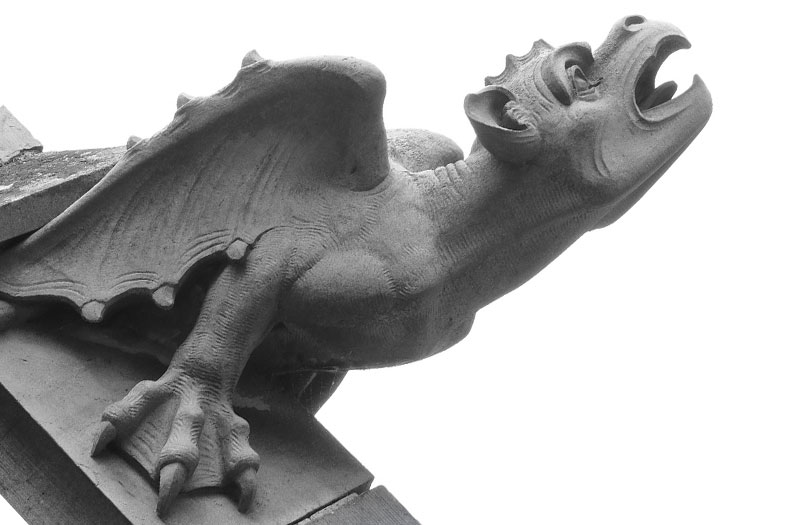
    Winged gargoyle stretching its neck towards the skyYou know that delicious shiver which good writing can deliver? This passage from Hilary Mantel’s Wolf Hall does it for me. It describes the scene of the procession through London for Anne Boleyn’s coronation.

    The route is hung with tapestries and banners, and at his orders the ground beneath the horses’ hooves is graveled to prevent slipping, and the crowds restrained behind rails in case of riots and crush; every law officer London can muster is among the crowd, because he is determined that in time to come, when this is remembered and told to those who were not here, no one is going to say, oh, Queen Anne’s coronation, that was the day I got my pocket picked. Fenchurch Street, Leadenhall, Cheap, Paul’s Churchyard, Fleet, Temple Bar, Westminster Hall. So many fountains flowing with wine that it’s hard to find the one flowing with water. And looking down on them, the other Londoners, those monsters who live in the air, the city’s uncounted population of stone men and women and beasts, fanged rabbits and flying hares, four-legged birds and pinioned snakes, imps with bulging eyes and ducks’ bills, men who are wreathed in leaves or have the heads of goats or rams; creatures with knotted coils and leathery wings, with hairy ears and cloven feet, horned and roaring, feathered and scaled, some laughing, some singing, some pulling back their lips to show their teeth; lions and friars, donkeys and geese, devils with children crammed into their maws, all chewed up except for their helpless paddling feet; limestone or leaden, metalled or marbled, shrieking and sniggering above the populace, hooting and gurning and dry-heaving from buttresses, walls and roofs.

    from Wolf Hall by Hilary Mantel
    (Fourth Estate, London, 2010, pp.463-64)

    There’s so much to enjoy here. Mantel piles detail upon detail, creating a cavalcade of creatures while dishing up some dextrous linguistic tricks to delight her reader. The use of assonance in this excerpt is especially pleasing. This is the rhyming of the accented vowel sound in words, as demonstrated in “horned and roaring”, “lions and friars” and those disturbing “fanged rabbits”.

    Alliteration is at play as well, with “metalled and marbled, shrieking and sniggering”, and who does not revel in the unexpected occurrence of the word “gurning”? There’s not even a listing for this in my New Shorter Oxford English Dictionary, nor in either edition of the Macquarie I own. Online sources assure me, however, that it refers to the pulling of grotesque faces, which is fitting for the image Mantel’s language evokes.

    Indeed, Wolf Hall is rich with many such magnificent images and descriptions. I love it when writing like this causes me to catch my breath, to stop and read again, slowly and appreciatively, certain sentences, scenes or phrases. It’s one of the reasons my job is such fun.

    There is always the chance that I’ll discover something wondrous like this.

    Now it’s your turn…

    What is your impression of this description by Hilary Mantel? What do you find most striking or enticing? What other exceptional texts have you been reading lately?

  • Choosing a word of the year the Macquarie Dictionary way

    The Concises Macquarie Dictionary, artfully arranged with a pen and a cup of teaWhile devising new words and wrangling existing definitions into curious contortions can be considered all manner of fun, it is only cautiously that such linguistic innovations make their way into official dictionaries. Yet the value of these terms lies in their ability to reflect the practices and preoccupations of the societies that generate them.

    This, at least, is the claim made by the people who bring you the Macquarie Dictionary. Since 2006, they have assembled an annual panel of experts to select the one word from the dictionary’s online update that most potently expresses the tone or focus of the preceding year. Past winners have included ‘infovore’ (2013), ‘burqini’ (2011), ‘googleganger’ (2010), ‘shovel-ready’ (2009) and ‘muffin top’ (2006). Of course.

    Shortlisted words are sorted into categories including arts, communications, social interest, technology, politics, business, health and (everyone’s favourite) colloquial. The word of the year is determined by an esteemed assortment of academics, librarians, editors and authors. However, we more ordinary folk can also join in the fun by nominating our selection in the People’s Choice.

    It’s dictionary meets democracy.
    (Would that be ‘dictiocracy’? ‘Democtionary’?)

    Voters are invited to select the word in each category that they think has made the most valuable or striking contribution to Australian English in the previous year. It’s a serious business – or at least it might be.

    In truth, it’s hard not to just plump for the most absurd or appealing word on each list, and believe me, there are quite a few.

    Words like ‘wikiwash’ (meaning to edit Wikipedia for the purposes of self-promotion) and ‘emoji’ (denoting ideographs used in electronic messages, from the Japanese e for picture and moji for character), from the communications category, indicate the direction of our online interaction. The slightly snarky ‘generation XL’ (referring to any generation characterised by high levels of obesity) in the social interest category also reflects a certain broadening trend.

    One for writers and editors to watch out for is ‘atomic typo’, listed in the arts category. This is the result of those slips of fingers on keyboard that produce a real – though incorrect – word a spellchecker will blithely ignore. (Another reason why human proofreaders are so valuable.) The phrase derives from the idea that the mistake is usually very small, often with only one letter absent or transposed. Even so, I would argue that the potential impact of such errors echoes in the more sobering associations of the word ‘atomic’.

    Meanwhile, the practice of concocting awkward nouns from other word forms lurches ever onward, as the phrase ‘to fly by the seat of one’s pants’ is transmogrified into the uneasy ‘pantser’. This term, also located in the arts category, describes a fiction writer who improvises without a definite outline, in contrast to a ‘plotter’ who writes to an established structure.

    Other shortlisted words show a more sombre side of the past year. These include:

    • ‘precariat’ in the politics category, which blends ‘precarious’ and ‘proletariat’ to describe a social class comprised of people who lack security in their work, income and material wellbeing
    • ‘defund’ (also in politics) to indicate the cancellation of government funds to organisations, programs or enterprises
    • ‘ambulance ramping’ (health) which occurs when a lack of hospital resources prevents patients from being transferred from an ambulance, with the result that the ambulance is unable to attend others in need
    • ‘bamboo ceiling’ (business), describing a kind of prejudice which impedes the progress of Asian Australians to leadership positions in business and government. (It wouldn’t be an Australian list without a hint of racism now, would it?)

    And in just case you dreamed that misogyny and homophobia miraculously disappeared from our lexicon last year, you’ll be discouraged to discover such terms as: ‘mansplain’ (colloquial), which occurs when a man delivers a patronising explanation to a woman with the assumption that she will be ignorant of the matter at hand; ‘dude bro’ (colloquial), referring to a man who demonstrates overt masculinity through dress, behaviour, and sexist and homophobic attitudes; and the contemptible ‘girlie man’ (politics) to denote an effeminate male. We can apparently thank Arnold Schwarzenegger for that one. Or not.

    Although certainly diverting, filtering through these lists and picking your word of choice from each could deliver you a dose of ‘decision-fatigue’ (general interest). If affected, don’t get all ‘flappity’ (colloquial). Just take yourself down to your local ‘cat cafe’ (general interest) and seek solace in a nibble from a ‘share plate’ (eating and drinking) or a bracing cup of ‘cold-brewed coffee’ (eating and drinking).

    I’m sure you’ll feel much better after that.

    Voting for the Macquarie Dictionary’s word of the year closes on 30 January, with the winning words announced on 4 February. To enact your dictiocratic right, head over to the Macquarie Dictionary website and let them know what you really think.

    Now it’s your turn…

    What nifty neologism, pointed phrase or twisted definition captured your attention this year? Which words from the Macquarie Dictionary’s 2014 lists most tickle your linguistic fancy?

  • A Christmas poem

    A Christmas poem

    An ivory coloured, fabric Christmas star with gold beading hangs amid green foliageIn my last post, I mentioned a collection of poems by e.e. cummings among the books I stole from my parents. In it I found this treasure which I’m happy to share with you today.

    little tree
    little silent Christmas tree
    you are so little
    you are more like a flower

    who found you in the green forest
    and were you very sorry to come away?
    see      i will comfort you
    because you smell so sweetly

    i will kiss your cool bark
    and hug you safe and tight
    just as your mother would,
    only don’t be afraid

    look       the spangles
    that sleep all the year in a dark box
    dreaming of being taken out and allowed to shine,
    the balls the chains red and gold the fluffy threads,

    put up your little arms
    and i’ll give them all to you to hold
    every finger shall have its ring
    and there won’t be a single place dark or unhappy

    then when you’re quite dressed
    you’ll stand in the window for everyone to see
    and how they’ll stare!
    oh but you’ll be very proud

    and my little sister and i will take hands
    and looking up at our beautiful tree
    we’ll dance and sing
    “Noel Noel”

    Here’s to taking out our spangles and allowing them to shine! And here’s to a Christmas filled with poetry and joy.

  • Murder, unkindness and storytelling

    Murder, unkindness and storytelling

    A murderous looking raven, who no doubt has a story to tell, glaring right at you.It began with ravens. A flurry of birds, persons and other wondrous beasties hurried thereafter. But it did begin with ravens. I read an interesting article about these sleek creatures and it led me to wonder. I was familiar with the expression “a murder of crows”, but what was the collective noun for ravens?

    Turns out, it is also a murder of ravens, as well as an “unkindness” which equally applies to crows. But it was a third collective noun for ravens that really caught my attention. This was a “storytelling”. And at that point, my mind lifted its wings, flapped them a few times and went soaring off into the skies.

    A storytelling of ravens. Isn’t that fabulous?

    It’s almost a small story in itself. In just four words, a surprising world is glimpsed. You can picture the birds, gathered blackly on the grass, cawing their ravenish tales. What stories do you imagine they’d tell?

    Off now on a jaunt, I started seeking out other collective nouns that offered equally intriguing impressions. And believe me, there are many!

    Bears come in sleuths or sloths – perhaps depending on the season and how sleepy they’re feeling. It’s a passel of possums and a kettle of hawks, a pod of pelicans and a knot of frogs.     An aurora of polar bears is nice, not least because it’s fun to say. I quite like a charm of hummingbirds, but it worries me that it’s also a “troubling” of them. Surely a “tremoring” or a “shimmering” would be more apt?

    Even hermits get their own collective noun, as paradoxical as that sounds. Should you ever happen upon a gathering of them, please note that it’s an observance of hermits.

    Some among these nifty nouns are considered to be official, in that they were written down centuries ago. Many of them show a distinct linguistic delight in their contrivance, just as those devised today do. It really is a fascination of boars, though I’m not so sure about a platter of platypuses. As for a committee of vultures… Well, I’m sure we can all understand that one.

    Entertaining as these explorations are in themselves, the realm of collective nouns in fact contains some valuable insights for aspiring writers.

    First, there’s the pleasure of encountering such rarely heard words as “gam” (of whales), “skirl” (of pipers) and “clew” (of worms). Sure, you may not find a use for these neglected treasures in everyday conversation, but isn’t your vocabulary improved by their inclusion?

    Next, there’s the rhetorical contrivance of collective nouns, many of which play around with alliteration, assonance and onomatopoeia. Not for nothing is it an armoury of aardvarks, a litter of kittens and a crash of rhinoceroses. The play of sounds in collective nouns is part of what makes them engaging and memorable. The same can be true of your writing too.

    Then there’s the condensed richness of the image. The juxtaposition of the collective noun with the object it describes can be poetic, provocative, or purely incongruous. (Why, I can’t help wondering, is it a “troop” of mushrooms? And how on earth can it be a “walk” of snails?) In any case, an effective collective noun is an evocative gem.

    Tighter than a haiku, it compels precision. It’s an exercise in finding that one right word which most potently and appropriately expresses some essential quality of the collection in question. And isn’t divining such perfectly pertinent words what the best writers successfully do?

    This leads us to the greatest gift that collective nouns bestow, which is the ingenious joy in inventing your own. This particular party trick invites you to employ all your wit and skill with language to find that artfully astute term which captures an essence and conveys a whole story.

    Messing around with collective nouns may seem like nothing more than an agreeable indulgence. But actually, it shows language at use in a deliberate and considered way. As such, it can be quite instructive, as well as being both amusing and diverting.

    Oh, and just in case you were wondering. The collective noun for writers? That would be a “worship”. Of course.

    Now it’s your turn…

    What’s your favourite collective noun? It can be official, idiosyncratic or entirely imaginary. Or, what throng of things do you believe is in need of an inventive collective noun? Share your cleverness below.

    Photo credit: That murderous looking raven (no doubt with a story or two to tell) was snapped by neeravbhatt and is used here via photopin under a Creative Commons licence.
  • Wherefore art thou?

    Wherefore art thou?

    Dictionary definition of the word 'artful'

    You don’t actually need to be languishing on a balcony in order to ponder what’s in a name. Yet as Juliet discovered, it can be surprisingly enlightening to consider how and why a certain thing is named as it is.

    If you are an artist, the title of your work adds to the impression a viewer has of it. For authors, the name of a book is often the first thing potential readers encounter. Equally, for students, academics or writers of any kind, a document’s title may be smartly deployed to inform, intrigue or otherwise entice an audience.

    Of course finding the right name for something can be difficult. But curiously, the decision to call my business Artful Words came easily to me.

    The word ‘artful’, evidently enough, evokes the richness of art. That which is artful contains, carries or embodies art in the same way that something which is beautiful embodies, carries or contains beauty. Yet ‘artful’ also implies the enactment of a practiced skill. There is a sense that devotion and care are required in order to create something artful.

    This need not suggest an overly ponderous practice, however. For me at least, there is an air of abundance, almost joyfulness, nestling within the word ‘artful’. It speaks not only of the delight derived from the finely formed outcome of considered effort, but also of the satisfaction to be found in the act of making itself.

    In naming my business Artful Words, I hoped to express all of this.

    I wanted to infer both creativity and refinement, dedication and flair. A quick glimpse at a dictionary, however, may convey a somewhat different meaning.

    The Macquarie Dictionary, for instance, includes both “ingenious” and “tricky” in its definitions of the word ‘artful’. The Macmillan offers “skillful at achieving an effect or getting something from people”, which doesn’t sound too bad. Until it adds “especially in a dishonest way”. Likewise, the New Shorter Oxford English Dictionary begins its definition with “skillful, clever” before continuing on to “crafty, deceitful”, while the Webster Universal is just boots-and-all blunt. “Deceitful,” it says. “Cunning, crafty.”

    Is this really the impression I want my business name to give?

    But then I have to wonder. Are those who use their words artfully really being deceitful? Is cunning indisputably a bad thing? Perhaps, as the Macquarie suggests, people who are artful in their expression are “skillful in adapting means to ends”. They mean that in a good way, though. Don’t they?

    As I see it, being artful with your words does demand a level of cleverness. But it’s not about being devious or sneaky. Rather, it means understanding the intricate effects that language can have and utilising these effects wisely to express a clear and effective message.

    Dictionaries may label this as deceitful, but I believe that in our writing and in our speech, in what we name and what we proclaim, it is worthwhile using and improving whatever skill, ability, dexterity, ingenuity, inventiveness, art or craft we possess.

    Aside from which, artful words really are more fun.

    Now it’s your turn…

    What does being artful mean to you? What do you consider when naming your work?