
Category: craft of writing

  • Courage to overcome the impostor: Advice for writers

    Courage to overcome the impostor: Advice for writers

    Who do you think you are? What makes you think you can call yourself a writer? You know they were just being polite when they claimed they liked your writing. It’s only a matter of time before everyone realises you have no talent. Nobody wants to read what you write. You’ve got nothing original or interesting to say.

    Let me be clear: I am not saying these horrible things to you, and I never would. But I bet you’ve said something like this to yourself at some point. I know I have.

    It would be a rare writer indeed who did not wrestle with some level of self-doubt. For some, however, those uneasy feelings go deeper, leading us to believe that we are genuinely unworthy of our efforts and achievements. If heeded, such feelings can fool us into thinking we are nothing more than fakes, frauds, phonies—not ‘real’ writers at all.

    Impostors, in fact.

    Known by various names, the impostor complex is a treacherous tangle of thoughts that seek to convince you any success you experience is due to luck or chance or circumstance—or maybe it was the weather? Whatever the case, it was not the result of any effort, skill, or ability on your part. And by the way, you know you’re never going fluke a win like that again, right?

    The impostor complex exhorts you to believe that any minute now—indeed, any second—you will be exposed as the incapable, inadequate, talentless charlatan you feel yourself to be. And it keeps viciously insisting, against all evidence, that you’re not ready, you’re not good enough, you don’t deserve it, you shouldn’t, you mustn’t, you can’t.

    Honestly? It’s exhausting just writing about it, let alone having those ideas gnawing remorselessly at you.

    If such erroneous notions are eroding your confidence, here are a few things to keep in mind.

    1. According to Tanya Geisler, an expert in this area, the impostor complex affects high functioning, high achieving people who hold strong values of integrity, mastery, and excellence. That’s you, incidentally, even if you don’t recognise yourself in that description. (You see how this works?)

    2. The impostor complex only shows up when something really matters to you. It diminishes your existing accomplishments and makes shaky every potential new venture. If you feel it in relation to your writing, take it as a sign of how important your words and your role as a writer are to you.

    3. Three effects of the impostor complex are to make you doubt your capacity, to prevent you from acting, and to keep you isolated. Clearly, none of that is fun, and nor is it particularly conducive to writing.

    4. Appearances to the contrary, it’s highly likely that everyone you have ever respected, most of the people you have met, and all those you wish you could be more like feel this way too. Yes. All of them. You are in good company.

    5. While it is unlikely that the impostor complex can ever be completely defeated, there are ways to curtail its effects. I strongly recommend that you start identifying and practising these.

    Some suggestions for overcoming the impostor complex include:

    • recognising it for what it is: a malicious mess of conjecture that is as unhelpful as it is untrue
    • understanding that your doubts are not proof of your inability but rather an indication of your desire to meet your own (almost certainly unfeasibly) high standards of integrity, excellence, and mastery
    • questioning the accuracy of the messages you receive about yourself, your work, and your worth, whether these arise internally or come from external sources
    • giving yourself generous evidence of your abilities, resources, achievements, and brilliance, because you have an abundance of these, even if you don’t always acknowledge them
    • making meaningful and supportive connections, and—here’s the tricky bit—actually believing these people when they encourage and praise you
    • developing the capacity to encourage and praise yourself; after all, if your mind can persuade you to think you’re an impostor, it can also point out that you’re not.

    There are lots of other strategies you might try, but my advice to help you face the impostor complex is to just keep writing.

    Keep making, keep doing, keep creating, despite what those vicious whispers tell you. Use your voice and cultivate the courage to trust that your work matters—that YOU matter—because it’s true.

    Truer than any impostor could be.

    Note: Much of the information for this article came from the work of Tanya Geisler. If you’d like to know more, please visit her online. And for those pondering the correct spelling of impostor/imposter, have a read of this.

  • The role of rhythm in lively and enticing writing

    The role of rhythm in lively and enticing writing

    There are moments in life that echo with unexpected resonance. They arise like reminders of a truth held deep in your being that you may not recognise or express until it is brought to light by an external catalyst. Such moments occur for me when I’m wandering through an art gallery and find myself drawn to certain works that rouse a powerful response. They happen, too, when I’m reading and I encounter an image or phrase that renders the world more lucid or beautiful. Then there are the times when a comment from an admired author illuminates an intrinsic understanding.

    A recent instance of this arose from an observation by Philip Pullman on the significance of rhythm in his process. In an interview with the BBC, he said:

    “When I’m writing, I’m more conscious of the sound, actually, than the meaning. I know what the rhythm of the sentence is going to be before I know what the words are going to be in it. That’s a very important factor in the way I write … I have to have silence, so I can hear the rhythm.”

    This reflection resonated with me because it describes, to some extent, the way that I write, but it also alludes to how—and sometimes what and why—I edit. Much of my work involves sensing and finessing the rhythm in sentences, paragraphs and whole manuscripts.

    Punctuation has a role in this, of course. There are the varying pauses offered by commas, semicolons, dashes and full stops. There’s the space that is made by a paragraph or line break, as well as the emphasis implied by an exclamation mark, the rising note of a question mark, the trailing off of an ellipsis… The length of sentences and placement of phrases in relation to their neighbours also alter the tone.

    But mostly it’s the words themselves, how they interplay and the way they sound.

    Beyond the simple yet undeniable effects of syllables and stress, many rhetorical devices may contribute to the melody of a text. Assonance, consonance and alliteration can all be employed; variety, repetition and rhyme too. There is an abundance of techniques that will give rhythm to your writing, but the best approach is to nourish an individual instinct for it.

    Tuning in to the rhythm in writing begins with listening to how it sounds. Always read your words aloud, and pursue opportunities to hear good writing by others, either at live events or in the form of audiobooks, podcasts and so on. You might also seek out speeches—as both recordings and transcripts—delivered by eloquent orators, or consider the way that music might inform the balance, pacing and inflection of your sentences.

    Better yet, listen to poetry.

    There is perhaps no better way to cultivate an appreciation of rhythm in writing than to immerse yourself in poems. Let the musicality of the words, their pitch and lilt, their harmony and sonority, and even their dissonance reverberate through you.

    Philip Pullman lauds the potency of poetry, noting that it, initially more than stories, was “the great key” for him. Speaking with Michael Williams from the Wheeler Centre, he commented that:

    “I loved poetry; I loved the sound it made. I didn’t understand it always, but I didn’t need to understand it because I’d got the idea that if I just spoke it, if I read it aloud, it would communicate something to me, and it did, and it still does.”

    We may not all have the ability to write like the author of His Dark Materials, but whether you craft your sentences by placing cadence before content or you tinker with the tempo later when editing, having an awareness of rhythm is, in my view, vital for devising lively and enticing writing.

    It invites readers in, guides and beguiles them, and it may even help kindle those glorious moments of resonance.

  • Consistency, repetition and difference: A dance with language

    Consistency, repetition and difference: A dance with language

    Artful writing is like a dance. There’s a rhythm and a deftness to it, a blend of temptation and respect. It requires attunement to certain textual nuances, among which are consistency, repetition and difference. Achieving a balance between these seemingly contradictory but in fact complementary qualities can help enliven your writing, enabling you to engage with your readers in creative ways.

    Consistency

    An essential task for any copyeditor or proofreader is to achieve consistency in a document. This ranges from maintaining the same spelling for individual words to ensuring a harmonious tone of voice throughout. Both author and editor need to be clear about the direction and intention of a text so that a coherent message is shared. Consistency is also important in terms of the structure of a manuscript. The aim is to create a considered container in which your ideas can flourish.

    These issues of consistency matter not only because they are pleasing in themselves, but also because they afford a more assured experience. By smoothing away any potential concerns about errant spelling or uneven pacing, you allow your readers to give their full attention to the meaning you are seeking to convey. They can absorb the information, enjoy the artistry of your words and appreciate the care you have taken, rather than being distracted by needless niggles.

    Instilling consistency in your work is a way of demonstrating respect, both for your reader and for your work, and it is a vital part of being an artful writer.

    Repetition

    Repetition can be effective. Repetition lends emphasis. Repetition gives rhythm and form to your writing. But employed without thought, repetition risks becoming rather dull. Using the same word or phrase again and again and again may end up sounding insipid. Likewise, a sequence of sentences that have a similar beginning may indicate a lack of imagination at play. Even echoing the same pattern or length in sentence after sentence can make your writing seem clumsy.

    The trick is to distinguish between repetition as a deliberate device and the less conscious habit of relying on familiar—if somewhat dusty—utterances. In this regard, it is wise to become aware of the terms and sayings that you frequently use. You may want to search for them in your document and try an alternative form of expression instead.

    It is important to note here that repetition and consistency are not the same. Although alike in some ways, they serve different purposes and accomplish different ends. Consideration of both is necessary, and the two need to tango to let your words flow.

    Difference

    While the distinctions between consistency and repetition may be subtle, difference is outright contrary. That’s why it can be so striking. It shows up in writing in various ways: from the sudden, short sentence that interrupts a run of longer ones, to the unexpected flip in perspective that sparks in your second last paragraph.

    An astute use of difference can be your mark as a writer, whether in your choice of vocabulary and themes, or through the unique voice you espouse. It adds interest, piquancy and depth to your texts, but it too must be applied with care. Too radical a departure from your tone or argument can disorientate your readers. Instead, be selective and implement difference to indicate significance.

    Dancing with language

    Consistency, repetition and difference are qualities that can either enhance or detract from your writing. They are features I search for and sense in a text, and I encourage you to do the same—in your own work as well as that of other authors. As you become more aware of the effects they confer, you can use them with greater sophistication.

    Circling back to the idea of the dance, your role as a writer is to tune in to the essence of each, to feel into the patterns they present and to bring all three elements into harmony to entice your readers to glide, sway and whirl with you and your artful words.

  • Owning your writing

    Cup of tea on a windowsillWhat does it mean to achieve mastery? What are its qualities, and what responsibilities does it bring? When do you get to call yourself an artist? Does the affirmation—and indeed declaration—of this come from without or within?

    These are some of the questions I pondered with a friend over a late breakfast one rainy day. It was a deep conversation, rich in digressions and connections, but one point she raised lit the spark for this article.

    Do you own your writing?

    Interestingly, my friend and I had different interpretations of this question. While notions of ownership often relate to intellectual property and copyright, our discussion did not venture in those directions, and neither does this article.

    Rather, my friend recalled that she first heard the query in a writing course, where she understood it to refer to the language and stance that are present in a text. “Owning”, in this sense, means constructing clear, definitive sentences with no vacillation or equivocation, no might or may or could or should.

    This is certainly a valid reading of the idea, and it may, if adopted, result in a more robust approach to writing. But as the preceding sentence shows, sometimes allowing a hint of doubt can be effective and even necessary.

    Unusually, perhaps, for an editor, my perspective on the idea of owning one’s writing is less about the words themselves and more about an attitude of assurance and authority.

    It’s how you feel about your writing and your identity as a writer.

    To own your writing, in this view, means taking care in its formation and feeling pride in its creation—regardless of how it is received. It implies a readiness to express your truth, a respect for your contribution, and a recognition of your unique vision.

    Threading back to the exchange my friend and I shared, another aspect of owning your writing may be a desire to seek mastery, when you know your work is good but believe it can be better. Conversely, mastery may also be at play if you discern your words could be improved yet feel content with how they are.

    Either way, owning your writing and having integrity as a writer may well be the marks of an artist.

    This all sounds grand, but how can you purposely own your writing?

    As with many things, it comes with practice. You start by writing badly, and then you write better. You learn to use your voice and discover what you want and need to say. You figure out when to seek feedback and how to receive it, listening judiciously to others and knowing that ‘yes’, ‘no’, ‘maybe’ and ‘thanks’ are all appropriate responses. It is by reflecting on your writing and defending your choices as an author that you take greater ownership of your work.

    Most importantly, you need to know yourself as a writer and become (if only a little) more comfortable using that title. Some of you might already be at ease with this while others are still exploring their way towards it.

    Regardless of your position, I invite you to consider what owning your writing means to you and how it applies in your life. It can be a powerful concept to adopt, affording you more certainty and confidence.

    And it’s definitely worthwhile discussing it with an insightful friend over breakfast.

    Now it’s your turn…

    Do you own your writing? What is your interpretation of this question? How do you enact this idea?

  • On not being inspired
    and not giving up

    Blue sky with olive treeOne of my lovely clients contacted me recently regarding his current manuscript. He ended his email with the words: “I am trying to encourage myself to keep going.”
    If you are a writer, then you know—with a weighty, world-weary certainty—that writing is not always fun. It is rarely easy and often unrewarding. Finding the motivation to keep putting one word after another (while most likely also going back to delete, tweak or shuffle a whole bunch more) is a challenge when you lack inspiration. Even the most eloquent and impassioned writers get disheartened from time to time.

    The hard truth about encouraging yourself to keep writing is that it’s entirely up to you.

    Leaving aside the commonly quoted notion that we write because we ‘must’—as if impelled by an inner imperative that seeks to be appeased—the reality in most cases is that we write because we choose to do so. I’m sorry to say it, but with some exceptions, it makes no essential difference whether we write or not.

    But.

    This does not mean your writing is not important.

    It is, and that’s the point.

    What you write does not have to change the world. It doesn’t need a million and six readers, but it does have to mean enough to you that you will find some way to keep going with it, even when motivation and inspiration are low. Even when you doubt yourself and your ability. Even when you are utterly discouraged.

    The only person who can incite you to continue is you.

    You need to believe your writing matters.
    That is what will stop you from giving up.

    Maybe you hope your story will help others. Maybe you yearn to educate or entertain, or perhaps you are, quite simply, a kinder person when you give yourself time to write. Whatever your reasons are, remember them and repeat them to yourself in moments of misgiving.

    If you’ve lost enthusiasm for your writing, try taking a new approach to it. Pick a different time or place to write. Set yourself challenges or restrictions and work within them. If you currently spend hours groaning over your computer screen, limit yourself to handwriting for no longer than thirty minutes a day. If you’re stuck on a particular passage or chapter, prohibit yourself from working on it for a week.

    It is also wise to find external support, whether it is from a family member, a friend, a fellow writer, an imaginary mentor or even an editor. Although you are the only one who can decide whether or not to persist with your writing, you do not need to feel alone during difficult times. Meaningful affirmation can come from others, especially if they see the value that writing has for you.

    Sometimes the inspiration comes later and sometimes it doesn’t come at all. The trick is to keep going regardless.

    If you are really struggling and none of these suggestions brings you any relief, then it may be time to let it go. Despite its myriad frustrations, writing is ideally an enriching activity. If it has ceased to be so for you, perhaps the most generous choice you can make is to do something else instead. The world is full of wonders that have nothing to do with words (or so I’m told). You could always go and discover some.

    As writers, we must come with ideas, dedicate the time to write, linger and labour over language, redraft and revise, endure—or hopefully enjoy—being edited, anticipate rejection, withstand doubts, and keep writing despite everything. In addition to this, we are responsible for generating and sustaining our own encouragement.

    That might seem unfair. It may even be enough to make you want to give up. But you are the one who gets to choose.

    So tell me: what are you going to do?

    Now it’s your turn…

    What discourages you about your writing? What do you do to motivate and inspire yourself? What support or advice can you share with others who feel like giving up?

  • Thoughts on truth for writers from Vincent van Gogh

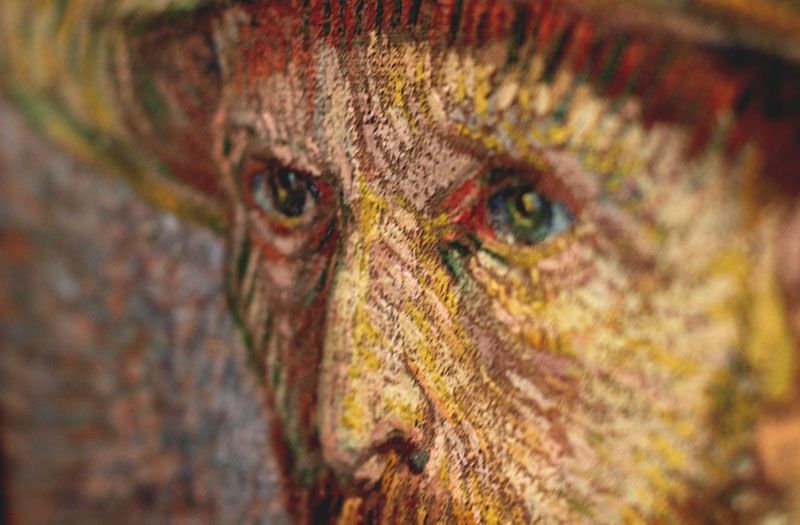
    Close up of portrait of Vincent van GoghAs far as I’m aware, Vincent van Gogh never shared any explicit advice about writing. (If he did and you know of it, I’d be delighted to hear it.) What van Gogh did was draw and paint. A lot. He also wrote very many letters. One of these, to his brother Theo in July 1882, contains this engaging thought:

    One must work long and hard to arrive at the truthful. What I want and set as my goal is damned difficult and yet I don’t believe I’m aiming too high. I want to make drawings that move some people … In short, I want to reach the point where people say of my work, that man feels deeply and that man feels subtly.

    Whether or not you believe van Gogh achieved what he sought will depend on your perspective on his art. Regardless of this, his words to Theo hold wisdom for writers and creators of all kinds.

    What is clear in these brief lines is the entwined importance of truth and diligence. The language in this letter shows that Vincent van Gogh knew how challenging being guided by truthfulness can be, and yet it is through devotion to truth, despite the discomfort it can bring, that we may create works that embody those qualities of deep and subtle feeling.

    As artists, writers and makers, truth offers itself to us in a range of ways. The most vital of these concerns our honesty with ourselves. It is my belief that we need to know our own truth and affirm the integrity of our intentions in order to create works of genuine meaning. Only then can we engage in authentic communication with our audience.

    This is not to say that everything we make must be based on empirical fact or that we ought not invent or contrive. Bringing the vibrant sparks of imagination to life is, after all, the task of the artist. Still, there must be truth in it.

    The sort of truth that I—and perhaps also van Gogh—speak of here goes beyond simple veracity. It has an emotional or even a spiritual essence that resonates within us despite its guise. We know this truth, intrinsically and viscerally, when see, hear or feel it in art. In its presence, we perceive, consciously or not, that the person who crafted its expression did so with dedication and an awareness of reaching towards something ineffable.

    That’s the kind of art I want to experience.
    It’s the kind I aspire to make.

    The search for this truth and our desire to proclaim it must be at the heart of our creations. We need to become attuned to it in the themes we choose, the ideas we explore and the words we use. This means we must be willing to become more aware of those moments when we feel our integrity waver, whether through fear or uncertainty or doubts about our ability. It is in such moments that we decide what kind of artists we are.

    Later in the same letter to Theo, Vincent van Gogh acknowledges that art “demands persistent work, in spite of everything, and unceasing observation”. He goes on:

    By persistent I mean in the first place continued labour, but also not abandoning your approach because of what someone else says. I have hopes, brother, that in a few years, and even now already, you’ll gradually see things by me that will give you some recompense for your sacrifices.

    I hope that as writers and creators we can commit to our work with honesty and courage, not varying our vision due to the opinions of others. I hope we find recompense in our efforts, yet even more, I hope that what we do moves people in some way by offering them a glimpse of what we know to be true.

    A damned difficult goal it may be to pursue the truthful. But it is a wholly worthy one too.

    Now it’s your turn…

    What are your views on art and truth? When have you faced a moment that challenged your integrity? What do you do as a writer to explore, express and experience truth?

  • Advice on finding (and using)
    your voice

    White Buddhist statue against cloudy blue skyExcuse me if I get a bit Zen for a moment. I’d like to share with you some thoughts on voice.

    Perhaps it is the association we make between words and their sounds that gives rise to the idea of the writer’s voice. In most cases, we develop the ability to speak before we learn to write, so it may be that the value we put on voice derives from some sense of veracity.

    Our spoken voice may be considered as one of our most distinctive features, and the same can be true of our writing too. When we talk of voice in relation to writing, we are referring to an author’s characteristic and sometimes idiosyncratic style of expression. It’s about how you put your sentences together and includes elements such as the level of formality and complexity you employ, the images or metaphors you use or don’t use, and even the individual words you choose. All of this combines to create the voice in your texts.

    Really, your voice is that precise parcel of poetry and peculiarity that distinguishes your writing as being undeniably your own.

    Voice is an important quality for any author to possess, and the question of how to find one’s voice is asked by emerging and established writers alike. Even a cursory search on this topic reveals that the internet is bristling with tips and tricks, step-by-step guides, instructions, injunctions and assorted exhortations. Alongside these are the inevitable articles that contest or reject the whole concept. (It’s kind of blunt, but one way to let your voice sound is to disagree with any opinion that is commonly accepted.)

    My perspective on all of this is not particularly original, which in some ways may be the point. Simply put, I believe that your voice is not out there somewhere, waiting for you to find it. Instead, it is inside you, waiting for you to use it – and this is where things get a little Zen.

    The way to find it is to use it.

    Think of it this way: your voice is the part of you that comes through in your writing, whatever your theme happens to be. If you are the person putting one word after another on a page or a screen and you are expressing some kind of truth in doing so, then your writing will contain your voice.

    It’s that simple. Except maybe it’s not. It can’t be, otherwise there wouldn’t be so much advice on the internet about it, right?

    If you have ever fretted about finding – or indeed losing or not ever having – your voice as a writer, please understand that I don’t mean to dismiss your anguish. However, chances are that your real concern in worrying about this is either that you don’t believe your writing is good enough or that you fear it sounds like someone else.

    The solution in both cases is the same. The way to find your voice and to feel confident that it is yours is to use it.

    The more you write, the more aware of your own style you become. If it seems like that style is in need of some refinement, then practice and play. Keep writing, keep trying, keep exploring. Similarly, if you find yourself emulating an admired writer or adopting an unaccustomed tone because you think it is more appropriate than your natural approach, try experimenting with your word choice, your sentence length, the structure of your text, the level of formality, the imagery.

    It is by writing and by reading back over our own words (again and again, and sometimes aloud) that we become familiar with our work. From there, we can rewrite and revise, making subtle adjustments or dramatic transformations. In time, with dedication and attention, we learn what feels most authentically ‘us’. We find our voices by using them, just as we find ourselves by being who we are.

    It’s simple and complex. It’s obvious and elusive.

    It’s kind of Zen, but really, the only thing you need to do is to write and keep on writing, until you hear the sound of your self in your words.

    Now it’s your turn…

    What’s your perspective on the whole question of finding your voice as a writer? How did you find your voice and how did you know it was truly yours? Has this article given you any insight or encouragement on this topic or is just another drifting echo on the internet?

  • Designed to delight and to inspire

    Four Ferris wheel carriagesIt is unlikely to come as any surprise to you that I think about words a lot. Not only do I engage with them deeply and daily in my editing work, but I also enjoy pondering their meanings and derivations. Call me curious (or quaint or novel or peculiar), but I am entranced by their cadence and nuance, and intrigued by their implications.

    This is why I took great care in choosing the four words that appear on the homepage of this website. Just in case you missed them, they are considered, creative, precise and persuasive. I believe they convey the qualities that characterise artful writing.

    Considered

    With the poetic exception of spontaneously scribbled love notes, most of the meaningful writing we do is considered. Both our message and its expression are given due thought, as we muse over what we want to say and how best to say it. Even those who write fluently spend time reflecting on the selection and arrangement of their words – and it shows. Artful writing flows.

    Artful writers, moreover, consider not only the words but also their readers. This invokes the concept of respect, which I find is vital in effective writing. Recognising the needs of your audience and showing them consideration requires the same level of contemplation that goes into your writing. Keep them in mind as you write, and already your words will be more artful.

    Creative

    If consideration is the foundation of artful writing, then creativity is the “art” part of it. This is when things become fun, as idiosyncratic phrases, distinctive images and unexpected juxtapositions start sparkling in your sentences. Such flashes of inventiveness are often what stay in our minds when we read fine writing, and they can bring a definite glow to otherwise customary prose.

    For some writers, such creativity is innate, but it can also be developed through practice and attention. Without the gem of creative inspiration, writing may be considered good, but it will never exactly dazzle. Let your imagination play as you write. It may not always deliver what you are seeking, but the effects might surprise you.

    Precise

    Of course, writing can’t only be about play. Creative as they may (and hopefully will) be, the purpose of your words is to communicate meaning. The precision required here involves finding the exact and most apt expression of your message. It demands an adept understanding of language, including a sensitivity to those nuances I mentioned earlier. Artful words are not ambiguous, except when they are deliberately intended to be so. Instead, clarity is crucial in both articulation and form, and this is where editing can be essential. Precision arrives through revision and refinement. Only then can your writing reveal its true – and most artful – power.

    Persuasive

    We’ve all had that wonderful experience of being enraptured by what we read. It occurs when the words persuade us to engage, imagine, believe and perceive. We allow ourselves to be momentarily or more intrinsically transformed. At times your writing might be explicitly persuasive, such as when you advocate for a particular perspective or outcome. But even when your goal is not so obvious, your words still need to persuade.

    It’s a kind of seduction that hints at the more cunning or contrived aspects of being artful – which is not to say that it is manipulative, only strategic. If nothing else, your intention as a writer should be to keep your readers reading. You need to convince them that what you’ve written is worthy of their attention. The approach must be subtle and also respectful. There is a skill to managing this, and that’s why it is a mark of artful writing.

    To delight and to inspire

    As you can see, artful words are not accidental: they are crafted. Writing that is considered, creative, precise and persuasive may take more effort to produce, but it is also more likely to delight and inspire.

    That’s the kind of writing I want to read. It’s the kind I aspire to write too.

    Now it’s your turn…

    What defines artful words for you? What characterises exceptional writing? What qualities or traits do you want to develop in your own written work?

  • “This… because… and… but…”:
    A clever and flexible structure

    Coloured blocks of fabric sewn into an appealing structureAs anyone with a even passing awareness of who Maria Popova is and what she does will know, there is much to admire about her. She is the one-woman wonder behind Brainpickings, the the extraordinary website which offers readers an interlaced array of articles on life, love, art, culture, literature, philosophy, psychology, science and every intriguing realm in between.

    To sustain her dedication to reading and writing for the site, Maria brings a crystalline discipline to her days, and a similar appreciation of structure can be found in her approach to her articles. In an interview with Georgie Okell for Radio Headspace, she reflected on how these have evolved from originally being short and expository paragraphs to the longer and more considered essays that grace the pages of Brainpickings these days.

    Here’s how Maria describes it…

    When I started Brainpickings, I was doing at first something like three articles a week and they were not really articles. They were very curatorial. They were one little paragraph about something that was interesting, and over time they became longer and longer. So they changed from “This…” to “This… because…” to “This… because… and…”, and so I’d relate it to other relevant things, and over time, “This… because… and… but…”, so I’d counterargue the point and kind of play devil’s advocate and provide multiple perspectives on the subject, and the consequence was that my articles now on average are probably 1500 words.

    “This… because… and… but…”. As a structure for writing, it is both clever and flexible.

    “This” tells your reader the topic of your treatise. Easy as that. It is followed by “because”, which could offer further explanation of your central theme or may allow you to outline the reasons why you care about it and why you believe your readers should too.

    The “and” part of this framework affords a couple of options too. One is to add a further enticing piece of information to your explanation, or you could, like Maria, link it with something that is related in some way. (A clever writer can almost always find a connection between disparate ideas. At the very least, it’s fun to try.) In more persuasive styles of writing, the “and” can be used to introduce an additional element of your argument.

    Then we come to the “but”, and it’s here that things can get interesting. The word “but” when used as a conjunction signals contrast, exception, contradiction or exclusion. It often evokes an opposing notion, so why would writers seek to throw such disruption into their prose?

    Sometimes, the presentation of a differing perspective can be used to strengthen an argument through refuting the conflicting point of view. Yet in the case of Maria Popova’s essays, which she says are written for her own edification, there is no need to persuade in this way. Rather, counterargument – or perhaps counterpoint is a better term to use here – can be a means for extending one’s thinking into new directions. It may also demonstrate sophistication by acknowledging limitations. This is how I see the final part of the “this… because… and… but…” structure working in the articles on Brainpickings.

    The pliancy of the whole design is apparent even from this brief synopsis of it.

    With the exception of the first element, which needs to state the topic, each of the others can be shaped to serve an appropriate purpose. Even better, the whole thing can be applied at a sentence, paragraph and full text level.

    For instance, a sentence structured on this sequence might read as: “This is a useful strategy to use in your writing because it provides a neat technique for linking ideas and saves you from wondering what to put next but still allows you generous scope to adapt it as necessary.”

    See what I did with that last bit?

    Instead of using the “but” to mount a counterargument, in this case I employed it to add another point to my claim, thus demonstrating again the flexibility of the framework. If I were to propose a limitation for this structure, it would be that it is more relevant to non-fiction than fiction. It also requires a certain subtlety in its application in order to avoid having your text appear too uniform. Robust though this format may be, not every sentence nor every paragraph needs to adopt it unvaryingly. Even so, it’s not a bad place to start for a first draft.

    I could go on about the potential implications and artful variations of this useful structure, but I’d rather let you explore it for yourself.

    As for the fascinatingly labyrinthine Brainpickings website, it really is a case of “but wait, there’s more…” because, thanks to Maria, there always is. And long may it remain so.

    Now it’s your turn…

    Do you read Brainpickings? What treasures have you discovered there? What systems or structures do you use to draft your documents and guide your writing?

  • Exploring, experimenting, expressing: The value of journaling for writers

    Stack of journals, tied with stringI’ll admit I may be a bit biased about this. For almost six years now, since July 2010, I have written every day in my journal. I didn’t necessarily intend for this to happen, and nor do I claim it as some special achievement. It does, however, demonstrate the value I place on journaling. Somewhere along the way, it has become essential to me. I cannot imagine my life without writing about it and I do not know who I would be if I did not write.

    The rewards of journaling are plentiful and varied, offering everything from personal development and healing to stress reduction and a scrupulous reckoning of life. For writers in particular, keeping a journal has definite benefits. Many eminent authors, including Virginia Woolf, Sylvia Plath, John Steinbeck, Anaïs Nin and Henry David Thoreau, are well known as dedicated diarists. Despite being originally penned in private, the published versions of their journals afford interesting glimpses into the writing life and the minds behind some great works of literature.

    Whether or not we aspire to the heights reached by these authors, journaling can be useful to all of us as writers. Among its gifts are exploration, experimentation and expression.

    Exploration

    The times we write about may be difficult or delightful. In either case, journaling allows us to explore our experience. Collected and contained in a journal, our perceptions, reflections and questions can be examined more thoughtfully. We can begin to recognise aspects of our personality and become more aware of our preferences, both as people and as writers. Fascinations and frustrations are revealed in the words we pour onto the pages of our journals, sometimes resulting in insights and sometimes not.

    Many of us learn who we are through what we write.

    This is an important aspect of journaling, yet our explorations can and should extend beyond ourselves. The ability to observe and describe the world around us can be enriched through journal writing. People who write journals may find themselves developing an attitude of curiosity towards circumstances and events, with impressions that are usually fleeting finding form in words. In this way, a journal can be a safe space in which to refine our awareness, deepen our discernment and cultivate our craft.

    Experimentation

    One of the most significant distinctions between journaling and other forms of writing is that a journal is usually kept confidential. Released from the pressure of writing for an anticipated reader, we are free to frolic, make mistakes, experiment and invent. The words in our journals are for our eyes only. This means we can write whatever truth or fiction we like in whatever form we desire. We can give ourselves the rare grace of writing without judgement or expectation.

    What we put in our journal doesn’t have to be ‘good’. There is no need for it to be grammatical or even comprehensible. The act of writing itself and a readiness to engage in the process is what matters, rather than any notion of a finished product.

    In your journal, you can try on different styles, test out techniques, set yourself challenges, and delve into discomfort if you wish. No one is watching. Writing purely and playfully for yourself allows you appreciate the writer you are, but it also lets you apprehend the kind of writer you might become. Most likely, that exists somewhere beyond your current vision, but you may discover hints of it through your journaling practice.

    Expression

    The gem at the heart of journaling is expression. The opportunity to vent or reflect, rejoice or recriminate, describe or define, and to enclose our own vital but otherwise incoherent experiences in words is truly invaluable. By letting out our thoughts and feelings, we can (perhaps) also let them go and clear some space inside. A journal can be a confidante, a mirror, a companion and a guide. Into it we can write our deepest truths and our truest depths, expressing ourselves fully, openly, intimately and creatively.

    I believe we all need a place to do this, and that writers especially require a private space to inscribe the words that converge in their minds. This capacity to translate all the chaos and splendour of life into language through journaling makes us, in my view, not only better writers, but better human beings too.

    Now it’s your turn…

    Do you write a journal? What benefits and challenges have you found in your journaling practice? What have you learned about writing or yourself through journaling?

  • “We never finish books”:
    Wise words from Dani Shapiro

    Detail of a white flower against a pale skyIt is a reminder I gave to the research students who I advised at university. It’s an assurance I give to the writers I work with today. And it’s something I heard author and memoirist Dani Shapiro say recently.

    “We never finish books.”

    She doesn’t mean that we never read all the way to the final page (although sometimes that can be the case too.) Rather, it is the books we write that we never really finish. What happens instead, according to Dani, is this:

    “We reach a point where we have made them as good as we can with the tools we have at the moment we have them. And so could any book benefit from being put in a drawer for another year and then pulled out again and looked at with cold eyes? Probably. But at a certain point you say, ‘It’s time for this to go into the world. I’ve taken it as far as I can.’”

    Writing can turn into a endless process if we let it. There are always more tweaks to make, more details we could add, and more words we might shuffle, shift or discard. It is devastatingly easy to come up with reasons why our manuscript is still not yet ready and to justify our inability to finish it. If we just had a bit more time, if we just did a little more research, if we just keep working on it then surely we will get it right. Eventually. Won’t we?

    Allow me to tell you, as gently as I can, that your book will never be perfect.

    Despite your heartfelt efforts, it will never be definitive, never conclusive nor complete. All it ever can be, and all it really needs to be, is a reflection of a moment in time, crafted with the best tools you have.

    Of course you will do everything you can to make your book as good as possible. Yet even so, you may find that after taking the brave step of sharing it with the world, you will suddenly see a whole other way you could have done it. There’s a decent, if disappointing, chance that after all your labours, you may still look back on it someday with a sense of dissatisfaction or even embarrassment.

    Friends, that happens. It is part of being a writer. Sure, it’s not the best part. But neither is it a compelling enough excuse for us to not to write and not to publish.

    We are never really ready. Or we are already ready. Either way, at some point we must just trust – closing our eyes first if necessary – that we have taken our writing as far as we can and to realise that it is time to let it go into the world.

    That can be a scary moment for any writer, yet it is one that we must face and embrace again and again, for it is only in the world and in the minds of our readers that our words truly come alive.

    Now it’s your turn…

    Do you struggle to finish writing your books? Is it hard for you to send them into the world? What holds you back from sharing your writing and what helps you decide when it is ready?

  • Embarrassed? You should be!

    Black and white photo of an embarrassed little boyI know I’m not the only one. I know it has happened to you too. It happened to one of my clients just the other day. We have been working together for over a year now on a project which is almost ready to be published. As we were discussing the final stages of the work, she said to me:

    “When I look back now at the draft I first sent to you, I am so embarrassed by it.”

    I had to laugh, because I’ve been there too and so have you. Sometime or another, we have all read back over something we wrote a week, a month or a few decades ago, and yes, we are embarrassed by it. And so we should be.

    That is what I said to my client, the moment I stopped laughing. I told her it was wonderful that she felt embarrassed about her earlier writing, because it shows how much she has developed since then. Over the past year, both her voice and her vision for her book have become clearer, keener, more precise and more refined. Her style has changed and she has become more confident, which is a beautiful thing.

    Far from being unwelcome, embarrassment is sometimes a sign of progress.

    I remember once hearing the Australian writer Peter Carey give a reading of his work at a literary festival. He began, inauspiciously enough, with an apology for any awkward pauses that might occur during his reading.

    “I can’t read my own work in public without wanting to change some bit of it,” he explained.

    Know the feeling?

    I can’t help thinking that editors are particularly guilty of this proclivity to want to revise everything they have ever written, but my guess is that most writers are susceptible to it. We could choose to read this discomfort as evidence that we are genuinely inept at our craft. Or we could see that our tastes change, our talents evolve and our insight into our written expression alters over time.

    That is not to say, however, that there is anything wrong with revisiting some earlier work only to find ourselves pleasantly surprised by a deft turn of phrase, an arresting metaphor or the sincere emotion evoked by our prose. It doesn’t mean we have not advanced beyond that shining moment; only that there are times in our lives when we write with a certain elusive grace, and that we sometimes cannot truly see the beauty in our words until our eyes and minds are older.

    Either way, I encourage you, as I did with my client, to embrace your embarrassment but let yourself find delight in your own writing too. You are allowed both to be proud and to progress.

    That is, in fact, exactly what you need to do.

    Now it’s your turn…

    Go on, admit it. You’re among friends here, so go ahead and share the story of some occasion on which you glanced back at a piece of your writing and felt that little bit of a cringe inside. Or, if you prefer, tell the tale of a time when your words filled you with a flush of pleasure. I’d really love to hear it.